Saturday, 31 October 2020

A Little Light Reading


 Oh yes indeedy!

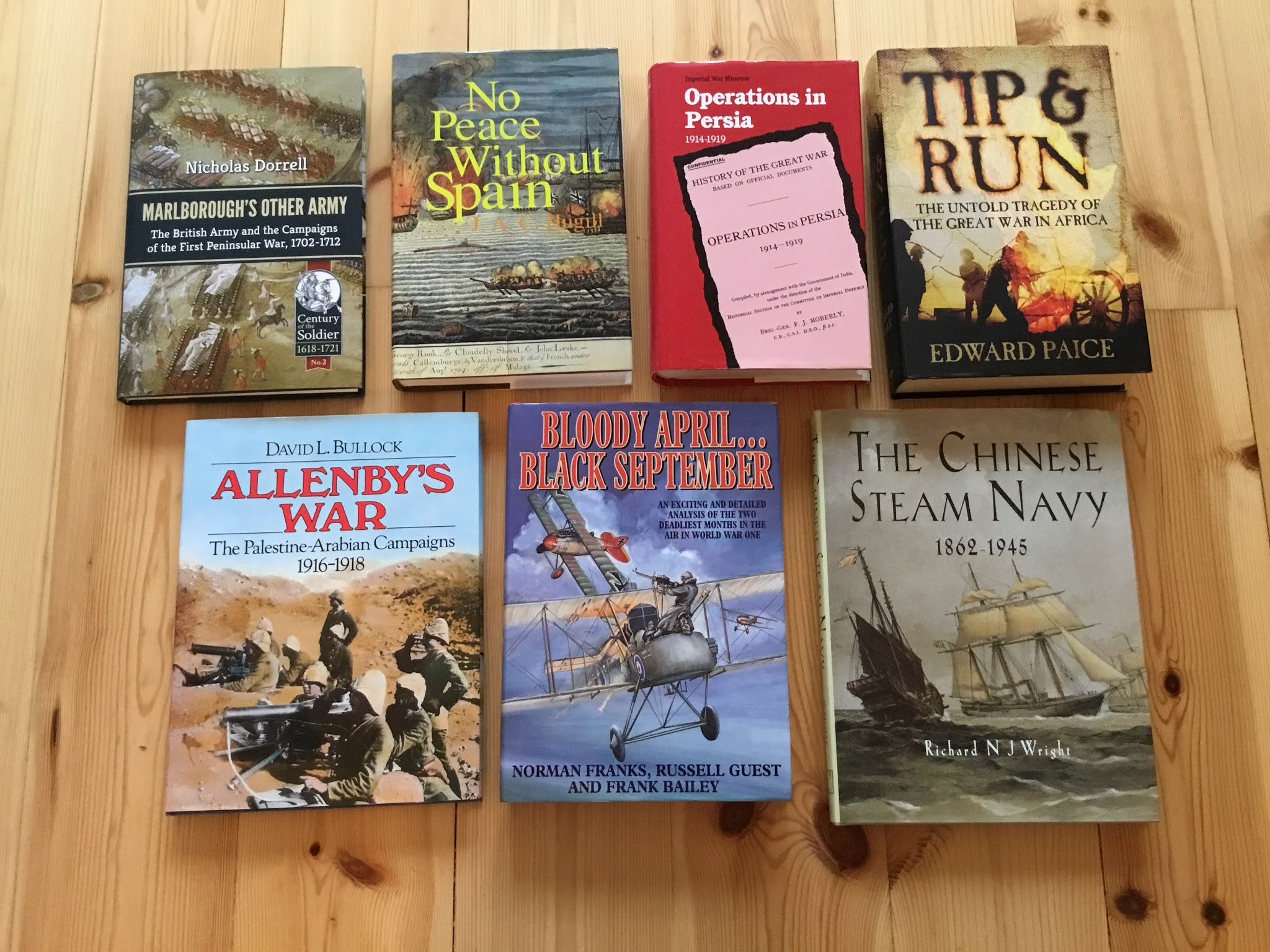
Take a look at the goodies above! Freshly arrived this morning courtesy of a very smooth transaction these will provide a welcome reinforcement to the book shelves.

I am rather taken by the Official History of Operations in Persia - especially with the fold out maps - and although it will be a dry read will certainly have plenty of ideas. The two Marlburian titles will be very useful for my planned WSS WoFun outing and the Chinese naval book will give me some ideas for the pre dreadnought phase of my building project. Allenby’s War I have owned before but sadly is one of those titles that mysteriously vanished from the collection some years ago. Tip and Run covers the Great War in Africa and this is a subject that partially inspired the famous Madasahatta campaign. Finally the WW1 air title will be handy to have when I drag out my copy of Richthofen’s War or Aces High to play at some point.

The above came about as the result of some of my recent disposals and so represent another example of churning through my collection. Going in the opposite direction was a few non Waterloo Napoleonic titles. There is a further disposal that is worthy of mention. 

The 30mm Spencer Smith ACW collection has moved on. In fact, it has gone home which is only fitting and so Old Painter Bob will be taking the collection to the next level in ways that I could not have.

All is well.

Friday, 30 October 2020

More WoFun and Games

More ECW goodness. At this stage all I am planning to do is to add another couple of guns and (possibly) a Scottish contingent

 The second part of my 28mm ECW WoFun order arrived yesterday and, with the exception of a couple of guns, is now table ready for action. I say second part deliberately as I am still pondering the Scottish side of the civil war with the Covenanters, Montrose and the Irish Brigade. The jury is still out on that one but I must admit I am weakening by the day!

The collection you see consists of the following:

8 x 48 figure infantry units

8 x 24 figure cavalry units

2 x 24 figure dragoon units

6 (soon to be 8) guns and crews

10 x command figures.

To put that into context we are talking about a collection of over 600 28mm figures that are table ready and that work out - allowing for shipping and everything else - at around less than 50p a piece.

Let that sink in for a moment.

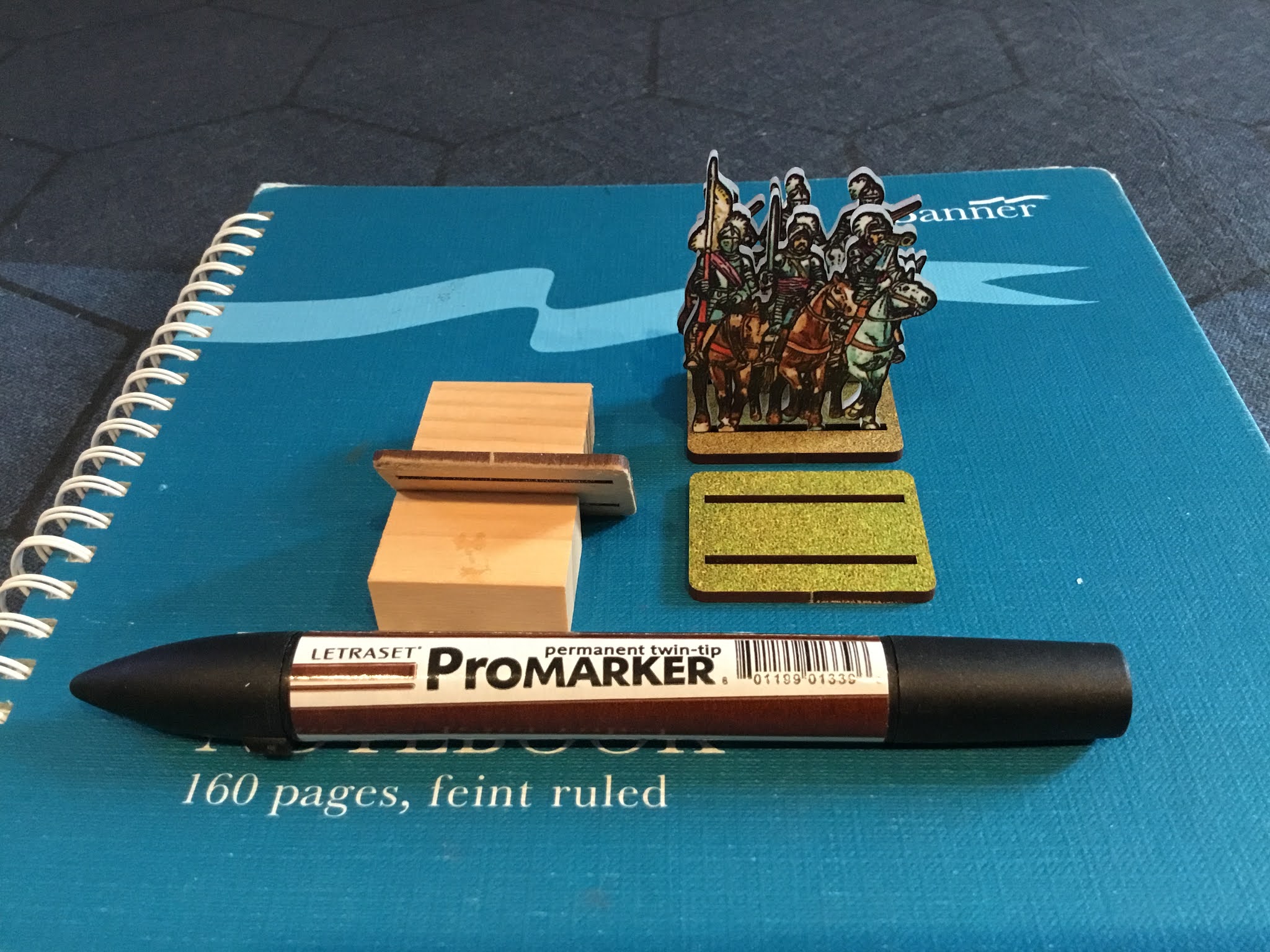
It has taken me around three hours in total to press out the figures and bases and to assemble them. That included fixing the artillery rather more permanently and ‘colouring in’ the base edges. Quite by chance I have a really useful Letraset permanent marker which is identical in colour to laser singed MDF. A quick run around the edges and the base is completed. 


That is my famous edging pen and a selection of bases so you can see the edge issue and how I have gotten around it. Does colouring the edges of the bases in a permanent marker qualify me as a figure painter? (Tongue largely in cheek!)

Note to self: Make sure I order another one of these!

Despite being knee deep in ACW ironclads I have still found some time to think about what I shall be using the ECW figures for and there are a number of options to think about. I rather fancy a hypothetical set up based on a fictional West Country county which will be a lot of fun to do. I have a couple of rules sets to play around with in any event but my most pressing need is suitable terrain. From my stock I am able to furnish trees and possibly hedges but that will be it. I need to source some buildings but at this stage I am thinking about scratch building some representational types - farmhouses or similar. Oh and walls, lots of walls.

For me, and my legendary reluctance to paint figures, the prospect of raising two armies for any period and to be honest, in any scale,  of 300 pieces or so would not even enter my wildest dreams. With this product I am able to do so and so as I have mentioned previously, it is an absolute game changer for my enjoyment of our hobby. 

Meanwhile, back to the ACW ships!


Thursday, 29 October 2020

Something Wicked this way comes....again!


The U.S.S. Potomac - newly commissioned and awaiting her paintwork


A rather better representation of the original U.S.S. Roanoke

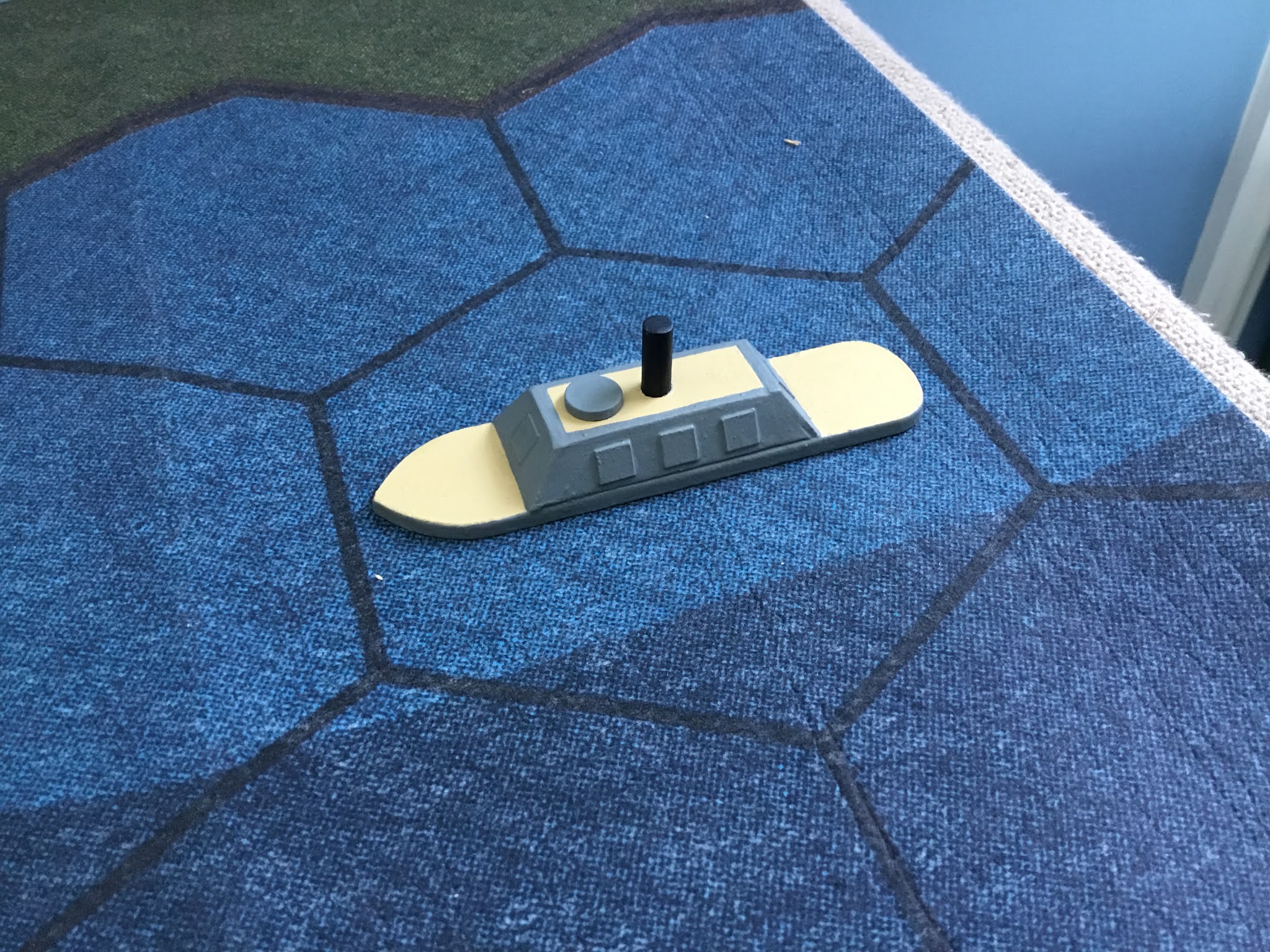
 Despite my avowed intention to avoid where possible building actual ship models as opposed to representative types the temptation to build the model you see above was more than mortal man could endure. Under normal circumstances I would not have dreamed of building such a monster but given that I am enjoying building anything with a turret at present (I am really looking forward to the pre dreadnought part of this project) it seemed rude not to.

With this in mind I present the U.S.S. Potomac based on the U.S.S. Roanoke. The original ship was a sister of the C.S.S. Virginia of Hampton Roads fame and although their paths never crossed after their respective conversions it is fascinating to speculate how they would have fared against one another.

The model is ‘based upon’ rather than super detailed and took me around twenty minutes to build. I am rather taken with it and it will become the flagship of the monitor fleet under the command of Rear Admiral Douglas Mortimer who, now that his teeth have been attended to, is eager to get back into action.

I have one other monitor to build to complete this part of the collection and it will be a single turreted version. I have the U.S.S. New Ironsides on the stocks to build and am still mulling over the next three Rebel ships. I have in mind an idea for at least one and am also thinking about some small ironclads. Once this phase of the build is complete I shall be looking at gunboats and various permutations of paddle driven types.

It is great fun building these though and I am thoroughly enjoying myself!

Final Thoughts for the Time Being


A three turret monitor? It would be rude not to - so I will!

After some fairly intense work on drafting my tweaked version of Bob Cordery’s Gridded Naval Wargames ACW rules I reckon I have now got the main donkey taken care of. Following my post of yesterday I ran a further play test incorporating the changes proposed and it worked like a charm!

The main effect I was trying to achieve was the ‘two ironclads battering away at each other, Hampton Roads style’ which meant the odd hit being scored and a gradual wearing down of the ships in question. The rules reflected this really well with long range shooting being for the most part ineffective but with the odd hit going in. The two ships cancelled each other out to a great extent but the overall flavour of the action felt as though the pace was right. I actually fought for 8 turns and when I eventually packed up both ships were still full of fight, battered but hanging in there.

There is still work to do and I need to consider the following:

Firing modifiers
Provision of Critical Hits
Musketry
Shore Batteries
Mines and other obstacles

This is all to come but for now I am drawing a line under things whilst I get some more ships built. I am keen to do this if only so that I can increase the variety of types I can use. Mind you, of the two models I currently have under construction Only one of them constitutes being a different model to the selection I already have!

Wednesday, 28 October 2020

The Mist is Slowly Clearing


 Can you tell what it is yet? There are two models to be built from the selection of bits and pieces you see above - both for the Union.

As a result of an email exchange with Bob Cordery and a blog comment from Archduke Piccolo my thought process has been set happily back on track in respect of the rule tweaks I have been experimenting with. 

In the first instance Bob drew my attention to the ship section in his recent book The Portable Colonial Wargame - a title I had completely overlooked! In this Bob outlined the formula he used for calculating ship flotation values which takes into consideration length, breadth, construction material and level of protection. This is really helpful although I have sneaked in a further construction method. Bob used a factor of 0.25 for wooden ships and 0.50 for Iron/Steel ships. I added in 0.375 for those vessels that used wood and metal for construction. Using two of my models as guinea pigs I was able to come up with the following hit points.

Union Monitor

10cm long by 2.5cm wide - 10 x 2.5 = 25

Iron Construction - 25 x 0.5 = 12.5

Heavy Armour - 12.5 x 2.0 = 25 Flotation Points

Confederate Casemate Ironclad

10cm long by 2.5cm wide - 10 x 2.5 = 25

Wood/Iron Construction - 25 x 0.375 = 9.375

Heavy Armour - 9.375 x 2.0 = 18.75 (19) Flotation Points

I think that is a fair representation between the two types so this would ordinarily be the standard I would use for calculating Flotation Points except for one crucial area. If I opted to use this as well as allowing for the effects of gun weight versus armour type I believe that I would in effect be counting the defensive capability twice. 

What I wanted was a system whereby the armour value had to be overcome in order to score damage rather than incorporating the defensive capability of the ship into its flotation points. In many ways you could call this the ‘Star Trek’ approach - defensive shields have to be overcome in order to effect damage.

With this mind I have dropped the armour modifier to Bob’s formula. This has the effect of bringing the flotation point totals in the above examples to 12.5 or 12 for the monitor and 9.375 or 9 for the casemate ironclad. To allow for the protection value of the armour a damage roll is made following a successful hit.

Archduke Piccolo with his comment nudged me a little further along a direction I had been seriously considering but had not explored fully. I am going to use a very simple firing method in that each gun rolls a single d6 to hit the target and having done so the target ship rolls for the effect of the said hit. There are three range brackets - short, medium and long with the scores required to hit the target being 4, 5 or at short range, 5 or 6 at medium and a 6 at long range. There will be situational modifiers as well as an allowance for using rifled weapons. Once a hit or hits have been scored then the effect rolls are made. The damage table is very simple in that 1 through 3 are misses, 4 and 5 are a single damage point and a 6 or more is two damage points. This is the standard damage template that Bob used in Gridded Naval Wargames.

To represent the effect of armour the following modifiers are applied to the damage effect rolls.

A heavy gun rolls as per the standard table when engaging heavy armour but gains a plus 1 to the damage roll when engaging a medium target and plus 2 when engaging a light target.

A medium gun rolls as per the standard table when engaging a medium armour but gains a minus 1 when firing at heavy armour and gains a plus 1 when firing at light armour. 

A light gun rolls as per the standard table when engaging light armour but gains a minus 1 when firing at medium armour and minus 2 when firing at heavy armour.

All guns firing at an unarmoured target will score as follows: 2 through 5 equals one point of damage and 6 equals 2 points.

In all damage rolls a natural 1 is always no effect and a natural 6 is always the usual 2 damage points unless there is an applicable negative modifier in which case it drops to a single damage point.

The above system is something I have used before with a set of Pre dreadnought rules so I know it works satisfactorily. 

I will need to test this further and so will organise a further action for later in the week. In the meantime though, I have the small matter of getting a couple of new ships built.


Tuesday, 27 October 2020

Letting the Tail wag the Dog


 Things that make you go Hmmm....

I should know better, I really should. I have allowed myself to be sucked down the complexity rabbit hole with my efforts to ‘tweak’ Bob Cordery’s ACW rules and am getting myself in a flat spin with unnecessary levels of complication.

I stepped back from the process and reckon that I have now found a workable compromise that addresses my needs.

If you recall the original firing system employed by Bob was based on the ‘x number of d6 at range 1 reducing a by a d6 for each hex’ This means in simple terms that more damage is likely close in and also that larger guns have a longer reach. This is all very straightforward and accurate and I certainly have no problems with the approach per se. Where it got a little fidgety for me was that there was such a wide variety of naval ordnance in use as well as protection levels of the myriad ship types in service I did not feel this was represented sufficiently for my taste.

I want to reflect both varying weapon calibre and protection levels and so am focussing my efforts on these elements. The first change I shall make is that there will be a single range for all weapon types - an idea borrowed from Andy Callan’s ‘Noddy’ rules. For the recent play test I made this 8 hexes but on balance this seems a little on the long side so I am scaling this back to 6 hexes. I am going to stick with the gradual reduction of firing dice that Bob used but it will be used in a different way.

I am going to maintain the ‘heavy, medium and light’ categories for weapons and protection levels and in the case of the former this will determine the number of firing dice thrown. Taking a heavy gun as requiring 3d6 you can see that Bob’s Turreted Monitor has a base roll of 6d6. This works out spot on as the two guns contribute 3d6 each. Bob has a maximum rage of 5 hexes for this type so it means at range 5 the monitor will be rolling 2d6 to hit. By extending this out to the desired 6 hexes it means that the monitor will be rolling a single dice to hit at maximum range.

Where this gets a little more complicated is when you start looking at at gun types. At the ranges used on the rivers and inland waters even the smallest naval artillery had quite a reach but if you, for example, adopted the dice reduction method to a single gun rated at 3d6, 2d6 or a single d6 the ranges would equate to 3, 2 or 1 hex which is clearly not what I want. The solution is quite simple and I do not know why I did not think of it sooner!

As I am looking at individual guns firing all I need to do is to assign range bands per type of gun that allow for range degradation. With this in mind I am using the following.

Heavy guns roll 3d6 at ranges 1 or 2, 2d6 at ranges 3 or 4 and 1d6 at ranges 5 and 6

Medium guns roll 2d6 up to range 3 and 1d6 at ranges 4 to 6

Light guns roll 1d6 throughout 

The effects reflect the fact that lighter and more handier guns have a greater rate of fire which is why they can still cause damage at a long range due to the sheer volume compared to such things as muzzle loading 15” guns.

Firing will be based on the number and type of guns multiplied by the d6 rolled for the range. There will be modifiers but these will be applied to the overall salvo rather than by individual pieces unless that is the only weapon firing. I have assumed (and this is how Bob works it) that all guns will engage the same target when firing. This will of course mean that the number of d6s rolled will vary from ship to ship but the ship record card will ring the changes.

As far as damage is concerned my thinking at present is to allow a heavily protected ship to roll 3d6, a medium protected ship 2d6 and a lightly protected ship a single d6. This is the same as I used in the previous play test.

I want to try this out using the same set up as previously but I will not write up the action for the blog as it is really a play test of a play test.

Overall I think I am pretty close to completing this stage of the rules although I want to add some provision for critical hits albeit at a fairly simple level. 

Onwards and upwards!


Monday, 26 October 2020

Breakout and Pursuit?....Summer, 1864....Game number 59

 Following on from the recent successful attempt to break out of the Blackwater River by the C.S.S. Secessionist the Confederate command decided that a further ship should force the patrol lines and make their way to Immobile Bay. The two ironclads still up river at the small port of Hullbridge were now complete and ready for action although one was to be retained for local defence alongside the various other gunboats in in use. The C.S.S. O’Hara (Captain Butler commanding) was therefore ordered to make the attempt. As an aside Captain Butler had campaigned rigorously to make the attempt as he had important business in Immobile Bay that was vital to the Confederacy.

It was known that the Union employed monitors to patrol the junction with the Missenhitti and it was believed that due to the damage sustained by the U.S.S. Hiawatha in the recent battle with the C.S.S. Secessionist that only a single ship was immediately available.

What the Rebels did not know was the identity of the ship that was tasked with protecting the vital Blackwater junction.

The Combatants


The U.S.S. Senator

U.S.S. Senator

Protection: Heavy
Speed: 2
Armament: 2 x Turret each with 2 x Heavy Guns
Flotation: Value: 20 
Critical Point: 7


The C.S.S. O’Hara

C.S.S. O’Hara

Protection: Heavy
Speed: 2
Armament: Forward 1 x Medium (R), Broadside 1 x Heavy, 1 x Medium (R), Aft 1 x Medium (R)
Flotation: Value: 12
Critical Point: 4


The initial dispositions.

Turn 1. There was no firing from either side. The Union rolled a 1 for initiative opposed to the Confederate 3 so they moved first. Both sides maintained course and speed so moved 2 hexes straight ahead.


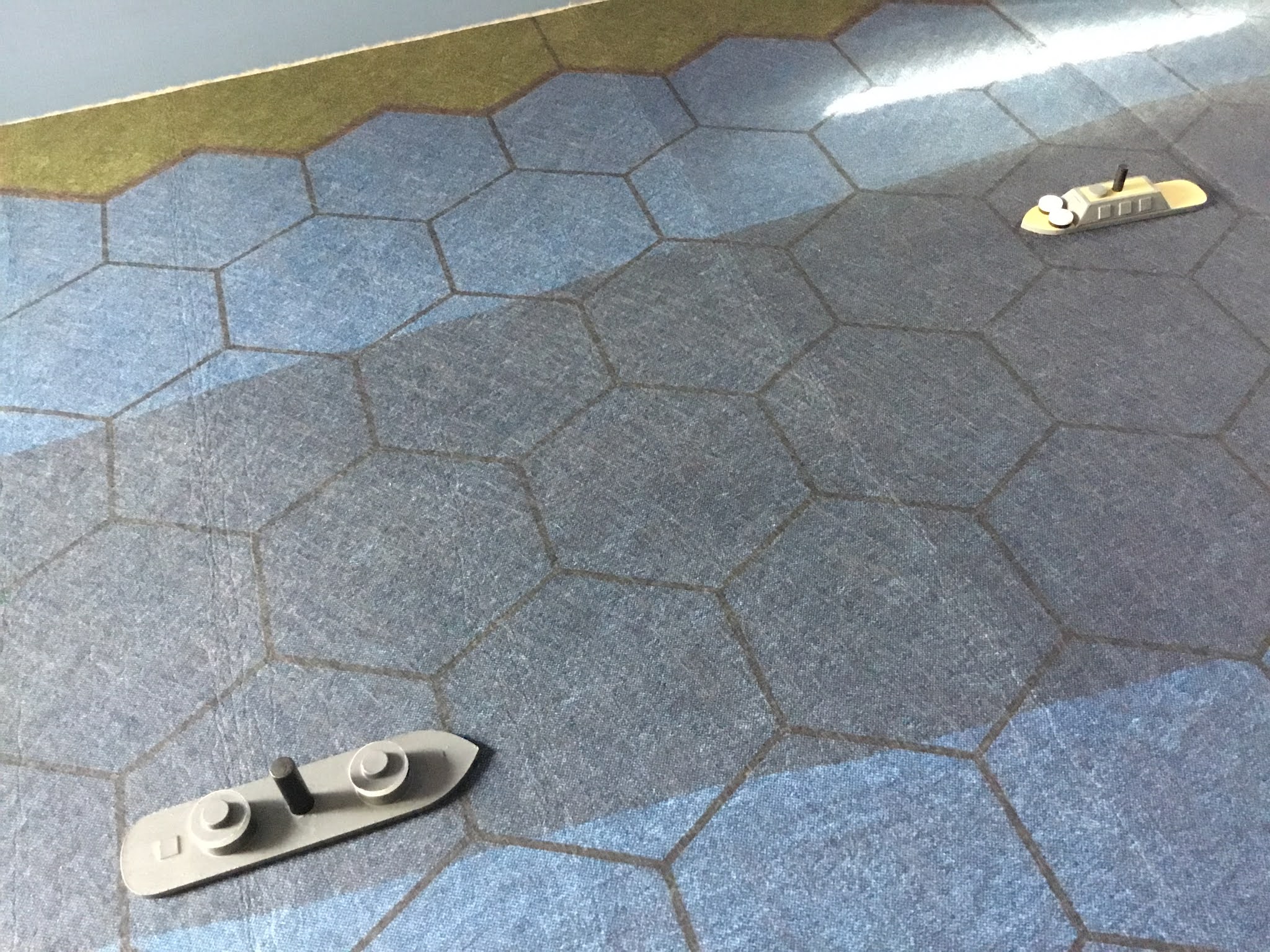
End of Turn 1. Note that the distance between the two ships is now 8 hexes or maximum gun range.

Turn 2. Both sides are able to fire - all firing is simultaneous - and do so. The U.S.S. Senator opens fire with her forward turret with two heavy guns. These roll 3d6 each but deduct 1d6 for the range meaning that 5d6 are rolled in all. The scores are 1, 2, 3, and two 5s so there are two potential hits on the Rebel ship. The Rebel player now rolls for his saving throw. As a ship with heavy protection he is able to roll 3d6. He rolls two 5s and a 6 meaning that he has ‘negated’ 4 hits - as he had only suffered 2 the damage was comfortably avoided. The Rebel ship fires back. Her forward gun is a single medium rifle so 2d6 are rolled. The 1d6 deduction for range is offset by the additional d6 for being a rifle thus reflecting the weapons accuracy. The Rebel ship rolls a 1 and a 2 so misses entirely. For initiative the Rebel ship rolls a 5 whilst the Union rolls a 6 so the Confederates move first. Both ships turned so as to enable their full broadsides to be brought to bear with the Union ship looking to occupy the centre of the channel.


End of Turn 2. Both sides attempt to get the most amount of guns to bear on their opposite number. The Union certainly have the advantage in this case with their turret mounted artillery.

Turn 3. The C.S.S. O’Hara opens fire with her forward facing medium rifle at a range of 6 hexes. Again she rolls 2d6 with 2d6 being her base roll, minus 1d6 for the range and plus 1d6 for being a rifle. She rolls a 1 and a 6 meaning that there two potential hits arising from he roll of 6. The 1 is of course a miss. The U.S.S. Senator rolls 3d6 for its heavy protection saving roll. The roll gives a 1, a 2 and a 6 meaning that the two potential hits have been negated. It is now the Union turn to fire and with both turrets able to bear it could potentially be very effective. 

Rule on the fly. I have decided that turrets must be fired individually and that gun types can only be massed if they are of the same weight. Also, rifled weapons are fired separately. The deduction for range is applied to individual guns. Light guns may always fire at long range with 1d6 but do not get the bonus for being rifled if applicable. I will need to think about this further.

Each turret has two heavy guns meaning a base of 6d6 each. However each gun loses a d6 as they are smoothbore weapons firing at long range, This means that each turret fires 4d6. The U.S.S. Senator rolls four 3s, two 4s, a 5 and a 6 meaning there are 5 potential hits. The C.S.S. O’Hara rolls her 3d6 to save and gets a 3, a 5 and a 6 meaning that she saves 3 out of a possible 5 hits. Two hits are recorded on her damage chart. Both sides roll for initiative. The Union roll a 1 whilst the Rebels roll a 6 so the U.S.S. Senator moves first. Both vessels turn into one another with the Rebel ship desperate to bring her full broadside to bear. This far she has been fighting with a single rifle so is heavily outgunned.


End of Turn 3. The two ships readying to exchange broadsides. The damage markers are for show and are removed at the end of the turn with the damage recorded on the ship chart.

Both ship continue to fire with the C.S.S. O’Hara still relying on her forward medium calibre rifle. Again she rolls 2d6 as the range is still long. She rolls a 2 and a 6 meaning there are two potential hits. The U.S.S. Senator rolls to save and scores a 3, 4 and 6 so the hits are discounted. She returns fire with 8d6 and scores an incredible two 1s, a 4, 3 5s and a 2 6s for 8 potential hits! The C.S.S. O’Hara rolls to save and scores a 6, a 5 and a 3 meaning that she negates 3 hits but still suffers 5.

The C.S.S. O’Hara has now sustained 7 out of 10 hits which means she is now 1 point below her critical level and must therefore break off the action as best as she could.

Overview

Whilst I am happy with the firing system I need to rein in it a little. A salvo firing double turreted monitor seemed to be overly effective so I need to think further about the gun multiples. An idea that occurred to me was to restrict heavy guns to only being able to fire every other turn (Andy Callan employs this in his ‘Noddy’ rules) or to allow damage savings rolls against each source of incoming fire. For example, the monitor would resolve the fire from one turret (including target saving rolls) and then the second turret (again, including savings rolls). Remember that during the period there was not really much in the way of centralised fire control. 

On balance I am thinking that allowing saving rolls per incoming attack may be the best way to handle this - certainly the C.S.S. O’Hara may well have appreciated it!