Showing posts with label ACW Naval. Show all posts

Sunday, 17 May 2026

Game Number 80….Missenhitti, I’ll Remember You….*

 *With apologies to the Pussycats from 1976….

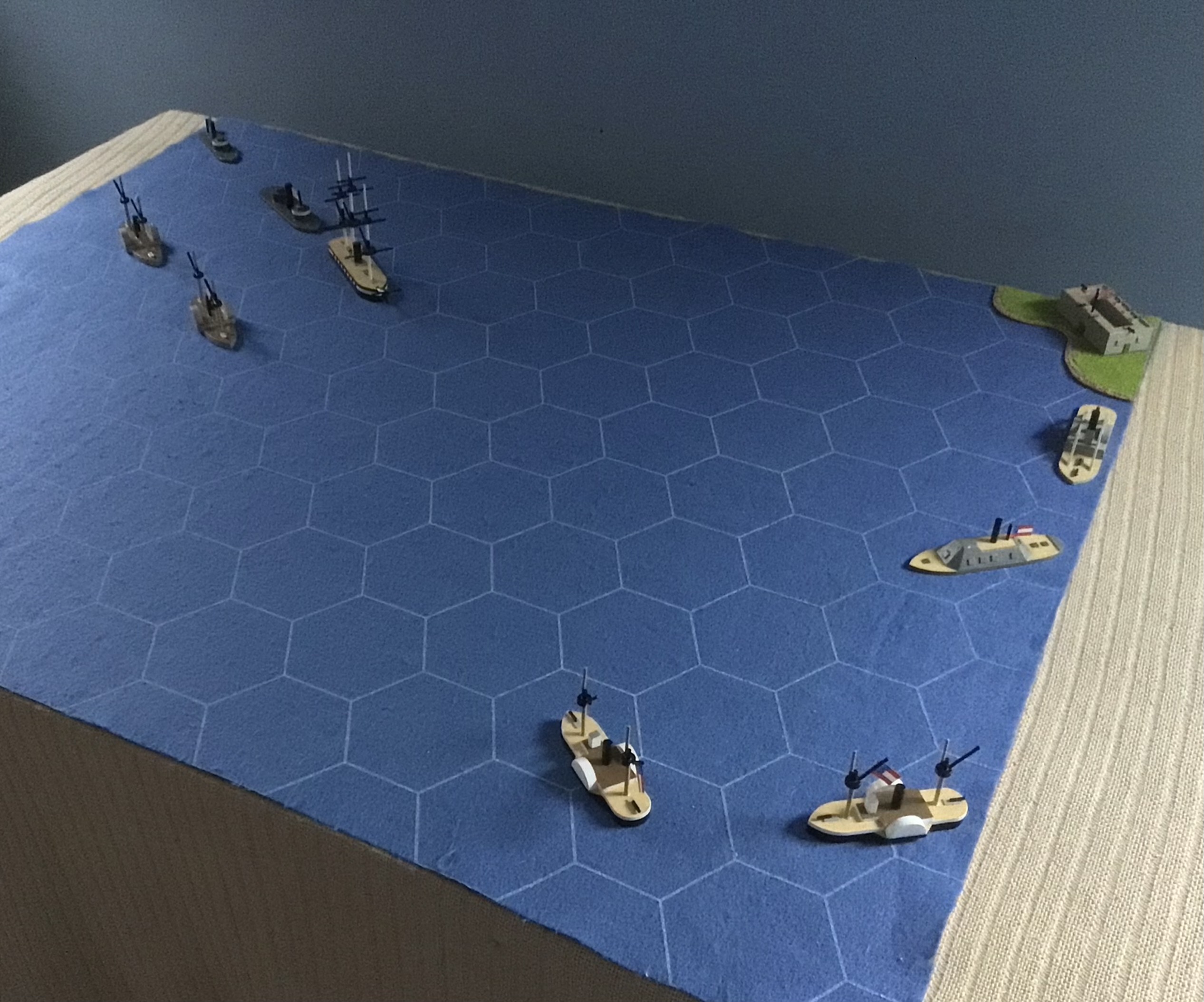
The initial positions. The U.S.S. Admonisher is at the bottom of the picture whilst the C.S.S. Missenhitti approaches from the top. 

I can do no better than to quote, verbatim, the words used by Bob Cordery to describe the background to this action, taken from his book Gridded Naval Wargames.


U.S.S. Admonisher

“For some months the Union government’s spy system had known that the Confederates had been building a Casemate Ironclad at Pratt’s Landing on the Missenhitti River. To ensure that this threat to Union army transport ships using the lower reaches of the river negated, the Union had stationed the newly-built Turreted Monitor - the U.S.S. Admonisher - on the Missenhitti. She had been patrolling the area for some weeks and expected to be in action as soon as the Casemate Ironclad appeared.


C.S.S. Missenhitti

Unknown to the Union forces, the C.S.S. Missenhitti had already been launched and her crew of sailors, riverboat men, and transferred artilleryman had been getting her ready for her maiden voyage down the Missenhitti River. One cold and misty morning she set sail downriver….”

Turn 1. The Confederate ship won the initiative (3-1) and as the range between the two ships was still some 13 hexes, opted to move first. Both ships moved at a speed of two and so moved a single hex forward and turned towards each other before moving a further hex.


End of Turn 1. Both vessels decided to move into midstream so as to have some room to manoeuvre.

Turn 2. Again the Confederate ship won the initiative (6-4) and again, as the ships were out of range opted to move first. The C.S.S. Missenhitti continued on her new heading so as to ensure that she could bring as much of artillery to bear as possible - she would be able to bring two heavy rifles into action against the two smoothbores the Union ship carried. The U.S.S. Admonisher turned directly towards her adversary, no doubt to close the range as quickly as possible, thus helping to negate the range advantage possessed by the Confederates. 


End of Turn 2. No firing as yet but you can be sure that the Confederate ship is ready to do so by virtue of her longer ranged artillery.

Turn 3. Yet again the Confederates win the initiative (5-4)! This time though, they allow the Union to move first. The Union ship slows down and turns to face the opposite bank of the river whilst the Confederate maintains her speed and course, mindful of keeping her guns facing towards the enemy. At a range of four hexes, both ships open fire. The C.S.S. Missenhitti is able to roll 1D6 with a plus 1 due to her weight of artillery (heavy rifle) against the medium armour of the U.S.S. Admonisher. She rolls a 5 which goes to 6 which inflicts a single flotation point and either a secondary or tertiary gun. Since she has neither the hit is classed as another flotation point making two in all. The U.S.S. Admonisher fires back at the same chance - overall plus 1 to the single D6 roll - and rolls a miserable 2 meaning she has missed the target.


End of Turn 3. Fortune thus far favours the South as the C.S.S. Missenhitti scores two hits on the Union ship. The return fire was ineffective, presumably due to range being at the maximum distance for her smoothbore artillery.

Turn 4. Finally the Union win the initiative (5-2)! Given the relative closeness of the Confederate ship the Union allow them to move first. Conscious of the fast approaching river bank the Confederate ship maintains her speed but turns hard to starboard so she is now facing the Union monitors. Unfortunately, her turn did not allow for the slow moving Union ship and so she now is unable to fire as her forward gun has insufficient traverse to reach. Not so the Union ship and so maximum range she opens fire again. She rolls a 4 which, with the plus 1 for the gun/armour modifier makes 5 - a flotation point.


End of Turn 4. Both ships have sustained minor damage with the Union ship getting the worst of the exchange. The Confederate ship now faces a tactical dilemma. Does she try to get the Union ship within a firing arc, thereby exposing herself to more fire, or does she go ‘hell for leather’ and attempts to position herself for a ram attack? The next initiative roll will be crucial.

Turn 5. The Confederates resume their winning ways with a 6-1 initiative roll victory! The Union ship moves first. The U.S.S. Admonisher moves forward one hex and turns to starboard, thereby ensuring that her turret is able to fire (she cannot fire directly ahead). The C.S.S Missenhitti surges forward and turns to face the Union ship and is able to make use of her forward firing artillery. The Confederate ship opens fire and rolls an abysmal 1!. The U.S.S. Admonisher is able to fire with both her heavy guns, each at plus 1. She rolls a 4 and a 1. The 4 goes to five so the C.S.S. Missenhitti suffers another flotation point of damage.


End of Turn 5. Both ships have suffered the same amount of damage - 2 flotation points - and from the perspective of the C.S.S. Missenhitti the next initiative roll will be crucial. Has the U.S.S. Admonisher made an error in keeping her speed down and occupying the centre of the river?

Turn 6. The Union win the initiative 6-2! Seeing the imminent threat of a ram attack the Union monitor accelerates and crosses the bows of the fast approaching Confederate Ironclad.At the last second she throws her helm over hard to starboard. The C.S.S. Missenhitti follows the Union ship and by cutting the corner comes up on her aft starboard quarter - close enough to fire but not for a ram attack! The U.S.S. Admonisher opens fire at a range of one hex with both her heavy smoothbores. She rolls 2D6 each with a plus 1 gun/armour modifier. She rolls a 4 and 5 which go to 5 and 6. The C.S.S. Missenhitti suffers another flotation point for the 5 and another for the 6, along with a further flotation point as she does not have any secondary or tertiary guns, making three in total. This is sufficient to require a Critical Hit roll which comes up as a 6! The Confederate ship now has a fire to deal with, as well as losing a gun factor - in this case her forward heavy rifle. As damage is considered to be simultaneous she is still able to fire this turn. For the final shot from her forward rifle the C.S.S. Missenhitti replies with a roll of 3 that goes to 4, thus giving the Union ship a further point of flotation damage.


End of Turn 6. With a devastating point blank salvo the U.S.S. Admonisher batters the onrushing C.S.S. Missenhitti and is rewarded by seeing great gouts of flame pouring out of her forward gunport. The Union ship did not escape the return fire though and sustained a further point of flotation damage.

Turn 7. The C.S.S. Missenhitti rolls a D6 to determine the state of the fire. She rolls a 4 which means that it still blazes and so a further flotation point of damage is sustained. To add to the chagrin of her captain, the initiative roll goes against them with the Union winning handsomely, 6-1! The Union ship moves first, hoping to shake off the blazing Confederate ship. Not so, as the C.S.S. Missenhitti continues to doggedly follow the Union vessel. Only the U.S.S. Admonisher can fire as the Confederate ship has lost her forward artillery. The range is one hex and she rolls 2D6, again with each being at plus 1. A majestic 5 and 6 are rolled! The 5 goes to 6 and the 6 to 7. In total this equals a further four flotation points and a Critical Hit roll. The Critical hit roll is a 5 which is flood. Straightaway a further flotation point is lost meaning that the Confederate ship has suffered 6 in total this turn - one from the fire, four from shooting and one from the flood. As this is a further multiple of her hull size of 3 this requires a further Critical Hit roll. This roll is a 2 which is hull/armour. The C.S.S. Missenhitti opts to take a further 2 flotation points rather than weakening her hull or armour. She is in a bad way and needs to think about getting away.


End of Turn 7. With her hull leaking like a sieve and the fire continuing to blaze, the C.S.S. Missenhitti must seriously think about breaking off the action if she can. She is positioned nicely to ram the Union monitor assuming she can win the initiative but will this be enough to snatch victory from the jaws of defeat?

Turn 8. The C.S.S. Missenhitti fails both her recovery rolls scoring a 3 and 4 which in turn means two more points of flotation damage. More importantly she has now passed her critical point having sustained 16 points of damage out of 18. Reaching the Critical point also triggers a further Critical Hit roll and this comes up as a 6 - another fire (and a further flotation point of damage)! The Union win the initiative 5-2 and opt to move first. The U.S.S. Admonisher pulls away at best speed from the blazing and sinking Confederate ironclad that appears to be attempting to get away. Not wishing to risk his own ship the captain of the Union vessel is content to fire a final broadside at point blank range rolling a 5 and a 2 which go to 6 and 3. The resulting two floatation points inflicted on the battered C.S.S. Missenhitti are enough to sink her.


End of Turn 8. With a flood, two fires and more point blank battering from the Union monitor, the C.S.S. Missenhitti settles by the bow and sinks slowly in the shallows.

Overview

Now that was a lot of fun and no mistake! The rules worked very smoothly with no major issues to tell of. The damage levels felt suitably paced and with sufficient impact. I am quite pleased with how this is now working.

How should the ram equipped C.S.S. Missenhitti fought this action? Well, the mistake was in not pursuing either a standoff at range shooting or going full tilt for a ram attack. She appeared to have chopped and changed her mind during the action and crucially was often at a disadvantage in terms of gunnery - mainly due to not having a usable firing arc. Losing her forward heavy rifle was definitely a handicap as every time she was able to get in close she was unable to ‘shoot her way in’. All the U.S.S Admonisher needed to do was to stay out of way and make sure that she could get her turret to bear. The rolls of the dice during the game swayed first one way and then the other which I have no problem with as it all evened out. Early in the action I really thought that the Confederates had the measure of the Union ship but it soon went the other way.

It was tremendous fun to refight a wargaming classic action - once again thanks to Bob for the inspiration - and even though the outcome was different to the original it should not take away from the fact that it is possible to have a rewarding and entertaining game with but a single ship on each side.

Loved it!


Sunday, 20 April 2025

CSS Atlanta: Ready for Action!


Finally got the Spar Torpedo fitted. A simple construction although the original had a much more complex system for lowering the spar boom.

First of all, a happy Easter to all! It has been a busy bank holiday weekend as I am also involved in some DIY so gaming related stuff has taken a bit of a back seat. The available ‘me time’ has been spect preparing for the battle to be fought for Developing the Portable IroncladsWargame: The American Civil war. The scenario has been designed and aside from finishing the CSS Atlanta I also have a terrain piece to get ready - this is currently underway and should be finished in a couple of days or so.

For the spar torpedo rig I used two small pieces of MDF, cut from a Warbases dice frame ‘sprue’. these were placed either side of the bow with a length of cocktail stick for the spar. A large dollop of superglue placed between the two pieces of MDF and on the deck itself ensures that the spar is solidly positioned and hopefully table usage proof!

I have spent a lot of time thinking about how to model the spar torpedo - truthfully I have, as usual, overthought the whole thing. The end result was very much from the school of bodgery but it will suffice!

On with the terrain piece….(once the DIY is finished, naturally!).


Friday, 6 December 2024

Iron and Oak and Battle Cry

 This one nearly passed me by! I remember seeing this game when it first came out but never got around to getting a copy. This has been duly rectified and with an additional surprise in the box! The game is a ship to ship tactical combat game that uses a square grid, order cards and wait for it - opposing dice rolls for movement and firing. Needless to say, it would be very simple to use models rather than counters although in my case I would need a larger playing surface to accommodate my models.


The box lid....


....and the back.


The playing surface - note the square grid (actually rectangular).


The game components. Lots of damage counters and the all important ship cards and counters


Some additional scenarios and rules found in the C3i magazine

There are some unusual mechanics in this game - opposed dice rolls for movement and firing would certainly raise a few naval wargaming eyebrows for a start - but the rationale behind the various systemic decisions seem sound enough, certainly for the gamer that wants a 'game that has the flavour, rather than a 'flavour that has a game'. 

On a different tack....

I have been looking long and hard at the scenarios in Battle Cry and indeed, also reacquainting myself with the rules. The former was a pleasurable experience, the latter less so, mainly because I am averse to using them as written! A quick visit to the files section of Boardgamegeek soon rectified this and so I was able to download an advanced set which looks far more appealing. I also used the opportunity to download a variant for the Zulu War.

If time permits I am looking to run a Battle Cry over the weekend using the advanced rules so watch this space as I shall certainly be posting the after action report on the blog.


Tuesday, 12 November 2024

Thoughts on Needlepoint


Although sinking the CSS Tennessee was still stuck fast to the USS Monadnock. I played this ‘on the fly’ as I had not thought about entangled ships being able to carry on fighting outside of their ‘up close and personal’ situation. Read on for more insight….

In the picture above the CSS Tennessee has rammed the USS Monadnock and they are locked together as a result. The four white counters represent ‘sinking markers’ and one is removed at the start of each game turn. When they have all gone the ship slips slowly beneath the waves….

Now I had not thought about ships being stuck together being able to fight other than with each other at the point of contact but the situation above got me thinking (never a good thing….).

I have not researched this kind of situation in any great detail but I was reminded of the duel between the CSS Governor Moore and the USS Varuna. Although they were around ten feet apart at the time the Confederate ship fired into the hull of the Varuna through her own deck as she was unable to otherwise bring her artillery to bear. The unfortunate Union ship ended up being rammed three times before sinking - twice by the CSS Governor Moore. As ten feet apart would be within the realms of ramming in my rules - it would fall within one grid area - I got to thinking about how a ship could fight in such circumstances.

Looking at the picture above you can see that the bow of the CSS Tennessee is firmly stuck in the starboard aft quarter of the USS Monadnock.

My thoughts are as follows.

The grid area in which the ram occurs prohibits and form of combat IF the two ships are locked together. If they are separated then combat can take place as normal using the appropriate firing arcs.

Ships that are locked together may only fire from the hex that is not rammed so the ramming ship may not fire from her bow whilst the target ship firing will depend on which part has been attacked. Ships may fire outwards as per normal from their unengaged side and either ship may be fire on from any vessel in range.

I will have a bit more of a think about this but on the face of it this seems like a feasible ruling.

In the meantime though, have a look at the below.

The Varuna

Who has not heard of the dauntless Varuna?
Who has not heard of the deeds she has done?
Who shall not hear, while the brown Mississippi
Rushes along from the snow to the sun?

Crippled and leaking she entered the battle,
Sinking and burning she fought through the fray;
Crushed were her sides and the waves ran across her,
Ere, like a death-wounded lion at bay,
Sternly she closed in the last fatal grapple,
Then in her triumph moved grandly away.

Five of the rebels, like satellites round her,
Burned in her orbit of splendor and fear;
One, like the Pleiad of mystical story,
Shot, terror-stricken, beyond her dread sphere.

We who are waiting with crowns for the victors,
Though we should offer the wealth of our store,

Load the Varuna from deck down to kelson,
Still would be niggard, such tribute to pour
On courage so boundless. It beggars possession. — 
It knocks for just payment at heaven's bright door!

Cherish the heroes who fought the Varuna;
Treat them as kings if they honor your way;
Succor and comfort the sick and the wounded;

Oh! for the dead let us all kneel to pray!

For the record both the Varuna and the Governor Moore are STILL on the modelling tray - and have been for best part of a year so I reckon I need to do something about getting them finished!

Sunday, 10 November 2024

The Battle of Needle Point, November 5th, 1864….Game Number 78

This will the last game fought using the published version of the Portable Ironclads Wargame because from here on in I shall be making use of some of the optional rules that will appear in Developing the Portable Ironclads Wargame. I should point out that these are optional and so the rules as written are in fact largely unchanged - unless you change them that is!

Having said that, there is one amendment to the original version that I shall be using for this battle and that is the amended fire arcs for Forward Wide and Aft Wide artillery. 

If the set up below looks familiar then it will not surprise you learn that it is! I have fought a rather more involved version of something akin to this scenario previously. It was great fun to fight and in truth running something broadly similar is no great hardship.  


The opening positions. The Rebels have hastily raised steam and are looking to engage the oncoming Union force.

A small Union force has been tasked with carrying out a reconnaissance of the Confederate coastal defences beyond the small fort at Needle Point and up as far as the main base in the area at Hullbridge. They are also further ordered to engage and destroy any Rebel shipping they find en route. Finally, the fort at Needle Point is to be bypassed if possible as it was expected to be invested by the advancing Union troops in the near future - a captured Rebel fort complete with its garrison made for a tempting objective.

The opposing forces

Union

USS Brooklyn (Flagship) - wooden first class sloop

USS Monadnock - double turret monitor

USS Canonicus - monitor

USS Sassacus - 'double-ender' gunboat

USS Metacomet - 'double-ender' gunboat

Confederate

CSS Tennessee (Flagship) - casemate ironclad

CSS Selma - gunboat

CSS Morgan - gunboat

CSS Gaines - gunboat

The small fort at Needle Point is unmanned other than by a small observation post. The garrison and artillery had been withdrawn some weeks ago to bolster the defences in and around Hullbridge itself.

The Battle of Needle Point

For some weeks the Union navy had been scouring the delta of the River Crouch for any sign of Rebel warships, thus far without success. There could only be two possible explanations for this. Firstly, that the Rebels did not have any naval assets to speak of or secondly, and on balance the far more likely explanation, that they did have and were keeping them back as a reserve. The latter option was settled on by the Union command and so an endless round of tedious and fruitless sweeps around the delta by assorted task forces had achieved little other than burning through a prodigious quantity of fuel.

Spies had reported that a few ships were available at Hullbridge - mostly extemporised civilian vessels - and that rumours of an ironclad being readied had also been heard. Thus far though, there was little in the way of concrete evidence to support the story - just wild speculation.

Nevertheless, the navy had to take this threat seriously given that virtually all the invading Union force needed access to the river or sea for supplies and reinforcements, not to mention mobility.

The decision was taken to force the Rebel's hand in that a squadron would be sent past Needle Point and up as far as the outer defence works of Hullbridge itself to engage any Rebel shipping and hopefully draw out the mysterious ironclad. So, shortly after nightfall on the 4th of November, the Union squadron quietly weighed anchor and headed out into the open river, to arrive on station around dawn the following day.

Every precaution was taken to ensure that as little noise as possible was made on the journey, chains were carefully wrapped in cloth so as to muffle any clanking, all unnecessary lights were extinguished and orders were urgently whispered. Lookouts squinted into the darkness in an attempt to identify anything onshore that could spot their secretive approach but for the most part, nothing was seen, only the slumbering landscape gliding by. It was an unbelievably tense journey and undertaken at the lowest speed possible due to darkness and the uncertainly of the depth of the water.

The only sound to be heard was the rhythmic and monotonous thump of the engines as the five vessels cruised along, wraithlike in the blanket of the night. 

As the sun rose and began to burn off the early morning mist, the small squadron was able to increase speed for the last leg of their journey. So far, so good - or so they thought.

Unknown to the commander of the Union squadron they had been shadowed almost as soon as they had set sail. A small Confederate cavalry piquet had been observing the Union anchorage throughout the day and indeed, was on the verge of heading back when the sergeant in charge of the small detachment - who happened to a be former sailor before the war - noticed an increased amount of activity around the five Union ships anchored midstream. He knew enough to know that they were obviously readying to sail and so he ordered his best mounted trooper to report back that the 'Yankees were a-coming!'

The news was received with a mixture of excitement, dismay and bravado, tempered ultimately with a degree of fatalism from the more knowledgable of the Confederate command. Arguments went back and forth as to the merits of engaging the Yankees as opposed to letting them approach and fall under the guns and mines protecting the approaches to Hullbridge. Eventually the war party prevailed and so, much against the wishes of the navy - the Tennessee had not been properly worked up  and there were shortages of of just everything a warship needs to function efficiently, so the navy said - the plans were drawn. The high command would brook no arguments, the fleet must sail. With an air of resignation the orders were given and so the Confederate ships hastily raised steam and cast off in the early light of dawn to meet and engage the oncoming Union force - three gunboats and the ironclad, the CSS Tennessee.

Sailing in two columns, with the CSS Tennessee leading on the starboard side, the Confederate squadron made the short trip to Needle Point from Hullbridge at a steady, measured, almost leisurely pace. All pretence at being on a pleasure cruise quickly evaporated when the lookout on the lead ship of the port column, the CSS Morgan, urgently shouted out "Smoke ahead!" "Where-away?' Came the questioning reply. At this juncture Needle Point jutted out from the north shore and so the Union squadron were masked from view. The Captain of the CSS Morgan, his ship already turning to port so as to clear the point, guessed that any shipping coming from that direction would certainly be enemy in origin, immediately ordered the crew to beat to quarters. Almost as soon as his port turn was completed he ordered the helm hard over to starboard to engage the enemy.

CSS Morgan leads the CSS Gaines into a starboard turn prior to engaging the Union force. In the near distance the CSS Tennessee starts her turn followed by the CSS Selma. 

The starboard column of the Confederate squadron followed the turn of the port column but did not do so immediately, thereby allowing a gap to form between the two divisions. Fortunately, the CSS Tennessee reacted promptly to the starboard turn of the CSS Gaines and her captain immediately ordered her helm to follow suit. It was a ragged approach but with just about enough time and space to reform into a more suitable formation.

As the four Confederate ships cleared Needle Point in turn so they saw for the first time the approaching Union squadron - five ships against their four with two of these being monitors. This was going to be a hard fight indeed.


Something wicked, this way comes....The sloop USS Brooklyn leading the double turreted monitor the USS Monadnock and the USS Canonicus. Off their starboard bow the two 'double-ender' gunboats - the USS Sassacus leads the USS Metacomet

Meanwhile the Union flagship, the sloop of war the USS Brooklyn, had spotted the oncoming Rebels almost simultaneously and so a flurry of signals alerted the rest of the squadron. The enemy gunboats should be relatively easy to deal with but the low, squat bulk of a Confederate ironclad was a different game altogether. The monitors made ready, for this was to be their fight.

The Battle of Needle Point


The starting positions - The Confederate force are scrambling to get into a semblance of a fighting formation whilst the Union steam resolutely onwards.

Turn 1.  As the two sides were out of effective range there was no firing and so initiative was rolled. The Confederates rolled a 4 and the Union a 3 so the Confederates opted to allow the Union to move first.


The end of Turn 1. The Confederates attempt to get into a formation as the Union ships head off in two opposite directions. Is there a cunning plan here? The two monitors that appear to be heading straight towards the CSS Tennessee would argue yes!

Turn 2. Firing - of which there was plenty! CSS Morgan opens fire at the USS Sassacus at a range of 3 with her Forward Wide artillery (rated 2/3) so she rolls a single D6 which comes up a 5 with no modifiers so a potential hit is scored. The Penetration Factor of the Morgan is 3 opposed to the zero armour factor of the Sassacus. The roll is a 4 making 7 in total. This translates as 2 points of damage for reaching the score of 6 and a one in six chance of scoring a further damage point.The roll is a 6 so no effect, a 1 being required. The two point of damage are duly recorded. The CSS Morgan is not finished yet as she also opens fire against the USS Metacomet, again using a single D6 (her Starboard broadside is rated 2/3 so the range takes it down to 1D6). This time she rolls a 1 so misses.

The next to fire is the CSS Tennessee and she chooses to concentrate on the imposing bulk of the Union flagship - the USS Brooklyn. She is able to engage her with her full Forward Wide battery rated at 2/3 and also her starboard battery although as only a single hex of the enemy ship is within the arc the fire effect is halved to 1D6 - which is the default minimum, even allowing for the range reductions. She therefore 2D6 to hit. The dice come up with a 3 and 4 so there is one potential hit. Her Penetration Factor is 3 opposed to the Union ships 0 and the roll is a 2. Adding 3 to this makes 5 so a single point of damage is inflicted on the Union flagship. 

Finally for the Confederates, the CSS Selma opens fire against the USS Brooklyn with her Forward Wide artillery (rated 1/2) at her maximum range of four hexes. She rolls 1D6 scoring a 3 for a miss.

The Union return the complement with the USS Sassacus opening fire at the CSS Morgan at a range of three hexes. The hapless Rebel ship receives fire from a full Port broadside (her bow occupies a partial hex whilst her stern is fully in arc) and the same from the Forward Wide guns. In each case it is a single D6 but with different Penetration Factors - 3 for the heavier FW guns and 2 for the P guns. The CSS Morgans Armour Factor is 1. The Union ship scores a 6 with the FW artillery and a 2 with the P broadside which is a miss. The natural 6 is rerolled and comes up a three for no effect. There are two potential damage rolls to be made, both at plus 2 - this could be serious! The two damage rolls come up as a 6 and a 3. The natural 6 scores two points of damage and gains an extra two D6 rolls. One of these is the normal natural 6 roll and the other is because 6 and the Penetration Factor of 2 makes 8 so the roll of a 1 or 2 causes an extra damage point. First the natural 6 reroll - this comes up with a further 6! As one roll for a natural 6 has been made this will not require a further roll except for the passing 6 rule. 

As it stands the CSS Morgan has sustained two points of damage from the first natural 6, one point of damage from roll of 3 adjusted to 5 and then a further two points of damage due to the additional natural 6 roll. That is five points of damage in total but the USS Sassacus is not finished yet as she also have a further two D6 rolls each requiring 1 or 2 to inflict an additional damage point. She rolls a double 1! The CSS Morgan has sustained seven points of damage in total and as her hull factor is 3 this will mean a roll on the critical hit table. She is in very poor shape after that shattering opening salvo from the Union ship!


The USS Sassacus and the CSS Morgan exchange blows with the Rebel ship definitely coming second!

The critical hit roll is a 3 which is the gunnery factor for the nearest arc. Her Forward Wide artillery was reduced by one so is now 1/3.

The USS Metacomet also fires at the CSS Morgan, solely with her Forward Artillery which will mean 1D6. She rolls a 3 and so misses.

Next up is the forward turret of the USS Monadnock (rated 4/4) against the CSS Tennessee at a range of 4 hexes. She rolls 1D6 and scores a 6! Her natural 6 reroll is a miserable 1 but she has to roll for two potential damage rolls. These will be at evens as the Armour Factor of the Rebel ironclad is 4. The rolls are 3 and 1 for no effect.

That concludes the firing. 

For initiative the rolls are as follows: Union 3, Confederate 1. The Union allows the Confederates to move first.


The end of Turn 2. With her speed reduced the CSS Morgan reduces speed with the CSS Gaines following suit so as to maintain station. The CSS Tennessee moves into the centre to better engage the Union flagship only to find herself staring at the double turreted USS Monadnock! Meanwhile the CSS Selma attempts to join up with the CSS Morgan and Gaines to provide support but, the Union flagship is positioning herself off the stern of the Rebel ship. The other Union Monitor - the USS Canonicus - heads towards the two gunboats to provide some heavy support. The two gunboats have reduced speed to administer the coup de grace to the hapless CSS Morgan.

Turn 3. Once again the CSS Morgan resumes fire at both the Union gunboats - with 1D6 apiece. Against the USS Sassacus she scores a 4 meaning one potential damage roll - the score is a five so a further point of damage is recorded. Against the USS Metacomet she scores a 6! the natural reroll is a 3 for no effect. The two potential damage rolls are a 1 and a 6 which adjust to a 4 and a 9 (her Penetration Factor is 3 against the 0 Armour Factor of the Union ship). The natural 6 additional roll comes up as a 3 which in turn adjusts to a 6. The total damage inflicted is thus: one point for the 4, two points for the 9 (the original 6 plus 3)and two points for the 6 (the additional natural 6 roll scoring a 3). There is also an excess roll requiring 1, 2 or 3 to score an additional point - the roll is a 1 so six points of damage in all are scored against the USS Metacomet which will require a critical hit roll (her Hull Factor is 3).

The Critical Hit rolls come up as a 5 which is a flood and so immediately causes a damage point making seven in all.

The CSS Gaines resumes firing at the USS Metacomet with her Forward Wide artillery. She rolls 1D6 and scores a 4 for a potential damage roll. This is a 5 which is a further point of damage which takes the Union vessel to her Critical point of 8! This requires an immediate critical it roll which comes up as a 1. As she is unarmoured she has to take a further damage point making 9 in all. The USS Metacomet begins to settle by the bow. She rolls a 5 so will take five game turns to slip beneath the waves.

The CSS Tennessee continues to batter the Union flagship. She rolls 2D6 - one for each arc - and scores a 3 and a 4. The 3 is a miss but the 4 requires a damage roll. She rolls a 4 which is adjusted to 8 meaning two point of damage and an additional roll requiring 1 or 2 for a further point of damage. A 2 is rolled meaning that the Union flagship has sustained three points of damage in total.

The Union reply with the USS Sassacus firing at the CSS Morgan with both her Forward Wide and Port broadside. She rolls a 5 with the Forward Wide guns and a 3 on the Broadside which is a miss. The damage roll (which is at net plus 2) comes up 1 for no damage! The USS Metacomet fires at the CSS Morgan, from her Port Broadside and Aft Wide guns at full effect and her Forward Wide guns at half effect. The 3D6 (one for each arc) come up with a 2, a 3 and a 5 from the Aft Wide guns. Again the damage roll is a miserable 1!

The USS Monadnock opens fire at the CSSTennessee at a range of two hexes with both turrets. They are rated as 4/4 so 2D6 per turret. The score is three 4s and a 6 with the additional roll also coming up as a 6. This means that seven damage rolls are made, all at evens as the CSS Tennessee has an Armour Factor of 4. The dice come up with 1, 2, 2, 2, 4, 6 and 6. That is five points of damage with two natural 6 rerolls that come up with a 3 and 4. There are six points of damage in total and a Critical Hit roll required. This is a 1 which is either the loss of an armour factor or a damage point. 


After a furious round of firing, the Union have sustained further damage to their flagship (the USS Brooklyn) and have a gunboat sinking (the USS Metacomet). Whilst the CSS Morgan escaped unscathed this turn she is still in poor shape whilst the CSS Tennessee has taken a battering from the USS Monadnock.

The initiative for this turn would be critical. The Union rolled a 3 whilst the Confederates rolled a five. The Rebels opted to move first.


Despite her damage the CSS Tennessee rams the USS Monadnock. She rolls three D6 (her hull factor) each with a plus 1 as she is equipped with a ram. She rolls 1, 3 and 5 which adjust to 2, 4 and 6 meaning that she has inflicted 3 points of damage against the Union vessel. As the Rebel ship scored hit as against the Union monitor so she also runs the risk of sustaining injuries. The Union ship rolls a 1, a 2 and a 5 so the Tennessee sustains a point of damage. Each ship then rolls to see if the ships are locked together - if either player scores a 6 then the ships are deemed to be stuck together. The dice are a 4 and 6!


The situation at the end of Turn 3. As the USS Metacomet settles slowly by the bow, the USS Sassacus turns away from the oncoming Confederate line headed by the CSS Morgan, followed by the CSS Gaines and the newly arrived CSS Selma. The USS Monadnock and the CSS Tennessee are locked together in the centre with the USS Canonicus about to enter the fray. Meanwhile the USS Brooklyn prepares to engage the CSS Selma.

Turn 4. A sinking marker is removed from the USS Metacomet and the two locked ships roll to see if they are able to free themselves. The rolls of 1 and 3 are not sufficient - a 6 is required.

CSS Morgan fires at the USS Sassacus with 1D6 and scores a 4. Her damage rolls are at plus 3. She rolls a 1! Nevertheless, a further point of damage is scored against the Union ship. The CSS Gaines also tries her luck. She rolls a 6! The natural 6 roll is a 4 so there are three damage rolls to be made, each at plus 3. The rolls are 1, 3 and 4 which become 4, 6 and 7. That means five points of damage and a one in six chance of a further point. The roll of 3 is no good. The Critical Hit roll is a 6 - Fire! 

CSS Selma fires at the USS Brooklyn. She rolls 1D6 at plus one as the Union ship is adjacent and rolls a 6. the natural 6 additional roll is a 3. The damage roll, even with a plus one is a miserable 1. The USS Brooklyn replies. She rolls 2D6 (the CSS Selma is on a partial hex so fire is at half effect) each with a plus 1. A 4 and a 6 adjusted to a 5 and 7. That is three potential damage rolls but the 7 is ignored as this was a to hit roll. A 3, a 4 and 5 adjusted to a net plus one (penetration 2 versus armour 1) to 4, 5 and 6 means four points of damage on the Rebel ship.

The USS Sassacus fires at the CSS Morgan with 1D6 scoring a 5. The damage roll of 1, even allowing for the net plus 2 is not enough - the Rebel ship seems to be leading a charmed life!

The USS Monadnock and the CSS Tennessee are unable to fire at each other due to being locked together but are able to fire out of their unengaged sides. Obviously this only applied to the Confedrate ship and so she fires at the USS Canonicus. She is able to bring her Port Broadside and her Forward Wide guns to bear so rolls 4D6, each at plus one for the range. A 1, a 5 and a pair of magnificent 6s! This means no less than 6 damage rolls (the roll of 5 was adjusted to 6) at a net minus 1 (penetration 3 versus armour 4). A 1, two 3s, two 4s and a 5 means but a single hit on the Union ship.

The USS Canonicus fires back with 4D6 each at plus 1. A 3, a 5 and a pair of 6s follow. The two natural 6 rolls are a pair of 2s for no effect.This means five potential damage rolls at a net plus one (penetration 4 versus armour 3). The rolls are pair of 1s, a 2, a 3 and a 4. The 3 and the 4 become 4 and 5 meaning two points of damage are scored. This takes the CSS Tennessee over her critical point and indeed, is enough to sink her. She goes down in four turns - possibly taking the USS Monadnock with her unless she can free herself!


The situation after the firing phase for Turn 4. The USS Sassacus sustains more damage and more seriously, catches fire. The CSS Selma gets a rude awakening from the USS Brooklyn whilst the CSS Tennessee, determined not to go down without a fight, batters the USS Canonicus on her unengaged port side. She paid for her temerity though as a point blank salvo managed to sink her.

Endgame

I called it at this point as with the loss of the CSS Tennessee the Confederate force lacked the firepower to tackle the pair of Union monitors. I did play out the fate of the USS Sassacus and of course, that of the USS Monadnock who was still entangled with the CSS Tennessee as she started to sink. 

The USS Sassacus rolled for the fire Critical hit at what would have been the start of the next turn - she rolled a 6 which meant that the fire was uncontrollable and so would sink in D6 turns with a chance of blowing up each turn as the fire raged. The ‘sink’ roll was a 2 so it would take two turns for her slip beneath the waves. Her two explosion roll in each case was a 3 so although she was ablaze from stem to stern she did not explode.

It took two turns for the Monadnock to roll a 6 and so she was able to picot away from the sinking Tennessee and beat a hasty retreat. As hasty as a double turreted monitor could do that is. At this point images of the USS Reliant in the Mutara Nebula in full ‘Wrath of Khan’ mode with the USS Enterprise backing way came to mind - can’t think why!

Strategic Overview

The Confederates, despite sinking a brace of gunboats, definitely came off the worse as the loss of the CSS Tennessee would be a grievous blow. Of the gunboats the CSS Morgan would need extensive repairs, the CSS Selma less so. The two Union monitors proved their worth and would be repaired in short order. As for the two lost gunboats - there were plenty of replacements. The USS Brooklyn would need some repairs but would be good to go in fairly short order - the industrial capacity of the North would see to that. As for Hullbridge, it would only be a matter of time before she fell.

Tactical Overview

The rush of blood to the head of the captain of the CSS Tennessee as she decided to take on the Union monitors was palpable. Had she concentrated on the USS Brooklyn (as she started to at the outset of the action) then there would be little doubt that she would prevail. Wooden ships against ironclads would never end well and in a lesser way the fight that the USS Sassacus/Metacomet and the CSS Morgan/Gaines reflected that. The two Confederate ships had a modicum of protection that proved to be crucial.

Rules Overview

All worked well and for the first time I believe that every ship sustained some damage! At range nearly everything was rolling single D6s to hit which I am happy with but get up close and personal and you could find yourself in a world of pain. The only thing I want to inject some clarity to concerns ships firing when locked together. In the game this was ‘taken on the fly’ but I should formalise it in some way.

Something to think about.

In closing….

It was great fun and after all, that is what it is all about!


Sunday, 4 February 2024

Assaulting the Jailers….Game Number 76, Part 1.5


Something wicked this way comes….C.S.S. Tennessee heading into the fray.


C.S.S. Tennessee viewed from her starboard aft quarter


Meanwhile, the U.S.S. Hartford and the U.S.S. Manhattan look to make the Confederate ironclad their next project…. ;-) 

For a variety of reasons, too tedious to mention, the first run out of this scenario was abandoned around game turn 3. It is never a good sign when one gets in a tangle over one’s own set of rules! In my defence I was kind of thinking ahead of myself in that I was using rules that had nt even been written down, let alone tested.

Anyways, all is now OK and so I shall be running the action over the course of the next day or so - and with the correct rules in place!

As a taster though, I have included the starting set up pictures - these are far better than the original, rather dull version featured in an earlier blog post.

On with the action!


Wednesday, 17 January 2024

Assembly finished….Now for the painting


Sealed and ready to paint. The actual ship appeared to have a rather tall and quite slim funnel although this may have been a replacement after she was captured. The flagstaff I found in a spares box and was originally going to be used to fashion gun barrels from. Note the hole drilled for the flagstaff - the funnel is glued directly to the roof of the casemate. The ruler is so you can see how big she is.

After a quick half hour session in the man cave at lunchtime the C.S.S. Tennessee is now ready to be painted. I had some deck detail, cut a suitable length for the funnel and managed to find a piece of previously painted cocktail stick to use for the flagstaff - very much a case of ‘here’s one I prepared earlier!’ 

The whole thing was coated with a sealer which is now drying prior to undercoating and then the final paint job.

According to most of the pictures and plans I have seen of the actual ship itself there should be a pair of funnels forward and two pairs aft, along with the deck mounted chains leading to the rudder aft and he anchors on the bow. As I have not depicted either of these parts on any of my previous models it seemed fairly pointless starting now despite the actual ship becoming unmanageable due to having the steering chains  severed by gunfire during the fateful battle of Mobile Bay. I have instead opted for my default deck detail of hatch covers! 

Strictly speaking the hull should also have an angle leading to the waterline which I probably could have done using my Dremel but for the fact that by the time I had thought about this the models was more or less complete - especially the casemate.

Once again then we have a ‘purely representational’ or Hollywood ‘based upon’ style of model - a fact of which I offer no apologies for! ;-)

Tuesday, 16 January 2024

Fitting out


The business end - I was struck by the angular shape that seems to feature in more and more modern warship designs.


The view from the stern. Note the steering cover on the stern.

Two posts in one day?! I can’t remember the last time I managed that!

Further progress with the C.S.S. Tennessee. After having cleaned up the filled sections I then set about adding the gun port covers. These are not the right shape but hey ho - neither are the vast majority of all the others in the collection! I drilled out a hole for the flagstaff and added a piece of plastic card to the stern - this is the cover for the steering assembly. 

The next step will be to organise the funnel and the flagstaff. I always paint these before I fix them to the model as I find easier than having to paint around a circle! Once these have been sourced the whole lot can be sealed prior to undercoating.

She will be ready to join the rest of the collection by the weekend.

Now, about Mobile Bay….

Sunday, 14 January 2024

Building and Boxing

I am feeling rather virtuous today as I not only made a major step forwards with Eric’s WW2 collection but I was also able to get some modelling in.


From the bow - the yawning gap you see will be filled.


The view from the stern. The pilot house will fully enclosed once I have decided how best to do that. Again, notice the yawning chasm of the casemate corner crying out for lashings of filler!

Eric's collection previously made use of a wide variety of box sizes as well as some wooden drawers - most of which were solidly built (meaning heavy) but had seen better days. The upshot of this rather haphazard system was that it took up a substantial amount of space. Eric was meticulous in respect of his organisation so every box and drawer clearly identified the contents so the random selection of storage worked well enough but I needed to be able to properly tidy things up so took the decision to decant the collection into boxes of a uniform size. I duly ordered a pack of 20 boxes from Amazon and somewhat naively thought that would be enough….

I have filled 19 of them - 9 British, 5 American and 5 German but the latter also have 2 box files and 8 Airfix series two boxes. The German collection is very ‘Eric’ in that the artillery component is prodigious along with an impressive amount of armour - no Tiger 1s or Panthers though which was a surprise. Mind you, the pair of Jagdtigers, a Sturmtiger and a trio of King Tigers made up for this shortfall. Did I mention the eleven 88mm guns?

Now that I have decanted this lot it will be a whole lot easier for me to tidy the whole lot up into some kind of order for disposal but that will be for another day. I can now organise each box full in a far more leisurely fashion and without battling precariously balanced piles of odd sized boxes - rather like playing Jenga with odd shaped blocks. At least doing this has reduced the footprint of the collection in the man cave!

On the building front I was able to get some more work in on the C.S.S. Tennessee. As you can see the main parts of the casemate are not in place and the angles will be filled with filler. The plan is to tackle the pilot house tomorrow along with the filling so by the middle of the week she should be finished bar the painting. My building technique struggles with angles so it was quite a relief that this went relatively smoothly - I am crossing my fingers when I say that!

Tuesday, 12 December 2023

One Year Ago….


One year ago - I was (and still am) dead chuffed to have gotten this into print!


The contents.

The year since the Portable Ironclads Wargame was published has flown by! I would like to thank everybody that has acquired a copy and hope that you have enjoyed the book and have even gotten some games in using the rules. If it served to push undecided gamers over the edge into gaming the period then even better!

The book is not without its faults and time and hindsight has a great way of making one look at something with a fresher pair of eyes. Thankfully the problems are not massive although I must confess that I have winced at some of the language used - there was much bloviation for sure! Some of the explanations in the rules could use a little tidying up as well. There is a lesson to be learned here in that what I had written occasionally did not tally with what I thought I had meant!

I had always planned to produce a follow up volume and that is still the plan although it has changed shape slightly. Rather than being a volume consisting merely of optional rules and updated ship specs I have taken the opportunity to rebadge it as a fully revised and expanded version. I thought long and hard about this but my reasoning is quite simple. It is easier to write it this way and will enable me to iron out any remaining wrinkles from the Portable Ironclads Wargame in a tidier manner and without having to go back and forth between volumes. In truth this revised and expanded edition is, upon reflection, what the original title should have been.

So what will be in the new book? Without going into too much detail I plan to include the following:

The rules - tidied up from the first edition and including all the planned optional rules - there will be explanations about these as well as I believe it is important to understand the whys and wherefores. This section will also include the use of a square grid as well as the original hexagonal version.

Expanded ship specifications for the ACW and including those for the War in the Pacific.

A couple of battle reports.

There is something else I am thinking about but have yet to finalise the details…..

A lot of the groundwork for this has been prepared so now the long and laborious task of getting numerous scribbled notes and partially drafted chapters into some kind of order can continue in earnest. There is also the small matter of some further models to be made and of testing a few bits and pieces.

To those that joined me on the first step in this endeavour I will say only this - many thanks and get ready for the next phase!


Wednesday, 22 November 2023

The Portable Ironclads Wargame - Revised and Expanded


 “Now this is not the end. It is not even the beginning of the end. But it is, perhaps, the end of the beginning”. One can usually rely on Winston Churchill for an appropriate quote!

It is hard to believe that it is nearly a year since the Portable Ironclad Wargame was published! Aside from being dead chuffed with getting into print I am also hugely grateful to everyone that has purchased a copy - rather more than I expected for sure! 

For most of this year I have been occasionally scratching about working on the follow up volume, provisionally titled: Developing the Portable Ironclads Wargame. The ideas are all in place and much of this has been drafted and could be polished into something usable relatively easily BUT, and it is a big but, I am now no longer convinced that this would work as I envisaged. 

The Portable Ironclads Wargames works well and I am happy with the scale and scope of the rules. For sure there are certain parts where my meaning may be a little unclear - show me a set of rules where this is not the case and I will be properly impressed - and there is the occasional error but by and large it works as intended. As mentioned previously, there was much left out in the way of optional rules and more significantly, the use of a square grid as well as hexagonal. Developing the Portable Ironclad Wargame would have addressed all these points. 

There is one fly in the ointment though, a burr under the saddle, a speed bump, call it what you will. 

I am now of the opinion that rather than drafting a volume that merely adds to the existing one I would be better served by revising and expanding the original title. This would have the advantage of having everything in one place - especially important in respect of the rules - as well all the other ‘good stuff’ - the after action reports, the ship specifications, modelling ideas etc. I believe that this will be a far better approach than merely bolting on a volume of optional rules, expanded ship specifications and anther after action report.

So this is now what I am going to do.

For gamers that have purchased the original volume this news will make little difference as presumably they would have looked to acquire the Developing title when ready - assuming that  the first book ‘floated their (ironclad) boat’ that is. The revised and expanded edition will be in effect the Portable Ironclad Wargame as I always intended it to be.

As a taster the revised and expanded edition will include the following:

Updated rules to include a couple of minor changes from the original version, optional rules, the use of a square grid as well as a hexagonal one, expanded ship specifications to include the War in the Pacific, another after action report (possibly two), more modelling ideas and an updated bibliography.

I am not going to rush this - in any event my domestic situation currently leaves me with little time for much in the way of creative effort - and so I am working towards publication at the latter end of next year, possibly earlier depending on how things come together.

As ever I will post on the blog any significant updates or milestones as and when they occur.

Tuesday, 20 June 2023

The Late Arrival


Definitely an area of interest and something I have had an eye on for ages!

The final part of my Father’s Day haul from my son arrived yesterday and it is a cracker! I cannot believe it has taken me this long to get a copy of the above but I am glad that I have at long last. The book includes eight scenarios - hex grid based - as well as the rules and is of course designed to be fought solo. There are a large number of these solo game books doing the rounds at present and somewhat surprisingly, given that most of my gaming tends to be solo these days, I am rather late arriving at the party!

Naturally my plan would be to game these using my models - luckily I have a hexed cloth that would be just about large enough to deploy the models within a single hex rather than the two I am used to - and after having run through them using the rules from the book it would be interesting to replicate them using my own Portable Ironclads Wargame.

I am looking forward to seeing how this system works out and will report back in due course - with pictures as well!

Sunday, 11 June 2023

The Soul of the Scratchbuilding Naval Wargaming Butterfly….


Next on the production line for the ACW. I shall be building two models using the above template and I am also looking at making this standard for other models due to the better ‘lines’. For the record it does NOT mean I shall be rebuilding the ACW collection!

Phew! What a blisteringly hot weekend it has been! Firstly I was not able to visit the Broadside in Gillingham, Kent - really sorry to have missed it but I have good excuse - as Laurel and I were at an all day soul concert in Maldon. This was very much her day as she is a great fan of soul music from the 60s through to the 90s and it was the first time she had ventured out for such an occasion - previously most of our trips were fairly localised so for her, spending some ten hours in her wheelchair was a big deal (as it was for me as the ‘pilot’! Laurel is a committed soul and Motown fan - my own tastes in that direction tend to be jazz/funk (1970s vintage) and anything Stax/Philadelphia - so it was great for her and I to get out in the sunshine for some ‘tunes’ on what proved to be a long day. I won’t go into details but it was a good, albeit exhausting experience. 

We even managed to have a dance - the first since 2020 which was pretty special given her circumstances. 

By mutual agreement Sunday was going to be a very easy day and so I was able to get a few bits and pieces attended to. My Warbases order arrived on Saturday and as expected a few minor tweaks were needed to some of the items I had designed. I will not go into too much detail at this stage but some of the bits and pieces will be of profound interest - at least to the die hard naval wargamer!


Bear in mind that my models tend to dance ‘fast and loose’ with finite detail - as long as it looks close enough to the original that will do!

I was also able to make a start on another couple of models for the ACW collection which was a little naughty really as I still have three models still on the go. The design you see above is for the C.S.S. Tennessee of Mobile Bay fame - my hull template is a little curvier than the original but is in keeping with the overall style of my largely ‘cartoon’ models. She was a casemate ironclad and the only difficulty will be the pilot house incorporated in the casemate. Then of course there are the corners of the casemate - why does have to be corners? (He says in his best ‘why does it have to be snakes?’ Indiana Jones voice) - which I will need to think about.

There are a couple of other things that fall into the ‘Scatchbuilding Naval Wargaming butterfly’ category along with something else that should be with me on Monday and so guess what? That will be the subject of the next post….