Tuesday, 22 February 2022

The Portable 3 x 3 Conquest Wargame


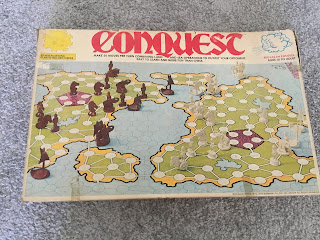
An ancient and battered copy of the game Conquest.


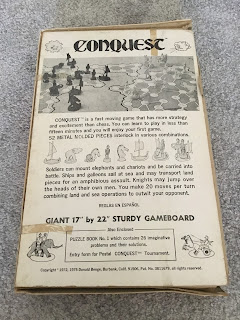
The back of the box showing the components.

This is very much a ‘seems like a potentially good idea’ kind of post or in other words a bit of a meander! Mark Cordone has been very busy on the Facebook Portable Wargame group with all manner of inspiring ideas. His latest involved using the pieces from a Chinese Chess set to represent a couple of armies and seeing this got me thinking along similar lines from my own collection. 


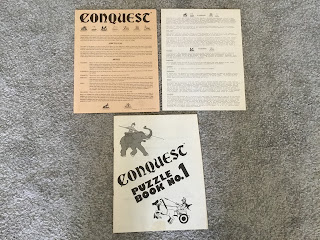
The rules and the puzzle book

Some years ago I picked up from a boot sale a copy of a 1975 edition of the board game Conquest designed by the late Donald Benge. The game is complete although the box is battered, the map board is about to fall in half as well as being stained around the edges but, crucially, all the 52 playing pieces are still present. The game contains the rules - in English and Spanish - and a book of Conquest based puzzles, rather like those one sees of chess problems.


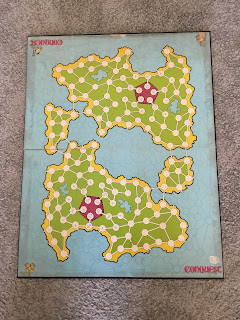
The map board. Movement is from point to point and this would be ideal for using on a campaign basis methinks!

Conquest is a point to point abstract game with no dice involved and has been described as being ‘chess like’. I used to play this a lot in the late 1980s with a version of the game that allowed for four players rather than the two in this one. It is great fun in an abstract sort of way. 


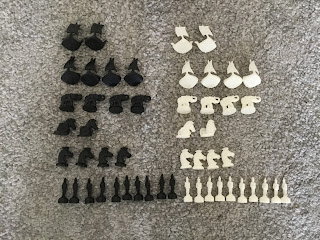
The game pieces moulded in plastic.

The pieces are stylised and functional and could certainly work within a conventional wargame if one was not too particular. The ships, elephants and chariots can all carry infantry figures and the object of the game is to occupy and hold the five spaces of the opponents capital. Each turn a player has 20 movement points to use as he sees fit (all units have a maximum movement distance dictated by the type) but the loss of each space of the capital reduces the number of movement points by 4. Opposing pieces are captured by  moving onto their space and removing them as in chess. There are various permutations around this, again depending on the attacking type opposed to the defender. Opponents can immediately recapture a lost piece as long as the target space is within two spaces.

As a game Conquest is very entertaining in a chess like way and the pieces could be readily used for something like the Portable 3 x 3 Wargame if required. The map could be used as the basis for an ‘imagi-nation’ style campaign of some kind for just about any historical or fantasy style setting.

Certainly something else to think about for sure.

Monday, 21 February 2022

One Million Years B.C., Tusk and the Palaeo Diet


What can I say? I saw this at the cinema as a dinosaur obsessed young boy but now as a adult I can better appreciate the historical accuracy, the tender human interest and sparkling dialogue - not to mention a couple of other assets….So we know humans were not around when the dinosaurs were but why let such a detail get in the way of a good story?

A number of bloggers have been dabbling with a set of rules published by Ganesha Games under the title Palaeo Diet - Eat or be Eaten. The subject is basically a pre-historic hunting style game that is ideal for solo gaming or co-operative play. It requires very little in the way of material - perhaps a dozen or so hunters and their targets and if one is not too fussy then happily using cheap plastic dinosaurs would be a great option.

In short, it is an ideal game for those limited in space, time or resources or those that do not enjoy painting vast amount of figures - like me! If I was not able to paint up a couple of dozen cavemen I may as well give up one and take up something rather like collecting antique snuff boxes or similar….

Anyway, inspired by the efforts of the good Kaptain Kobold as well as the legend that is the Jolly Broom Man I took a cheeky look at the Ganesha Games website and before you knew it I had pulled the trigger on a PDF version for a paltry USD 10. As a side note whilst buying PDFs is a great idea it is also more than a person of my notoriously feeble resolve can bear - this is why I try to keep away from the Wargames Vault if I can (and usually fail I should add….).


I actually saw both of these in the double bill you see above and remember being quite freaked out by the scene in She where ‘she’ - spoiler alert - turns into a very old woman. Raquel Welch and Ursula Andress in a double bill at the peak of their powers. More than mortal man deserves!

The first thing that struck me about the Palaeo Diet rules is their size - some 58 pages. They are nicely laid out with some wonderfully whimsical ‘cave painting’ style illustrations and with plenty of caveman style names in use for the examples of play. There are scenarios with some quite tongue in cheek names as well as the inevitable play sheets. It all looks straightforward enough and eminently playable and when I noticed the name of the author I could see why. 

Nicholas Wright has penned a number of Ganesha Games titles including Galleys and Galleons which are a really good set of naval rules for battles in the age of discovery - say the 16th and 17th centuries.

I plan to knock up a modest set up for this using 15mm figures and so I turned to the Irregular Miniatures website as I recalled a similar set of rules from a number of years ago covering a similar genre (although expanded to include Victorian dinosaur hunting) called Tusk and written by Matthew Hartley. Sure enough the rules and the battle packs are still available so with my resistance level at an all time low I placed a very modest order with them. Tusk was expanded to include Sci Fi and Pulp (Tusk 2 The Wrath of Kong and Tusk 3 Steel Tusk) settings and Irregular Miniatures issued a number of expansion figure pack to go with the rules.

Purely in the interests of high quality and detailed research I watched the 1966 Hammer classic One Million Years B.C. starring Raquel Welch which was a real blast from the past. Aside from the dinosaurs - Ray Harryhausen at his finest - and a very dodgy Iguana and a Tarantula it was actually not a bad film. I had forgotten most of it from having seen it at the cinema years ago but it ticked the boxes in respect of certain elements of how we would imagine early man lived - bear in mind I am saying certain elements!

I would have enjoyed watching She again - I did not know that a follow up was made in 1968 but with different actors called the Vengeance of She - and of course She is the inspiration of SWMBO or ‘She Who Must Be Obeyed’….


Classic swinging 60’s Sci Fi and the inspiration for the band Duran Duran. 

After having watched this and made some Stone Age style plans I then sat down to watch another classic from the swinging 60’s - Barbarella starring Jane Fonda. Now there is an idea for a game or two…

So my Saturday evening was spent watching Raquel Welch and Jane Fonda with a side dish of remembering Ursula Andress whilst planning some cave man gaming.

As Jack Nicholson said when playing the Joker in Batman….

“Gonna need a moment alone boys…..”


Thursday, 17 February 2022

Boardgames, Keyboards and Hospitals


Guess what I shall be reading later then?

Boardgames

Yesterday saw the arrival of my previously mentioned copy of Combat Commander: Europe published by GMT Games and the core set for the system. I am hugely excited about this game and am looking forward to getting it on to the table at some point - everything is currently classed as being ‘at some point’ for a variety of reasons! The game covers infantry combat during WW2 and it has a very ‘Squad Leader with Command Cards’ feel about it. A number of things struck me as I opened the box.


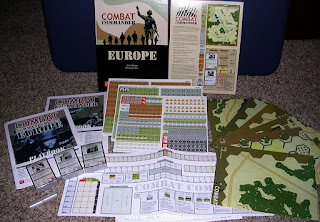
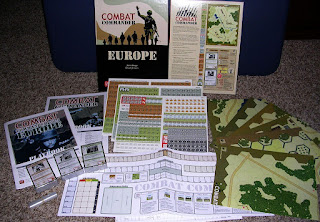
The contents of the box although not my copy!

1. Counters - as far as I can tell all are present and correct but there are two things about them. Firstly, they have been punched out by hand so will need to have the cardboard ‘tufts’ removed. I do not clip counters but I prefer them to be tidy around the edges so an evening session with a scalpel will be in order. They look the part bur are quite thin which I was surprised at given the quality of the counters in Wing Leader: Victories.

2. Maps - these are really nice and I will post pictures of them all in due course. There are six double sided maps showing a good variety of terrain types to fight over. They are printed on paper which will need either Perspex on top or laminating although the latter does create a storage challenge.

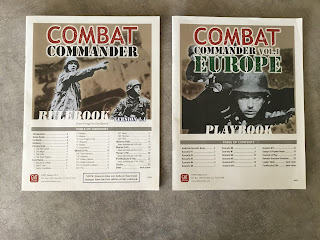
3. Rules and Playbook - the former is surprisingly thin (24 pages in all of which around 18 are the rules themselves and even then a substantial chunk is all about explanations of orders, actions, events etc) whilst the latter includes the 12 core scenarios, the all important designer’s notes, a random scenario generator and a reference of leaders and fortifications.

The game itself looks excellent but aside from the three fate decks - German, Russian and American ‘command’ cards - I have to say I am slightly underwhelmed by the production quality of the components. Never mind, they will do the job though!

Keyboards

Pretty much most of the blog posts I write have been drafted on my trusty iPad in conjunction with a Logitech Bluetooth keyboard case. This turns the tablet into a ‘not quite but close enough’ laptop. I first acquired one of these several years ago with my first iPad and basically wore them both out. When I upgraded to my current iPad (with 128Gb) I also purchased another Logitech keyboard. It worked perfectly well but a couple of years ago I chipped a small piece off the plastic surround that the tablet sits in. This had no effect on the use of the keyboard - it was merely a minor cosmetic issue.

My son had noticed this and so purchased me a replacement for Father’s Day (he is a good lad when all is said and done) and so the older keyboard, though still perfectly serviceable, was decommissioned in favour of the newer model.

In many ways the newer model was actually not as good as the original - with the newer version the tablet had a tendency to ‘pop’ out of the plastic holding surround, usually at the most inconvenient moments - and it also felt as though the case was too large for the model of iPad I own (it is fact the correct size). Anyway, to cut a long story short this newer case also repeated the chipping incident of the original one. I was not unduly concerned about this until last night when one of the keys decided to part company with the keyboard. Try as I might I was unable to fix this as one of the connections had broken off. 


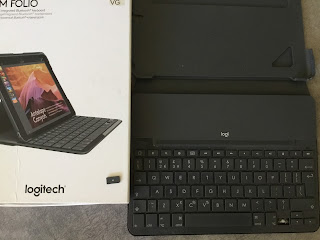
The old new keyboard now replaced with the older old keyboard. You can see the small chip on the right hand side at the top and the broken key

You can probably guess what I did next. Yup! I got my old keyboard out of storage, cleaned it up, popped in a couple of news batteries and let Bluetooth do its connecting thing and hey presto! I now have working keyboard that the tablet fits rather more snuggly in, with all the keys in place and a chip that is smaller than the one on the new case.

Hospitals

Big day today. Laurel and I are meeting with the physio, an occupational therapist, a nurse and a pathway coordinator (another nurse) to review Laurel’s progress so far and to get a more formal plan in place for her next steps. It also means that I will be allowed into the building and will able to spend some time actually in the same room with her - none of that lurking in the bushes stuff! 

In order to prepare for this I had to go around the house measuring and taking pictures of any steps, doorframes, bathrooms, toilets, beds and chairs. It took a whole morning to do this and if I have learned anything it is just how challenging our house would be for anyone suffering from mobility issues. 

I am hoping that the meeting today will address the concerns we have and what needs to happen next - my feeling is that at the present time and given Laurel’s current rate of progress - she is improving everyday but probably not enough to be allowed home - is that she may be an in patient for a while yet.

We shall see.
Monday, 14 February 2022

Birthdays, Anniversaries and Hospital Visits


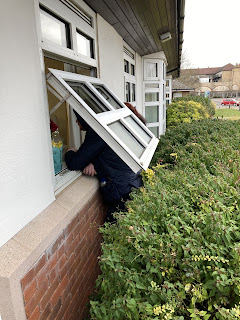
No, not an attempted break in - my son and daughter conversing with their mum courtesy of a hospital window visit - note the intervening foliage, so dense I am sure David Attenborough would have a field day investigating it!

The 13th of February was Laurel’s birthday and also our wedding anniversary. Today is of course Valentine’s Day and tomorrow, the 15th, is the anniversary of when Laurel and I first met back in 1980. February then, is veritable smorgasbord of special occasions.

This year was a little different due to Laurel still being hospital but it did not stop the three of us visiting her with a cake, cards and presents. It was the first time I had seen her since Sunday 30th January just before my bout of Covid. For my son and daughter it was the first time they had seen their mum since the 16th January for my son and the 18th January for my daughter due to the isolation requirement prior to Laurel’s surgery. It was a long time for me and even longer for the two of them.

The centre she is at are not allowing visitors in the building due to Covid but are happy to allow what they call window visits. As you can see from the picture above this was less than ideal for a number of reasons but we overcome the difficulties and managed to spend a couple of hours with Laurel after negotiating a series of bushes (including a particularly thorny rose bush), trying to keep out of the freezing wind and accompanying drizzle. 

It was an emotional visit for all concerned but we all felt much better for it afterwards and of course the boost to Laurel was immeasurable. Her phone was ‘pinging’ non-stop with friends and family sending their love and best wishes and she had also had numerous calls as well. Laurel is improving by degrees and her feeling in the surgery affected areas is gradually returning but she still has some way to go. We are meeting on Thursday with the physio, an occupational therapist, a Pathway representative and a nurse to discuss progress so far and the plan going forwards which is a positive step for sure. One of the nurses blue tacked all her get well and birthday cards on the wall of her room which made for a cheery display.

When we finally said goodbye and headed home my son got an Indian takeaway for our dinner as a treat and afterwards I sat down to the Good, the Bad and the Ugly in a far more relaxed frame of mind having seen my wife at long last looking rather more upbeat than previously.

She is getting there, albeit perhaps not as quickly as she would like!

Sunday, 13 February 2022

Combat Commander: Europe


 The contents of the box. The game comes with 12 scenarios but I am reliably informed that there is the facility for generating your own and with plenty of terrain options and troop types to choose from the potential replay value is huge. The base game covers German, American and Russian forces with others being available in the expansions out standalone games - Mediterranean and the Pacific. I am very excited about this and am looking forward to when my copy arrives (mercifully with the counters punched out!)

I have been a fan of low level tactical boardgames for many years although to be completely honest have only played a few. Memoir ‘44 and the various expansions most recently although I have also dabbled with Conflict of Heroes: Guadalcanal (good, but rather limited in scope), Heroes of Normandie (again good, but something about just did not feel right) and even a quickly aborted attempt at the rabbit hole that is Advanced Squad Leader. Back in the day I really enjoyed Squad Leader before it morphed into the advanced version although even then I felt that it had reached its complexity peak with the release of Cross of Iron - the first expansion that covered the Russian Front. The two following expansions, Crescendo of Doom and G.I. Anvil of Victory were obviously useful for the additional nations but made the system increasingly complex and unwieldy. I can remember also having lots of fun with the classic PanzerBlitz and PanzerLeader by Avalon Hill and not to be left the SPI game Panzer ‘44 was gamed pretty extensively.

Of the current crop of tactical WW2 games around the one that has really caught my eye is the Combat Commander series. The entry point is the game you see above which I have been fortunate enough to snag a copy of. 

I have been following with interest Paul Liddle’s excellent blog Pauls Other Wargames in which he has played through a number games of Combat Commander (including the Resistance expansion which I would love to get!) and this has been both helpful and inspirational. Many thanks Paul for helping me with my decision - having said that my wallet may not be of the same opinion!

As a rule I am usually wary of card driven game mechanics - only because I am of the opinion that these need to be rather more detailed than some of the early Command and Colours types. For most of the Richard Borg’s games these days the use of two decks seems to be the way forward - Ancients, Napoleonics, AWI, the ‘45 and Samurai Battles, not to mention the various expansions for Memoir ‘44 - as these enable a ‘closer’ degree of involvement. I have to say that I much prefer this additional layer of complexity as it gives one the impression of a greater degree of control even if the cards still are not alighting as one would like!

Hand management in Combat Commander is key and each nationality has their own deck which builds in a degree of national flavour/doctrine. Note that I deliberately refrained from using the word characteristics….

I have never had a problem playing a card based system solo and indeed, Paul has done this very successfully during the games on his blog. The table footprint appears quite compact so will suit the man cave well. Paul uses a sheet of Perspex to keep the maps flat which is something I may well do although having the maps laminated (which I have done before) may be an option albeit perhaps not as convenient for storage etc.

My decision to acquire this game was basically driven by wanting to have a low level tactical game with sufficient ‘meat’ in terms of complexity that sat between Memoir ‘44 at the lower end and Advanced Squad Leader at the top. Only time and playing the game will tell if my decision was the right one.

Once again many thanks to Paul for his excellent battle reports and help.


Wednesday, 9 February 2022

The Russo Turkish War in the Black Sea


One of my favourite wargame books. The only rules I have used extensively from this book are for the Great War but it is chock full of great ideas

Day 10 and still testing positive….

Historically the naval operations of the Russo Turkish War of 1877/78 were unspectacular to say the least. The Russians had very little in the Black Sea following their defeat during the Crimean War and the subsequent treaty restrictions. The Treaty of Paris signed in 1856 limited the Russians to a very small flotilla whilst the Turks, supported by Great Britain, were allowed to build up a formidable force of ironclads - many of which were built along the Thames. On the face of it then, the Russians were both outgunned and outmanned. Had the Turks chosen to be far more aggressive in the use of their fleet the outcome of the war may have been very different, however, muddled command, low morale and lack of properly trained crew meant that for all their superiority the Turks largely surrendered the naval initiative to the Russians. 

The Russians were nothing if not brave and inventive. The use of spar torpedo steam launches and mining operations, together with shore based artillery ensured that the Russians quickly seized the initiative along the Danube. Their armed merchant steamers were able to harry the Turkish merchant marine and lines of communication, thereby drawing Turkish ironclads away from their primary missions of shore bombardment etc. The Turks did enjoy limited success and indeed, a former Royal Navy Captain - Augustus Charles Hobart-Hampden - was appointed as an admiral in Ottoman Service and was known as Hobart Pasha was instrumental in this. His memoirs are available on Project Gutenberg and I am reading them at present and he was certainly very active in the Black Sea. He had an interesting career, fighting slavers, blockade running for the Confederacy and helping the Turks put down a Cretan rebellion. 

So for all this how does one make the game and setting rather more interesting than was historically? 

Well, I have been turning this over in my mind and have a number of ideas to play around with. The key thing is that the Russians definitely need some heavier metal, above and beyond the two circular ironclads, the Popov and the Novgorod, however whimsical they may be! I certainly plan to build these two naval oddities, if only for the sheer fun of it. During the war the main strength of the Russian Navy was in the Baltic so I could arguably cherry pick some ships from there and redeploy them to the Black Sea. The challenge there is how would they have gotten to the Black Sea? Another alternative, and there is a historical precedent for this, would be to allow the Russians to have captured and repurposed some Turkish ships. During the war the did this with a couple of Turkish Danube gunboats and later, during the Great War refloated the Turkish Cruiser Medjidieh after she had been sunk by a mine and took her into Russian service as the Prut. Given the Russian fondness for spar torpedoes and mines there could be an opportunity to ‘snag’ a Turkish ironclad or two. Perhaps the Russians could sow an offensive minefield on a suspected Turkish shipping lane whilst they are en route to bombard a harbour or similar. Coupled with a night time spar torpedo boat raid it would be feasible for a Turkish ironclad to be sunk in range of Russian territory. A swift salvage operation, some quick repairs and hey presto! A new Russian warship!


A few years after the Russo Turkish War but with a cracking idea to play around with

I should be mindful of making the Russians too powerful as the Royal Navy would not standby and see the Turks outfought in the Black Sea. Indeed, the Mediterranean squadron sailed to the Sea of Marmara to keep the Russians honest - remember this was the period when the Russian ‘designs’ in Asia that could potentially threaten India or the Suez Canal were viewed very seriously by Parliament so any Russian moves against Turkey would set alarm bells ringing.

Historically when the Royal Navy sailed into the Sea of Marmara at the end of the war the Russians planned to mine the Bosphorus to prevent them entering the Black Sea. Great Britain got wind of the plan and promptly told the Russians that this would be considered an act of war and so they backed down.

If I allowed the Russians to gain a couple of ironclads then depending on how well the Turks fared against them would determine whether or not the might of the Royal Navy would intervene. There is a marvellous battle report in Paul Hague’s book: Sea Battles in Miniature describing a fictional action between elements of the Royal Navy and the Russians who have been equipped with some British designed ships built by them from plans acquired from spies. By the simple expedient of adding ‘ski’, ‘vitch’ or ‘off’ at the end of the ship names these British ships were suitably ‘Russianised’.

Taking all this into consideration my options for the Russians are perhaps not as limited as history dictated. I rather like the idea of captured Turkish ships being repurposed - as mentioned there is a precedent for this - and also for allowing some additional units to have been built at Sevastopol. It will be fun factoring this in and of course building the models. One thing is for certain though. A six ship squadron for the Royal Navy will need to be built.

Oh yes indeedy!

Tuesday, 8 February 2022

Black Sea Turkish Ironclads….Part 3


The first of the Turkish ironclads. I have a couple of Russian armed merchant cruisers currently under construction by way of some opposition. Historically these were used as tenders for spar torpedo launches, minelayers and also to draw Turkish ironclads away from shore bombardments etc. Very much ‘shoot and scoot’ type operations.

It was a strange day yesterday. I felt particularly lethargic and it was a real effort doing anything let alone painting models but I gave myself a gentle nudge and pressed on and I am glad that I did. At the time of writing I am still testing positive but today, aside from a nagging and irritating cough I feel relatively normal.

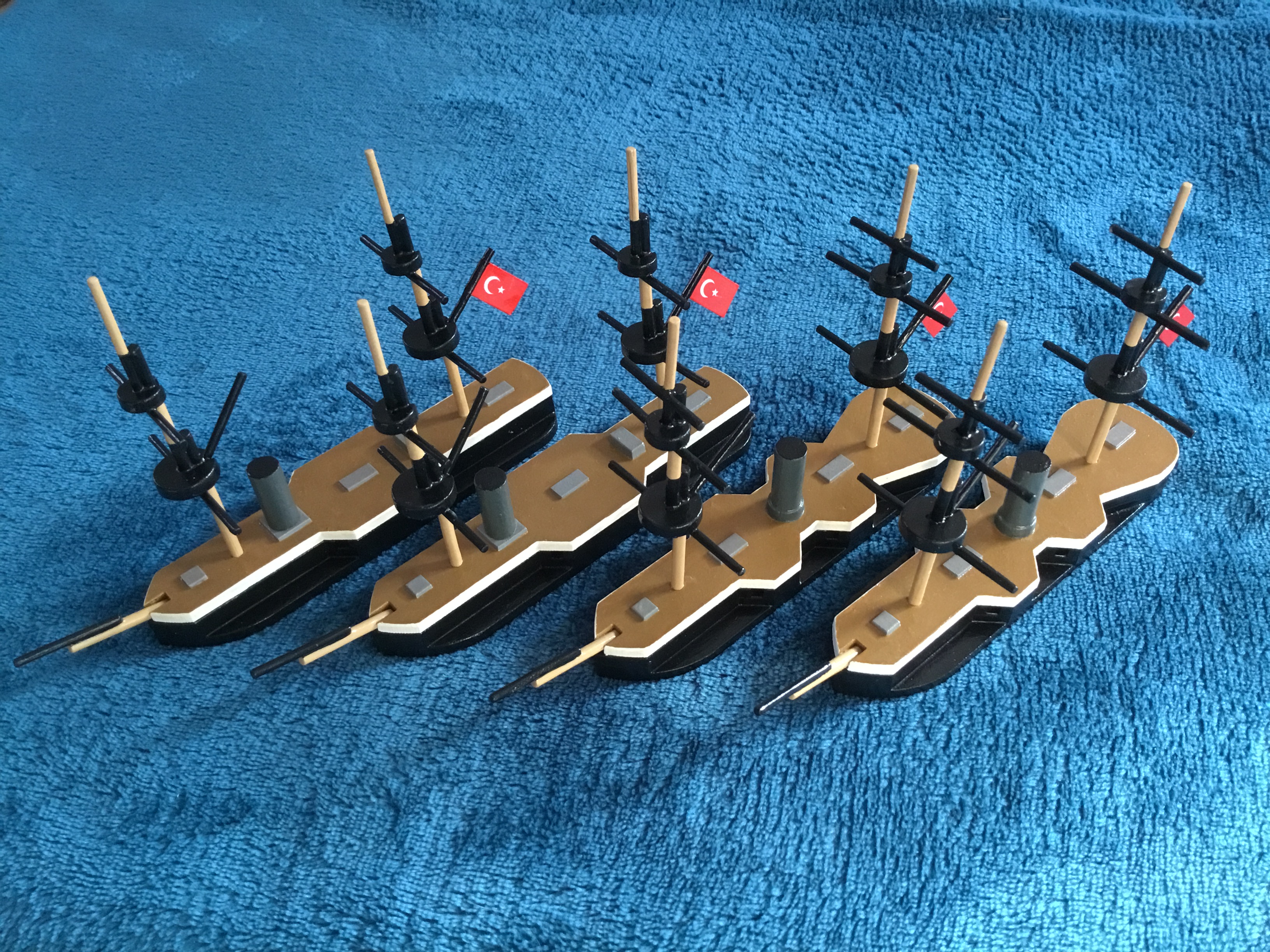
I finally finished the four Turkish ironclads and I have to say that I am rather pleased with how they came out. As usual they are very much ‘based upon’ rather than super detailed scale models but for my purposes they will work quite nicely. Whilst I was working on these I gave some thought to the opposition and so have taken a couple of hulls from the ACW ships currently under construction and will repurpose them into Russian armed merchant types. When my Warbases order arrives I shall be able to build the other two Turkish ironclads which will suffice for the collection although I could easily build another four!


The Feth-i Bulend class of central battery ironclads - one built on the Thames (Feth-i Bulend) and the other in Istanbul - the Mukaddeme-i Hayir


The Avnillah class of central battery ironclads - note the cutaway section in the casemate to increase the fields of fire. Both ships were built on the Thames and the other of the class was the Muin-i Zaffir

The models were built using my tried and tested MDF laminate technique - in this case four layers each of 3mm thickness. Deck fixtures are mostly card except for the funnels that are dowel rod cut to size. Masts are from bamboo skewers with cocktail sticks for the spars. Paint was a mixture of Humbrol enamel - and Vallejo - Iraqi Sand for the masts and Black for the hull and spars. As per usual I opted for a satin varnish as this gives a suitable ‘old school’ appearance and is in keeping with the overall ‘look’.

On the face of it the Russo Turkish War does not really have a lot to offer. Historically the Turks had an overwhelming superiority in terms of material but for the most part the overall command of the fleet was poorly handled and listless in operation. The Russians were quickly able to seize the initiative along the Danube, thereby ensuring that the armies movement was not overly inconvenienced. The various extemporised cruisers the Russians employed, whilst not being a match for the Turkish ironclads in a stand up fight, were able to operate effectively across the Black Sea with little interference. They did cross swords occasionally and one such incident will feature in a game as soon as I have built the Russian ship in question.

Whilst I was building these models and indeed, also the ACW collection my thoughts naturally turned towards the other periods of history that I could produce stylised models for. If I am honest I reckon that the pre-dreadnought era would probably be about as late as I would go for capital ships although certain facets of the Great War would certainly be achievable. The problem as I see is that when one get to the dreadnought era warships become a lot more ‘fussy’ in terms of above deck detail. My approach would probably not be flexible enough to capture this adequately. The type of combats I will be fighting tend to be at closer ranges so dreadnoughts hurling 15” shells at 20,000 yards does not really sit well with my system. Besides, there are plenty of cheap, commercially available smaller models to cater for these types of combat.

Thinking of the Great War and models thereof, I envisage primarily cruiser types being the main arm and these would be in certain cases very much the edge of the envelope for what I can build. Something to ponder for another time I should think.