Thursday, 2 June 2022

For the Honour of Turkiye.…The Sea of Marmara, March 1878….Game Number 73….Part 1


Sultan Abdul Hamid II - a portrait from 1899

It was well known that Sultan Abdul Hamid II did not enjoy a good relationship with his naval high command. Aside from mistrusting his admirals he considered the navy to be drain on the treasury and so, after the poor showing during the recent war with Russia giving him the excuse he needed, he resolved to keep the fleet effectively bottled up in the Black Sea. The Sultan, whose paranoia knew no bounds, was convinced that the naval hierarchy was plotting against him and so, in order to avoid the fate of his predecessor, he made sure that it was under resourced, underfunded and undermanned. In the long term this proved to be a mistake as morale, never high to begin with, eroded away and the fleet, once one of the most powerful in the world, was allowed to fall into decay. 

Recently Turkey had been deprived of a number of ships that were being built in England and compulsorily purchased by the Her Majesty’s government as a result of the threat of war with Russia. Although war with Russia was avoided tensions remained high and continued to do so when Russia commenced operations against Turkey. Unfortunately any sympathy the British may have had for the Turkish cause in the face of the Russian’s abject bellicosity had quickly evaporated in the face of several well publicised and unsavoury incidents undertaken in the Ottoman Balkan provinces and so when the ships were appropriated and taken into the Royal Navy it was widely seen as a good thing, except of course, in Turkey.

The war with Russia went badly for Turkey and so at the conclusion of hostilities the British finally realised that Russian gains at the expense of the ‘sick man of Europe’ could potentially threaten the Suez Canal, not to mention the ongoing situation in Afghanistan. Great Britain reacted as only she knew how and so immediately sent the Mediterranean squadron towards the Black Sea as a show of force to remind the Russians of exactly who ruled the waves and this was undertaken with scant regard to Turkish sensibilities at the infringement of her sovereign territory.


H.M.S. Superb - sister ship to the Turkish Mesudiye.

The Royal Navy Mediterranean squadron, under the command of Vice Admiral Geoffrey Hornby and consisting the ironclads H.M.S. Alexandra (flagship), H.M.S. Agincourt, Achilles, Temeraire, Sultan, Swiftsure and Superb and the despatch vessel H.M.S. Helicon, entered the Sea of Marmara, despite Turkish protestations to the contrary, and anchored. Shortly after their arrival word reached the admiralty that the Russians were planning an attack against the ships of the Mediterranean squadron under the cover of night using torpedo boats (mostly of the spar variety although some locomotive versions were available). The British responded by sending a sternly worded note to the Russian ambassador in London and telling him, in no uncertain terms that any interference with Her Majesty’s ships would be deemed an act of war. The Russians promptly backed down and abandoned the idea.

The treaty of San Stefano, whilst unsatisfactory in many respects meant that the Royal Navy squadron, its work largely unfinished, made ready to return to Malta but not without a small problem. H.M.S. Superb, the sister ship of the Turkish Mesudiye, developed an issue with her engines and so was unable to leave with the rest of the squadron.  Political expediency required the British ships to leave promptly so the decision was taken to leave H.M.S. Superb behind to make her own way back as soon as she was ready. By dint of her crew working through the  night she was at last able to raise steam at dawn and so set off on her own at best speed to rejoin her squadron. She was at least sixteen hours behind.

Despite the generally poor showing of the Turkish navy during the recent war there were some elements that tried to stem the slide into decrepitude. A small ‘band of brothers’, chaffing under the grinding rule of the Sultan and burning with shame at their perceived ineffectiveness, decided that a demonstration against those forces that deigned to encroach on the territory of Turkey with casual impunity, would be order. The situation in respect of H.M.S. Superb, alone in the Sea of Marmara, seemed like too good an opportunity to miss.

A plan was quickly hatched to intercept and capture, using force if necessary, the British ironclad or if unable to do so then to ensure that she would not leave Turkish waters. This was to be undertaken without the knowledge of the Sultan (although in his name) and if successful would restore the prestige of the Turkish navy and demonstrate to the Sultan the value of maintaining a strong fleet. It was a noble and patriotic thought to the loyal officers and crew of the three ships tasked with this dangerous undertaking. The great unknown was of course the reaction of the British to this enterprise - it was a gamble that the British would not want to go to war with Turkey whilst attempting to hold Russia at arms length. 

The Turkish navy in the Sea of Marmara routinely spread the ships around a number of small fishing ports and harbours, often barely sufficient for a single warship to dock. Facilities were often very basic and re supply of coal, ammunition and other supplies was at best tenuous. In spite of these operational challenges a plan was hastily improvised and agreed upon by the captains of the three small ironclads that were to attempt this daring mission. Overall command was assumed by the senior of the three captains, an experienced and seasoned Captain by the name of Ali Shuar. 


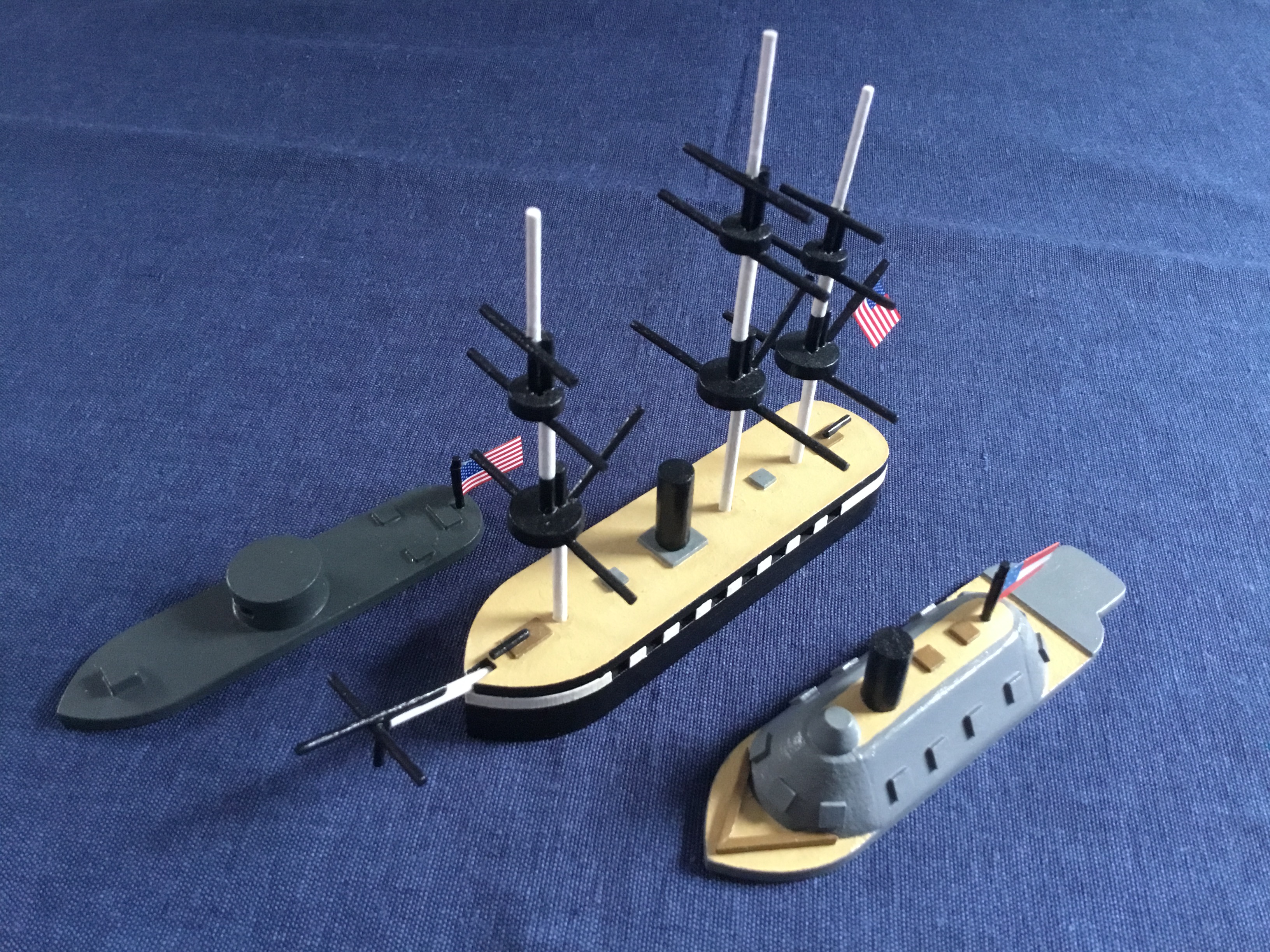
H.M.S. Superb. Originally I built this model as a kind of experiment - just to see how far my building technique would work. She is the largest model I have built and if I am honest I am not entirely happy with the paint job on the masts and the funnels so these will be redone at some point.

Binbasi (Captain) Ali Shuar was careful and prudent seaman and had served with relative distinction under Hobart Pasha in the Black Sea during the recent war with Russia - one of the few to do so. He was familiar with the Mesudiye - the sister ship of H.M.S. Superb - and so was not confident that his small command would fare well in a straight fight due to the overwhelming superiority of the British ship’s artillery. Manoeuvre would be their best hope and so his plan was to engage the great ironclad from the bow and the stern where possible, so as to neutralise the enemy firepower advantage. With this in mind he split his force into two - in actuality he had little choice given that the ships were separated geographically , his own ship was some miles further along the coast from the others. The two sister ships - the Feth-i-Bulend and the Mukaddeme-i-Hayir would operate together whilst his own ship, the Muin-i-Zafer, would work independently. He hoped that by having a range of targets the effect of the British ships broadsides would be reduced. With the minimum of fuss and surprisingly well organised, the three Turkish ships raised anchor and headed out to sea. A short while later the three ships rendezvoused and moved into formation with the Muin-i-Zafer taking the lead and stationed some distance ahead.


The Turkish flagship the Muin-i-Zafer (bottom left) flanked by the Feth-i-Bulend (top) and the Mukaddeme-i-Hayir (bottom).

Ali Shuar’s plan was to get as close as possible to the stern of the British warship and then he would take his ship starboard whilst the others went to port. Taking advantage of the sun being in the east would help to mask their approach until they were in position to force a conclusion. It was a gamble to be sure but under the circumstances probably the best course of action. He expected to make the interception at around 9am.

Aboard H.M.S. Superb the atmosphere was tense although her commander, Captain Archibald Bellend, appeared to be supremely unconcerned about the situation his ship was in. Thus far the ship had been making good progress following her repairs but the entire crew down to the lowliest stoker were of the opinion that the sooner they rejoined the rest of the squadron the better. Captain Bellend had a low opinion of the efficiency of the Turkish navy and was confident that they would not dare to impede his progress in any way. His senior officers did not share his optimistic appraisal and so the ship was quietly cleared and readied for action. Her Captain believed that it was all quite unnecessary but he allowed himself to be persuaded and besides, it kept the crew occupied. He stood calmly on the quarterdeck, hands clasped behind his back and with his chest and jaw firmly set when a cry from the lookout, squinting into the dazzling morning sun, disturbed his reverie. “Smoke off the starboard and port bows!”


Springing the trap - H.M.S. Superb found herself surrounded by Turkish warships

The Turkish approach had been flawless and brilliantly executed. Without being noticed they had arrived exactly as expected and had managed to get slightly ahead of the British ship and on either beam of her. All three ships were cleared and readied for action and so surprise was complete.

Captain Bellend stood in stupefied shock at the brazen temerity of the Turks as their ships loomed into view. Taking the situation in at a glance he immediately ordered an increase in speed and prepared to engage. With a strident crack one of the forward 20 pdr BLRs opened fire against the leading Turkish ship. Battle was joined….

To Be Continued….


Sunday, 29 May 2022

Ch, Ch, Ch, Ch….Changes….Turn and face the strain….

You know that feeling you sometimes get when something is not quite right but you are unable to put your finger on exactly what? Well, this week, following a successful play test of the current version of the rules I was left pondering one specific incident and the implications thereof. 


The defining moment - the C.S.S. Virginia meets her fate at the hands of the U.S.S. Monitor - two thirds of her hit points lost in a single pulverising salvo

On the very last turn of firing the U.S.S. Monitor fired on the stranded C.S.S. Virginia. After the dice rolls from both sides the C.S.S. Virginia suffered six hits which, along with the three hits she had already sustained, was sufficient to sink her. It was great at the time (not for the Confederates to be sure) but it did give me pause for thought. 

After pondering this (and indeed some other multiple dice roll induced effects) I realised that whilst opposed rolls works well, having great fistfuls of them tended to veer away from my original aim, that of maintaining a closer ‘feel’ between the characteristics of the ship the model represents and the game mechanics. 

I was pondering this when I had a bit of a lightbulb moment. As it stands at present a ship is rated for the number and type of guns carried and these in turn have a penetration factor based on the effectiveness of those weapons. For example a rating of 2/3 means the 2 refers to the notional number of barrels and 3 is the penetration factor. The current version of the rules adds these two figures together which is the number of d6 rolled when firing, in this example 5. It is fun but what tends to happen is the whole dice extremity thing makes things, well, extreme. It just felt a little over the top, even for my admittedly elastic and somewhat theatrical perception of reality!

So, what to do? Well the solution was an obvious one but as is usually the way with these things, it arrived in a roundabout fashion. I have gone back to my original idea of rolling a d6 per gun factor with the penetration factor acting as a modifier to each d6. The higher the adjusted score for each d6 rolled the more potential damage points can be inflicted. I have also added in ‘the rule of 1’ whereby when firing the roll of a natural 1 is an automatic miss. I did this because otherwise it would be possible, with the appropriate modifiers, to be in automatic hit territory which I have never been entirely comfortable with - there is always what I like to think is the ‘bead of sweat rolling into the eye of the tank gunner just as he fires and so misses the target’ effect or, the element of the imponderable that is ever present in warfare.

Damage points are now on a sliding scale rather than the 1, 2 or 3 being a miss, 4 or 5 a single hit and 6 is two hits. The damage point scale now runs as follows:

1, 2 or 3 - No damage

4 or 5 - 1 point

6, 7 or 8 - 2 points

9, 10 or 11 - 3 points

12 or more - 4 points

So you take the gun factor which is the number of d6 you roll, add any penetration factor with any applicable situational modifier to each d6 and consult the scale for the potential number of damage points. The target ship uses the hull factor to determine the number of d6 to be rolled and then add as a modifier to each d6 the armour value. The scores are then read off the same sliding scale as for firing to determine how many damage points are negated.

The end result is a system that feels more measured in that the potential for eye watering amounts of damage is still there  - as it should be - but is more the exception rather than the rule. 

I need to incorporate this in the draft that will be sent off to my trusty testing team - their patience knows no bounds - along with some other bits and pieces just to finish it all off. Overall it is getting pretty close to being finished - at least I think so!

Models and Boards

Based on some images I found on the net and being hugely flummoxed by my efforts at painting the ‘sun ray’ effect seen on some paddle wheel boxes and despite the etched versions I ordered from Warbases, I decided to replace them with my standard plain design. I now feel far more likely to get these built and so work has resumed on them.


The new board. The white spot in the square shows the corner of a 6” square for comparison.

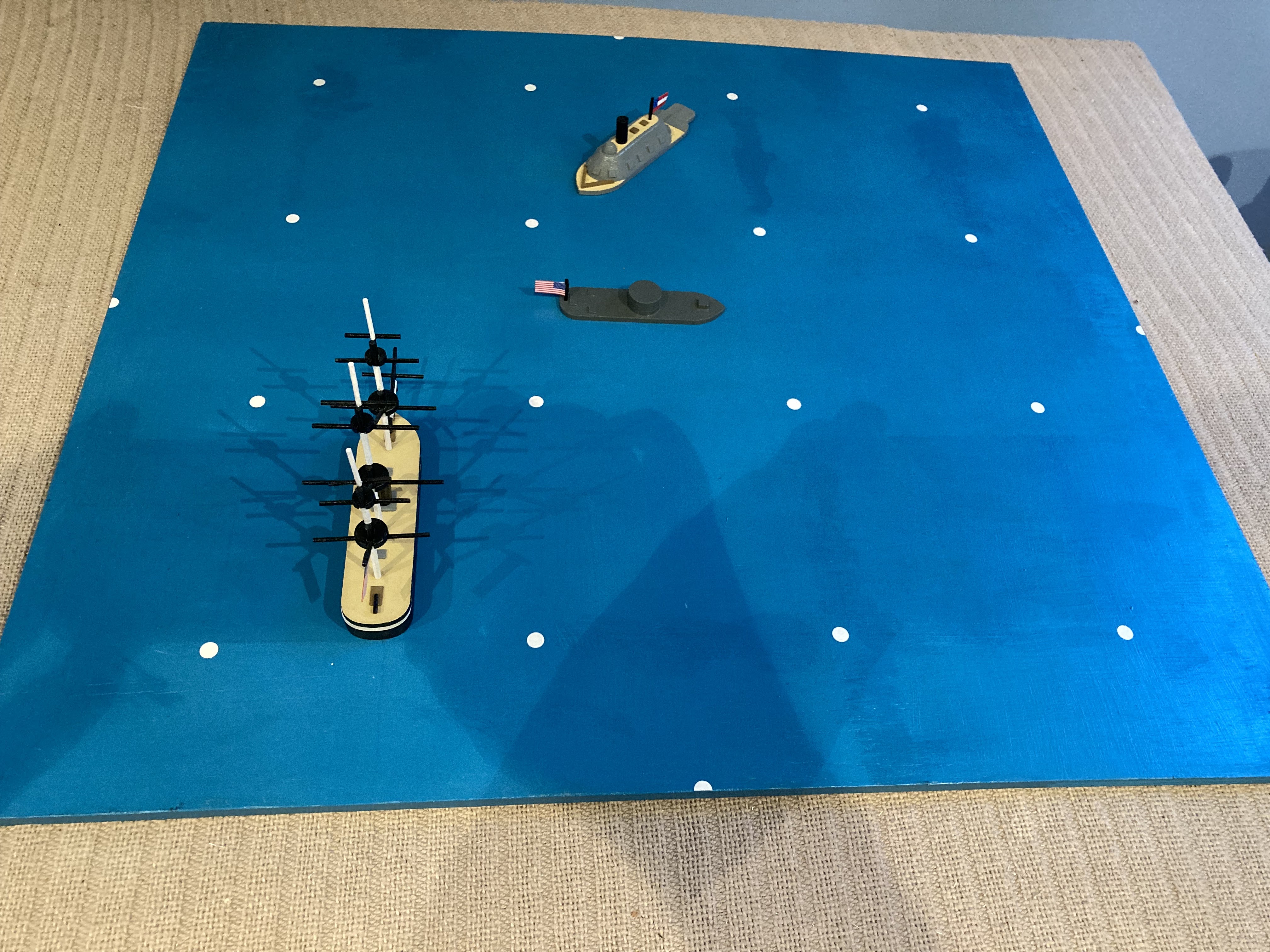
I also managed to get some work done on my new 3 x 3 board. If you recall the original version featured 6” squares but these felt a little on the cramped side. All I did was to repurpose the existing board with 8” squares - the board is roughly 2ft square - meaning that the reserve or manoeuvring zones are now off the board. Once again I used white sticky dots to mark the corners, hence the four you see in the pictures.


Two sloops in a 6” square - it is a little on the cosy side.


The same models in the larger square - far better looking in my opinion, it also adds to the illusion of range but I am thinking that bigger still may be the way forward for the size of models I have.

All in all then, progress is progressing, changes have been made in various ways but it is all to the good and I now feel far better placed to get things back further along the track.

Just need to crack on then!

Wednesday, 25 May 2022

Hampton Caught….January 1862….Game Number 72

This evening I fought a Zoom based play test game using my Portable Ironclad Wargame rules and based on the second day of the famous Battle of Hampton Roads. We (agent X and myself) used the 3 x 3 version of the rules and aside from a couple of points arising it all went rather well. This will not be a full blow by blow account of the game so I will instead let the pictures do the talking for the most part. Unfortunately taking pictures in the man cave at night and under artificial light is a real problem in that shadows etc are very noticeable.


Initial positions. The U.S.S. Minnesota is stuck firmly aground although still able to fire. The C.S.S. Virginia moved first.


Surprise! The U.S.S. Monitor emerges from behind the stranded frigate and prepares to engage the Rebel warship. Firing sees the U.S.S. Monitor inflicting 3 points of damage on the Rebel ironclad (this should have triggered a critical hit but in the heat of the action was overlooked…) whilst the Confederate warship fired at the stranded Union frigate to no effect.


Deciding to focus on the U.S.S. Minnesota the Rebel ironclad made straight for her whilst the U.S.S. Monitor, mindful of the potential effect of the Rebel ram, maintained a discreet distance.


The two ironclads continued to blast away at one another with little effect but by dint of a careful manoeuvre the Rebel warship was now positioned off the bow of the stranded Union frigate at close range. 


The C.S.S. Virginia manoeuvred until she was virtually under the bowsprit of the Union frigate and at last she began to score hits against her. Meanwhile the U.S.S. Monitor blazed away with little obvious effect on the Confederate warship.

Despite the risk of running aground the Rebel captain decided to risk ramming the Union frigate. The Confederate warship closed in on the U.S.S. Minnesota only to hear an ominous grinding noise as the ship shuddered to a halt. She had run aground! Worse as to follow as with the groan of timbers and the squeal of overstressed metal she heeled over meaning that her guns could not be brought to fire! Seeing the enemy warship in obvious distress the U.S.S. Monitor commenced pouring shot after shot into the grounded rebel ship - in short order she succumbed to the overwhelming weight of Union gunfire. The C.S.S. Virginia was battered into oblivion.

It was a fun game to play and I was delighted at how the overall system worked against a line opponent! A few points requiring some thought and clarification arose but nothing major. Mention should be made of the freakish nature of the Union initiative rolls - they won every one - as well as the generally poor standard of Confederate gunnery. 

I am well satisfied that the gunnery system works and having opposed dice rolls really adds to the fun factor. A couple of things were missed but this did not present a great problem overall. I need to really clarify a few things as follows:

Firing arcs

‘Supporting’ fire i.e. using more than one firing arc to engage an enemy ship

Diagonal movement and firing

All in all it was a great way to spend and evening and my sincere thanks to Agent X for his efforts thus far and his continued ongoing support. Next time I will let him choose the dice as well….


Readying for Action - Return to Hampton Roads


The three ‘not so amigos’ - from left to right the U.S.S. Monitor, U.S.S. Minnesota and the C.S.S. Virginia.

This evening will see the first play test of the Portable Ironclad Wargame via Zoom and with a live opponent. We shall be using version two of the rules and version three (actually two and a half at present) is currently underway. The work that my very own testing dynamic duo - agents X and Y - have put in has been first class and has really helped the project along. Without a doubt it would not be where it is now were it not for their valuable contributions!

To keep things simple, I have decided to rerun day two of the Battle of Hampton Roads featuring the U.S.S.Monitor, the (grounded) U.S.S. Minnesota and the C.S.S. Virginia. We will be fighting this using the 3 x 3 variant of the rules which, to be honest, is slightly misleading really. The rules are those of the ‘full’ set with the only tangible difference being that the maximum gun range is two squares. I have yet to formalise the rules for using the reserve areas - I had half an idea about how this would work - but these will come in time.

All being well I will have an after action report of sorts for tomorrow although if it all goes spectacularly wrong then it may be something rather different!

Tuesday, 24 May 2022

Boot Sales and Bone Spurs

I have to say that I have taken a vicarious pleasure in reading about Partizan last weekend - it is not a show I have been to but would like to do at some point -  although by comparison my own weekend was rather more sedate! 


Small and handy to have - no plans to tackle the period using figures….(not yet anyway….)


         Samples of the troop and character cards
 

Boot Sales

Laurel, Holly and I headed out to a boot sale on Sunday and it was quite a successful outing. We all managed to get some bits and pieces - mine you can see in the pictures - and best of all was whole pile of cheap fruit - a tray of twelve mangoes, four large punnets of raspberries and two of blueberries for five pounds - so we are now all feeling rather virtuous in a ‘five a day’ kind of way!

The first of the purchases I made is a card based game inspired by the Trojan War. It is largely a game of knowing when to influence fate and deploying your heroes in a timely way to support your troop cards. Simple and handy to have as well as fast playing. I was so inspired that I may well have to watch Troy again, maybe even tap into Homer once again!


Useful buildings to have around for the Green islands or, in the case of the right hand one, even the Middle East

The buildings are usually sold as cheap holiday souvenirs among the Greek islands - I already have a number of these - and so when I saw the four of these for a silly price I thought ‘well why not?’ OK so there are more churches than I would usually need but the small flat roofed house is handy. Indeed, I have used several of these buildings in a number of my games and they certainly look the part.

Bone Spurs

Way back in 1988 I damaged my left ankle. It was not a dramatic event as such - no skiing or sky diving accident - as all I did was to slip down two stairs and roll my foot so that it was at right angles to where it should have been. Miraculously I had not broken it but I had wrecked pretty much every ligament around the ankle. I remember the bruising was pretty spectacular and ran from the line of my toes to the back of my knee. Anyways, after some eighteen months being in and out of plaster it was more or less about as good as it was going to get. Since that time (and after extensive physiotherapy) it has given me endless grief and the the consultant I saw told me that in later life I would probably get arthritis in it and that surgery to fuse the ankle may be the only solution. It has not gotten that bad yet but it has really deteriorated over the last couple of years or so. It has now also impacted on my knee and hip. Later life is here so it seems!

A few weeks ago I had X-rays on my ankle, knee and hip and last Friday I visited the GP to go over the results. I have been referred to an orthopaedic surgeon as I now have a fairly substantial bone spur bang in the middle of the joint. Luckily it is pretty straightforward to sort out although naturally as a non life threatening condition I am fully expecting a bit of a wait. The one big plus is that the GP is of the opinion that once it has been ‘rebored’ (his expression, not mine!) my knee and hip will notice an immediate effect - the effect of the ankle injury carries up through the leg apparently over a period of time.

For the time being then, I will stick to my regime of only spending half a day at any given show - the rest of the time I shall spend with my leg elevated with a mug of tea and a good book (like that is going to happen!).

Sunday, 22 May 2022

The Return of the Desert Loving Englishman


A fascinating read about a sideshow of a sideshow of a sideshow….

It is funny how an idea can morph into another idea which in turn veers off elsewhere - and then comes back virtually where you started!

This will be the last post on the subject of my planned Portable Pre Dreadnought Wargame - not because I have abandoned the idea - as I have gone as far as I am able to at present. I have designed the bits and pieces I will need from Warbases and so these will be ordered so that when I am good to go all the proverbial ducks will be in a row, at least as far as building the models is concerned. 

Calling the rules the Portable Pre Dreadnought Wargame is a little bit of a misnomer really as I fully intend for the core system to be usable up to the Great War but with a fairly significant caveat. I am not sure that the firing system will work effectively with dreadnought sized main batteries - there are limits to the number of d6 one can roll comfortably at any one time! I fully intend looking at the lower level of action - cruisers and smaller - which will make for far more tactically interesting games than endless lines of dreadnoughts duking it out, not that that isn’t fun in itself.

Some time ago I mooted the idea of an expanded Madasahatta style campaign which would loop in East Africa and the Arabian peninsula. At the time I even went so far as to acquire the models in 1:2400th from Tumbling Dice - sadly long gone - but I never followed the idea through. Well, after a bit of a rethink, and more significantly a degree of scaling the whole project back a tad, I reckon it is now far more viable. Besides, I want to build the models myself.

The Royal Navy in the Red Sea

The Royal Navy Red Sea Squadron played a major part in both supporting the Arab Revolt and preventing supplies being delivered along the coast in regions occupied by the Turks. They had little or no opposition to speak of - the Turkish navy was concentrated in Turkey - which was probably just as well given the calibre of what they were equipped with. However, by dint of some historical legerdemain we could allow a combined Turkish and German squadron to be maintained on the island of Madasahatta and Dar es Salaam. 

My plan is to assume that the Central Powers have a greater naval presence than historically and that elements of both the Turkish and the German navy are available. For the Germans I am thinking some of the East Asia Squadron (they went west rather than east!) with some older bits and pieces facing off against the Red Sea squadron and some other bits and pieces that the Royal Navy happen to have kicking about - including stuff from the China station and perhaps a dash of modern light cruiser.

For this to work I will have to take a piece of wargaming history (Madasahatta) and tweak it - just to be clear this will mean taking history and also an alternative history to make something new - but I reckon that there is definitely some mileage (or for something naval should that be Knotage?) in it.

To give you a flavour of things take a look at some of the ships of the Red Sea squadron.

H.M.S. Euralyus
H.M.S. Fox
H.M.S. Minerva
H.M.S. Clio
H.M.S. Espiegle (note that R.I.M Minto was similar)
H.M.S. Odin

And from the Royal Indian Marine

Dufferin
Northbrook
Hardinge

The above were used as troop and supply ships that were also fitted out as armed merchant cruisers.

All the above are very much Arabian peninsula facing so the whole East Africa set up will also need looking at and organising.

Forward thinking

There is a huge amount of potential with this idea and it would certainly give me a great variety of lower level actions involving fewer ships as well giving me plenty of ideas for models. Given that Madasahatta is also relatively close to French occupied Madagascar it means that the potential for adding in some French vessels is also viable.

As I have often said in the past and will no doubt continue to do so in the future - much to ponder methinks!


Wednesday, 18 May 2022

Making Plans Before Plans Before Plans….


A German Wittelsbach class pre dreadnought battleship S.M.S Kaiser Wilhelm II. Although armed with 9.4” guns compared to the 12” guns of contemporary Royal Navy battleships it was felt that the increased rate of fire of the lighter weapon would offset the larger British weapons at expected battle ranges. It was for this reason that the German ships tended to have a weightier secondary and tertiary armament 

OK, I will be completely honest and admit that I have spent rather more looking at pre dreadnoughts than perhaps I should have! Aside from now being further convinced that it will be a good thing for me to tackle it has thrown up a rather delicious dilemma. I will go into that in more detail further down the post but before I do I wanted to throw in a quick ACW update - a ‘state of the Union’ address so to speak.

The rules, which are currently with the testing team - agents X and Y - have been turned into version 2. This is very much a halfway house as there are still some areas that need clarification and I am sure that a few other anomalies will be thrown up. I will stick my neck out and say that I am pretty confident the core system is sound but there is much in the way of player based testing polishing to be undertaken. I was scheduled to take part in a Zoom game this evening but as I had just finished version 2 of the draft based on preliminary feedback I figures it would make rather more sense using them for testing. We go again next Wednesday evening.

Work has resumed on the ACW ships but I am fully expecting to hit a snag with the current batch. These are paddle steamers but with the paddle covers being the more usual vented type - you know the kind of thing, the sun ray style effect that many of them had. I had ordered some of these to be custom cut by Warbases and they duly arrived but were not quite as I envisaged. I was hoping that the ‘rays’ would be cut right through the MDF but instead they are etched into the surface. I am really not confident in my ability to carefully ink these in but will give it a try. One idea I had would be to use a really sharp pencil and essentially fill in the etchings with graphite - failing that some Nuln Oil. I will see how it goes but reckon this is one of the reasons I have dragged my feet with these for so long!

The Russo Turkish set up is looking more and more like a hypothetical match up in the mid 1880s. I will have the vessels I need for the actual war itself but I am fleshing out the Russian fleet to give it some heavier metal than it had historically. At this stage I am thinking elements of the Baltic fleet and naturally the Royal Navy will have a representative squadron. I am pretty confident that once I have built the last of the ACW models completed the Russo Turkish set up will be pretty straightforward to organise as I have a lot of the bits and pieces I need already. This is all rather lovely and leads me nicely into the pre dreadnought project and the plan before the plan before the plan.


H.M.S. Canopus, a contemporary of the Wittelsbach class above. Designed with overseas service on the China station the class  carried lighter armour and were both smaller and faster than the preceding Majestic class. 

I have been looking at a lot of pre dreadnought era vessels from battleships down to torpedo boats and it has been a rewarding and enjoyable experience for sure. My dilemma is a simple one. Initially my plan was to model some representative second string, colonial style forces for five nations - Britain, France, Germany, Russia and Turkey. At first glance this would appear to be wildly ambitious but in actual fact as I am looking at small forces for each - say a dozen or so vessels - the entire set up will be around the same size as the ACW collection. I would also be building in matched pairs as far as possible so the British would be built alongside the Germans, the Russians with the Turks and the French would be separate. There is an alternative that has been tempting me though and is the cause of the dilemma mentioned.

I have been giving some serious thought to going full on ’imagi-nation’ for the pre dreadnought collection.  Of course this will mean coming up with two or three ‘imagi-nations’ to begin with! This I have no problem with and naturally from the modelling perspective it would give me free rein as to what I want to build in terms of designs etc - either actual historical types or ‘based upon’ interpretations. There is plenty of choice in this regard.

The historical option is very much geared towards colonial considerations which in my world invariably means Madasahatta. As an aside Bob Cordery has released a slightly revised version via the Wargames Vault as a PDF. I say revised as he has added his updated and coloured versions of the original maps which are worth the cover price alone but then I am probably biased! I wholeheartedly recommend this work - he has also added a number of his other titles to the Vault as PDFs - as being a great example of how an old school style campaign was organised and run. It was very much Eric Knowles’s baby and is chock full of irreverent and politically incorrect ideas - think of it as a wargaming version of a Carry On film and you will get the general tone of the content!

At this stage I do not have to make any decisions about nationalities, fictional or otherwise, but it certainly does not hurt to give it some thought. For now though all I shall be doing will be designing some essential MDF pieces for when I do pull the trigger. Hopefully by the I will have a clearer idea of what I am will be doing and more importantly, why!