Friday, 31 August 2018

A Return to the Swampy Bayous....


Bob Cordery's excellent book on naval wargames using a grid - and with much more besides. Note the rather fetching scratch built models in action on the cover.

My relationship with the American Civil war has been a chequered one for sure. I have bought and sold more material for this period than any other I can think of over a period of some forty years or so. Age has mellowed my temperament somewhat and so I am now able to see the war between the states with a greater sense of objectivity about the military and naval challenges the conflict offers the wargamer. My recent acquisition of the four volumes of Battles and Leaders and of Thunder Along the Mississippi have reinforced my intentions with the period and I would also add that Battle Cry - the Richard Borg designed Command and Colours boardgame - was probably the instigator of this apparent renaissance.

My situation at present with the ACW is that aside from a copy of the aforementioned Battle Cry my only investment in the period is around 40 1/600th ACW ships from the Peter Pig Hammerin' Iron range, together with some scenery. For figures I was considering using a fusion of Tumbling Dice and Peter Pig 1/600th figures in support of the ships or alternatively my block armies. Readers of the blog will no doubt recall a couple of river based games I fought using a combination of the block armies and my scratch built river forces. Two of the most notable games can be found here:

Raiders of the Lost Arkansas

The CSS Arkansas in trouble....

The Attack on Fort Duvet


...and about to be so again!

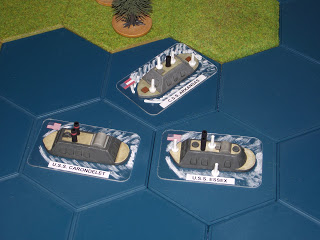
These games were fought a long time ago and reading the blog posts associated with the great scratch building effort I undertook to produce a pair of river fleets (there were over fifty ships in the collection eventually of which around a third were painted - only the ironclads for both sides) reminded me of how much fun I had actually building the ships.

I enjoy scratch building and whilst I do not profess to be a super detailed modeller producing ships for the American Civil War is not difficult. My old friend Bob Cordery has produced some really nice generic ship models and indeed, details how he made some of them in his very useful book Gridded Naval Wargames. Bob is very fond of making what he calls 'Cartoon Style' models - models that have the overall profile of the intended ship but with length shortened whilst being exaggerated in respect of height, typically with the use of Hexon tiles in mind. The big advantage of this is that whilst the 'footprint' of the model is small in relation to the height it looks better alongside the figures being used. Using the cover of Bob's book as an example these models look absolutely perfect alongside his Sudan collection.


Two of Bob Cordery's 'Cartoon Style' models shown to good effect.

I think for my planned needs I probably have too many models to consider with the Peter Pig collection - which was also true of the scratch built collection of several years ago. Dare I say it? It was a classic case of 'project creep'.

With this in mind I have taken the decision to part company with the Peter Pig collection (this time for definite!) as I want to build the models rather than use commercially available versions. It will take longer to get them into action but since I only envisage needing around a dozen models it should not be too onerous.

I have learned a lot from the original scratch building project in terms of construction techniques to know what I need to do this time around as the models will be more generic and will also be larger than the previous versions. Whereas I was modelling specific ships before this time around I shall focus more on the type being represented.

With the above in mind I have been quietly stockpiling building materials and so hope to start work once the WW2 ships have been finished.


Tuesday, 28 August 2018

A Balkan Intrigue


A selection of uniform styles for Russia and Turkey from the Crimean War to that of 1877. For my part the Russians will be wearing the kepi whilst the Turks will have the classic Zouave style uniform with a turbaned fez.

It has been a busy weekend on the domestic front but I have managed to nail a few things down in respect of my modelling and painting arrangements and also with the Balkan project.

After some internal changes concerning the man cave and our lounge I now have some dedicated storage space downstairs. By deploying my fold up table and desk lamp when needed I will be able to paint and construct models to my hearts content - without the trip and monastic retreat into the man cave when I want to do anything. The man cave will now be primarily a library and gaming room.

I have finally settled on the shape of the Balkan project and so the initial forces will be Russian, Turkish and Greek. There will be a number of Balkan irregular types thrown in to the mix that can be used as allies where required or as forces in their own right. I have yet to scope the back story in detail although I have the basic framework in place. 

The armies will be ‘based upon’ rather than detailed representations which will suffice for my needs. There will be plenty of colour for sure and the naval dimension will also have a lot to offer.

My criteria for this project are very simple - I shall be using Spencer Smith 30mm figures exclusively, the figures will be painted in an old toy soldier style which will mean gloss varnish, plain bases and block colours with no shading or highlighting and the basic organisation of the forces will based on that from Charge! For the naval side I suspect that the Portable Naval Wargame will be used or possibly something from David Manley.

The rules I envisage using are Charge! (The Victorian version), the Portable Wargame, The Men Who Would be Kings, A Gentleman’s War and possibly the Neil Thomas 19th century set for when I am feeling serious.

I am unsure about the naval dimension merely because I have not researched the fleets sufficiently but I will probably make use of what I can from the Peter Pig ACW range or else raid the Tumbling Dice 1/2400th series - mainly because they make a lot of Victorian-era ironclads. There is also the possibility of scratch building which could be fun. 

However, before all this fun and games commences I need to get back to the WW2 ships and my change of plan in respect of the destroyers for the British and Germans. With this in mind a small order will be winging its way to Navwar very shortly.

Sunday, 26 August 2018

Answering the The Eastern Question


The Greek army for the period under consideration - I rather like that very elegant looking lancer officer. I will take a look at some other sources for some closer details but reckon that the ACW kept wearing infantryman from Spencer Smith could serve quite nicely if one was not too pedantic about minor details.

OK then. You probably remember me mentioning an idea I was flirting with based on the Western Balkans and the Adriatic and set around the 1865 - 1875 period. This would involve the Greeks, Turks (via those areas that were still technically part of the Ottoman Empire) the Russians and the British - the latter as I wanted them still around occupying the Ionian islands. All of this came about as a result of my recent holiday in Corfu and seeing all the British buildings in the old fortress. The British had a governor on Corfu from 1815 until the mid 1860s when the Ionian Islands were passed over to Greece. For a variety of reasons I opted to shelve this in its intended form with the view to revisiting it at a later date.

Well, the later date has arrived via some further research into the period from the start of the Greek War of Independence until the outbreak of the Russo-Turkish War.

Over the whole period the permutations of alliances and influence was, to say the least, rather complex.

Initially the plan was to maintain Ottoman territorial integrity to ensure that Russian influence was in the area was kept honest (thus pleasing Austria). However, the notion of Greek independence had gotten a hold in the minds of many influential people across Europe and so the idea of autonomy for the region but under Ottoman suzerainty was mooted. This did not go far enough and so the French, the British and the Russians sent forces to support the Greek rebels - especially as things were going so badly following the arrival of the Turkish allies from Egypt. At this stage a concerted effort from the Turks may well have ended the Greek resistance but for the Allied naval victory at Navarino in 1827. 

The French then sent an expeditionary force to help with the subjugation of the remaining Turkish garrisons and remained around until relieved by the Bavarians when Prince Otto arrived to assume the kingship of the newly independent Greece.

The Russians went to  war with Turkey in 1828 as the Turks, in retaliation for the Russian involvement at Navarino, closed the Dardanelles strait to Russian shipping.


The Battle of Akhalzic 1828. Note the white trousered Russians and the rather nonchalant drummer!

With Greece now an independent nation and supported by both Britain and France the Russians continued to be the champion of the Slavic peoples and thi ultimately led to the war in 1877 as the Turks went from being a cause celebre to (almost) international pariahs. Britain and France (not to mention Austria) were always mindful of the Ottoman geographical situation and usually were supportive of their territorial integrity - especially where Russia was concerned.

I have thought about all the permutations of historical alliances and how this could translate into an 1865 to 1875 style set up. 

You will have no doubt noticed that at this point I have made no mention of imagi-nations. This is deliberate as I genuinely believe that the situation is this part of the world during the period under consideration was diverse enough generate sufficient interest using historical forces. However, therein lies a potential stumbling block. The forces I would consider for this will be made from Spencer Smith figures and so I am limited to an extent what can be produced. In fact it is fair to say that the armies will not be accurate representations of their historical counterparts - rather they will be ‘based upon’.  If tweaking a historical period and producing armies that are loosely modelled on their actual counterparts constitutes ‘imagi-neering’ then so be it. In any event the background is the thing and the armies (and navies) will be there or thereabouts in terms of what they look like and what would be available.

For the period in question the Spencer Smith ACW kepi wearing infantryman will be well suited for use for the Russians, the French, the Serbians and the Greeks (if one is not too fussy about the headgear). The kepi wearing cavalryman will be useful for both the Greeks and the Russians whilst the ACW Zouave will of course work for the Turk - as well as for many of the Ottoman Balkan subjects although I will need to lose the back pack. I can raid the other Spencer Smith ranges for assorted Balkan irregulars, other cavalry types and even, if needed, Bavarian infantry.

I have yet to finalise the shape this project will take and it will be very much a ‘what if’ style of set up. The troops fielded will be ‘based upon’ their historical counterparts and so in true Hollywood fashion ‘and resemblance between persons or events living or dead is purely coincidental and not intentional.’

That’s the plan anyway and so the Grand Duchy of Artois and the Electorate of Kronenbourg will appear in their 18th century guise in due course - as I always intended.

Friday, 24 August 2018

Thoughts on Imagi-nation Uniforms


A selection of French Zouaves wearing the turbaned fez. Note the 'camp follower' on the shoulders of the right hand figure!

My recent blog posts concerning imagi-nations have generated a number of comments that have given me much to think about – for which I am very grateful to those that took the time to write in.

In the interests of clarity I would like to detail what it is I am going to do and how in respect of the Spencer Smith project.

Initially I will be producing a pair of 1860/1870 armies organised as per Charge! and intended for use with a number of rules sets including A Gentleman’s War, Charge! (there is a Victorian variant on the Old School Yahoo Group as I recall), the Portable Wargame and The Men Who Would Be Kings (yes I know they are designed for Colonials but they would work well enough for what I am planning).

I was considering using the ACW figures as intended to support my 1/600th naval collection but have decided instead to follow the imagi-nation route as this will give me a lot more creative licence. The forces in question will be supported by a full back story complete with the all-important map (which will naturally feature some water for the naval side) and the essential dramatis personae.

At this stage I have not settled on the two armies yet  - whether they will appear as Kronenberg and Artois or Fezia and Rusland. The figures I will be using initially are kepi, trouser and tunic wearing ACW types and so there will be plenty of historical examples of similar uniforms to serve as inspiration. The kepi, trouser and tunic combination was a very popular style of uniform for the 1860 to 1870 period until the Prussian style came into vogue (and I am indebted to Bob Cordery for mentioning that to me). Aside from the American Civil War, uniforms of this type featured in the Italian Wars of Unification and the Pacific war amongst others which means that the standard kepi-wearing ACW infantryman is a very useful figure indeed. Fezia on the other hand, will be a little more problematic as there is but a solitary Zouave figure in the Spencer Smith range wearing a turbaned fez.

The Zouave style of uniform was again very popular for a while during the period in question and so would allow for some elements of the exotic in the armies under consideration. Should Fezia make an appearance then this fellow would serve as the rank and file for the regular army and probably as a Bashi-Bazouk style irregular alongside the Croats, Pandours and other assorted Balkan types available from Spencer Smith.


The Spencer Smith ACW Zouave - again wearing the turbaned fez


The 84th New York Zouaves from the brush of the very talented Jim Duncan 


Chronologically speaking I am approaching this toy soldier project from the wrong way round. I hope to tackle the 18th century in due course but for now the third quarter of the 19th century will hold sway. Of course there is also the small matter of the Napoleonic Wars ‘twixt the tricorne and kepi period….

....And the naval dimension....


Wednesday, 22 August 2018

Just my imagi-nation....Once again

Founded in 1664 the Electorate of Kronenbourg changed the spelling of their name in 1715 to remove any Gallic overtones.


The Grand Duchy of Artois dates from 1366 and has been bickering with Kronenberg on and off since 1700. Aside from border disputes and police style actions there has been at least three wars directly between the two sides

In my last post I mentioned about the two ‘imagi-nations’ I came up with several years ago, originally for an 18th century set up. The Electorate of Kronenberg and The Grand Duchy of Artois were inspired by Messrs Grant, Young and Lawford and took their names from two well known beers. I liked both the names but ‘Germanised’ the spelling of Kronenbourg so it looked less French. I had great fun looking up names of German and continental beers for the regiments in the army of Kronenberg and the names of wines for those of Artois. As an example the senior heavy cavalry regiment in the Kronenberg army is the Holstein Kuirassiere whilst Artois has the Cuirassiers du Chablis. You get the general idea. I also toyed with the idea of having a ‘British’ force where all the units were named after cheeses but the idea never really matured….

My own opinion is that one has to make a huge leap of faith to produce an imagi-nation to its fullest extent. By its fullest extent I mean designing uniforms and standards etc as well as the terrain and the whole back story because, let’s be honest, most imagi-nations are very much personal affairs meaning that inevitably a carefully painted unit of one’s own design will not find favour with the more serious historical fraternity – other than to admire the brushwork perhaps. You would also probably have a job selling them on should the need arise. If I am honest this had always been a problem for me as I am a notoriously slow and reluctant painter so painting something with little resale value was not something I was keen on. Churning out a unit based on a whim is all well and good as long as one is fully committed to the cause and is in it for the long haul. I am far more relaxed about this kind of thing now – I am pleasing myself primarily after all - and so ‘imagi-neering’ is a lot more viable. I suppose I am at that stage of my gaming career when the idea of ‘pleasing myself’ rather than ‘keeping up with the Joneses’ is far more important!

Messrs Young and Lawford mentioned in Charge! about the advantages of using mythical armies and of being able to design one’s own uniforms and standards etc. I have no problem with this and have even worked on the basic colours used for each side. The end result will not surprise you in that the main coat colour for Kronenberg infantry is dark blue whilst those of Artois are mid to light grey. Regimental facings would be applied to the usual places – turnbacks, cuffs etc and the cavalry would usually be more colourful and not follow the uniform conventions of their foot compatriots.

For the 18th century I would opt to use the Spencer Smith War of the Austrian Succession range rather than the later and more traditional figures seen in The Wargame. I would do this simply because the choice is far better and more complete than the original eighteenth century range and the figures lend themselves to an easier paint job.

There is also the possibility of pitting the two opponents in later years so it would be possible to raise Napoleonic forces – again, Spencer Smith have a small Napoleonic range - and then the same for the third quarter of the 19th century – naturally with a naval dimension adding to the fun. Producing pairs of armies for three different periods is obviously a long term project but it would enable different types of games to be fought as tactics and technology evolved. One could ensure a degree of continuity between the combatants and their units which helps to flesh out the story.

For me at the present time the great debate is whether to go historical or imagi-nation for my Spencer Smith project and if the latter will Kronenbourg and Artois see the light of day or will those old adversaries Fezia and Rusland cross swords once again?

I have time to think about this and so am not going to make any hasty decisions – I have done this far too many times in the past and have lived to regret it – as I have a number of supporting ideas to consider as well.

Tuesday, 21 August 2018

Charging into Battle via The Wargame


From the Spencer Smith Miniatures website. 

My previous post generated a some very thought provoking comments for which I am, as ever, very appreciative of. Those stalwarts of the wargaming blogosphere Archduke Piccolo and Ross Macfarlane and several others have given me much food for thought over both Charge! and The Wargame and the impact both have had (and continue to do so) on the wargames world in general.

The idea of fighting battles using the rules from either Charge! or The Wargame with 1/600th scale figures on the face of it seems slightly left field for sure but I believe it is doable. Whether or not I do it is another matter entirely but the idea has certainly put a 'burr under my saddle' so to speak! I think that the biggest challenge is representing a unit by a single base of figures rather than by using individual models. A roster would seem to be essential for this but there is also the thorny question of representing various formations on the table top - the inevitable column, line and square etc. One could produce bases for each unit in the required formation but this would add to the amount required and the time to paint, not to  mention storage and cost. Like I say though, it is doable and I am sure that someone will find a way!

On a more practical level I have mentioned in a couple of previous posts that I am shall be embarking upon a modest old toy soldier Spencer Smith based set up. It will be quite low key and the unit organisations will be modelled on Charge/The Wargame and so each side will consist of an infantry regiment of 48 rank and file plus officers etc, a cavalry squadron of 8 troopers and an officer and an artillery battery of two guns and crews plus command. I will also furnish a commander for the force with perhaps and ADC and an escort. the figures will be individually based (I suspect that movement trays will make an appearance though!).

The figures I will be working with initially will probably be for the ACW although the thought of imagi-nationing them is a very tempting one - originally this was the plan for the Western Balkans project with ACW kepi wearing infantry doubling as 1870's Russians. As it stands at present the ACW troops will probably be used as is and so my fondness for Kurz and Allison prints may at last find a 3D outlet!

Mention of imagi-nations (and let's face it, I have done so on more than one occasion!) reminded me of a pair of protagonists I came up with many years ago inspired (unsurprisingly) by the two combatants that Charles Grant used to maintain. My two forces went under the names of the Electorate of Kronenbourg (spelt Kronenberg as this was more 'Germanic' looking) and the Grand Duchy of Artois. As you will have guessed these are German and French based. I also stipulated that all of the Artois units were named after wines whilst the Kronenberg versions used beer as their inspiration. I still have the unit names for both sides in a notebook.

I actually did a lot of other work for this in that I drew up a map with the principal cities and forts (not to mention ports and harbours) for both sides and had even started on the dramatis personae to add to the background. I even got as far as looking at both protagonists at different times so the potential for a Napoleonic version and a late 19th century (well pre 1870 in any event) set was also considered. If you recall I also planned the same for Fezia and Rusland. There was also going to be a naval dimension.

It is no secret that I am a huge fan of both Charge! and The Wargame (and also Battle: Practical Wargaming) and so revisiting them as often as I have has given me not only a huge amount of satisfaction and pleasure but has also made me realise an inescapable truth. I am still thrilled and inspired by their writing and the imagery they conjure up. So why shouldn’t I use them for my wargames?

Seriously though, it may be thought by some that I am stuck in some kind of wargaming time warp and so have ignored the last forty odd years of wargames developments. In response to this I can only offer the following. I have used many different sets over the years for many different periods of military history – some good, great even – some bad and some truly dreadful. With a couple of honourable exceptions most of these have disappeared ignominiously back onto the book shelf or, more usually, have been sold or given away. As I keep coming back to certain periods of military history so I keep coming back to certain rules sets. If I am honest the catalyst for this line of thinking probably goes back to when I took part in the refight of Leipzig 1813 using Little Wars (complete with firing cannon and party poppers) last year. A set of wargames rules over a hundred years old gave me one of the greatest days of wargaming I have ever had the good fortune to take part in.


Charge! and The Wargame are not perfect by any means (show me a set of rules that is!) but for entertainment value they are a hard act to follow – so why should I try to? 

Whether I opt for historical or imagi-nation forces for my Spencer Smith project has yet to be finalised but I take comfort in knowing that whatever path I decide to follow for this particular endeavour it will be fun. Surely that is the whole point of it?


Friday, 17 August 2018

Granting a Wargames Wish....


Part of the Eric Knowles book collection passed over to me by Bill, his son.

Way back in May of this year I was surprised and delighted to receive a number of wargames books from Bill Knowles from the collection of his father, Eric. Aside from cleaning them up a little and glancing through them I must confess that they have sat on the bookshelf patiently waiting for me to do something with them. A couple of weeks ago I moved Grant's The Wargame down from the loft onto the single shelf I am allowed in the lounge for books (Laurel has very minimalistic tastes in decor and does not really like seeing lots of books lying around....) where it sits in pride of place next to Charge! and Battle: Practical Wargaming - a holy trinity if you like.

I should point out that my copy of Charge is not the one you see above but another softback version produced by (I believe) Ken Trotman (I stand to be corrected on this) that features coloured covers rather than black and white. I want to get a hardback version at some point but that is another story.

Anyway, to cut a long story short I decided to revisit The Wargame as although I have had a copy of Charge! in the collection for years (and have frequently 'dipped into' it for light relief, nostalgia and inspiration) The Wargame has always eluded me. It has been nigh on thirty years since I read this and so I figured it was high time I did so once again.

Needless to say I was very pleased that I did.

I had forgotten how logical Grant was in how he drew up his rules. They seem to be in marked contrast to the efforts of Messrs. Young and Lawford and I found myself wondering how they managed to game together so successfully for so long! I have said before that Grant's rules and approach provide a more, dare I say it, scientific game than Young and Lawfords. Both are enormous fun and I have used both on occasion and they complement each other very nicely indeed.

I was quite taken by a comment in the foreword by Brigadier Peter Young in that he says that "They (Charge! and The Wargame) differ also in a more important aspect. The latter are based on Napoleonic warfare while the Grant rules rest on a study of the wars of Frederick the Great. In fact either set will, with slight modification, serve for any period from the Thirty Years war to the American Civil War." I always thought that charge was firmly rooted in the third quarter of the 18th century.

I have fought actions using both Charge! and The Wargame sized units which is again a lot of fun albeit an expensive proposition these days.

It suddenly occurred to me though that there is a mad but viable alternative to huge armies of 28mm figures to game a la Grant/Young/Lawford.

Yup, you've guessed it - 1/600th!

Another chance to look at Scott MacPhee's quite delightful 1/600th scale French Napoleonics.

Now I know on the face of it this would seem slightly north of bonkers but it is not such a mad idea. Taking the infantry formation seen above one could readily deploy an infantry regiment with the command in its proper place on a single base. Movement distances, ranges, measuring devices could be scaled down accordingly and the only real issue would be the removal of casualties - this could be readily handled via a roster sheet. I am sure there are a few other rules wrinkles that would ned to be ironed out but as a concept I think it has some mileage.

I shall give this some further thought and who knows? The Electorate of Kronenbourg and the Grand Duchy of Artois may yet see the light of day....