Thursday, 13 December 2018

Military Map Symbols and the Changing of the Block

An example of NATO style military map symbols. The basic system is very flexible and allows for designing custom units as required.


A simpler guide produced by the Armchair General

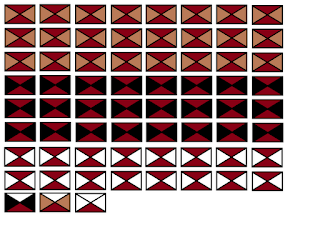
Originally my block collection was going to be limited solely to the traditional horse and musket period - roughly 1700 to 1900. As a result my blocks were quite simple in design as the units to be represented were confined to horse, foot and guns. I borrowed the design for what I use as a command block from David Chandler's book the Campaigns of Napoleon. The sole customisation I have used for the original set is to differentiate between 'heavy' and 'light' types by the addition of a black or white band across the bottom edge of the block label when viewed from above. If I am honest I am now thinking that I did not really need to do this as leaving the blocks as per their original design an element of the fog of war is introduced as the opposition will not know what troops they are facing unless they recce or attack the unit in question. 


The block in the top left corner is my default command block based on The Campaigns of Napoleon by David Chandler. The mortar and machine gun block (middle row left and centre) will need changing slightly and the armour block (bottom left) will have the track symbol flattened out slightly.

Where the issue gets a little more complex is when you get to the modern period. The bewildering variety of troop types that make up a modern army - and by modern I mean from WW2 onwards - means that a lot more labels will be needed. For my own collection I have cheated slightly in that I have not created a label for every troop type. A unit of armoured infantry for example would be represented by three blocks - two normal infantry and an armour block. Similarly a tank destroyer or a self propelled artillery unit would consist of an anti tank gun or artillery block deployed with an armour block. This works reasonably well but as I am looking to expand the blocks on a more systemic basis I will need to incorporate newer types on a more formal basis.

At this stage the first order of business will be to identify where the gaps are in the existing collection are and then to set about designing the new labels. There are also some existing types that will need modifying in order to align them to the style I shall be using going forward.

I have sets of blocks in six colours with the brown, grey and olive set being primarily for the modern era although the grey set also serves as Confederates for the ACW. My plan is to expand these three colours to better reflect the modern era whilst the red, green and blue sets will have those modern blocks reused. In effect I will have what I like to call a mechanised set of blocks and also a horse and musket set with the latter also being useful for earlier periods.


Wednesday, 12 December 2018

Being Purely Representational....


The main types of block I currently use. These will be expanded by some additional types, primarily for the modern period.

There is a throwaway comment that is frequently used by the denizens of SEEMS which has assumed almost cult-like status. Describing something on the gaming table as being "purely representational" and delivered whilst dripping in irony, usually occurs at least once per game in my experience and it is guaranteed to generate rolled eyes and a modest chuckle or two. It is however, an expression that has within our wargaming world a far deeper significance than being a mere jest.

As wargamers we routinely represent military formations with 'x' number of models or figures. These are linked with whatever rule set is in use and so there is usually a figure scale so that a single model soldier will represent an certain number of their historical counterparts. This can vary hugely from 1:1  for a skirmish game up to, well, any number you like really. For the purposes of this post let us work on the basis of around 1:25. A 600 man battalion will be represented then by 24 model soldiers. Multiply that by a dozen and you have a representation of a good sized division with usually some cavalry and artillery to taste.

Once assembled, and in the company of a like minded acquaintance the models are deployed on a table top with some items of terrain and battle is joined. A few hours later a decision or 'life' intervenes, the models and terrain are packed away and the game discussed over a cup of tea or something stronger.

So what has taken place? A game of war for sure, but what exactly was being represented? In this rather obvious case, a divisional level battle. At this point I feel obliged to ask - how many gamers know of any 'pure' divisional level battles fought during the horse and musket period? I intended this as a rhetorical question and for what it is worth I have absolutely no idea what the answer is although I am sure that there were some!

We could take the above battle further in that player A and B called their respective forces 'armies' and so the dozen battalions could be viewed as representing larger components than the number of figures would indicate. How many of us I wonder, have said "Right, those two battalions represent the brigade/division of General 'X'? Quite a few I reckon.

Straightaway this perfectly natural solution to the eternal problem of space and enough figures has the effect of skewing anything that approximates to a ground or figure scale. But the units mentioned in the previous paragraph will still look like two twenty four figure units - or in other words will still be purely representational!

The point I am trying to get to here is that using model soldiers to fight wargames is absolutely fine but let us not kid ourselves that by doing so we are accurately representing the art of war in miniature. What we are doing is playing a game based on our understanding of war that is in effect a kind of movable diorama or, dare I say it, something that is purely representational. I am as guilty as the next person for doing this and will continue to do so because, quite simply, as a hobby, a game of war using model soldiers is, to quote Messrs. Young and Lawford, "....a magnificent indoor sport."

However, for the grand scale of what I want to represent using figures is not the solution I am looking for.

It will probably some as no surprise as to what I am going to mention next. That's right. Blocks - or as my good friend Mr Fox once drily observed, "A load of Blocks...."

An earlier version of modern vehicle labels available in three colours. I was pleased with the way the drawings came out but opted instead to stick with military symbols.

My fondness for using wooden blocks featuring labels using common military map symbols is well known but I want to point out the advantages of using them, practical and otherwise.

As students of military history looking at maps of great battles and campaigns are almost obligatory. A well drawn map that is clear and ably supported by a relevant narrative can really serve to place the gamer in the shoes of the commander in question. The flip side of this is where the map is poor and the narrative is vague - and I feel quite sure that any reader of this blog will have experienced both extremes during their own research into their own particular period of interest!

The symbols employed on most maps are fairly standard and the core types mainly originated during the 19th century and were 'formalised' by the US during the Great War. The saltire in a rectangle  represents the cross belts of an infantryman; the diagonal line represents the sabre belt of the cavalryman whilst the single round spot is the muzzle of a cannon. These are the standard types and of course these can be expanded upon within the same generic type to represent specialists. The one thing they do not represent though, at least in the way I have fashioned my own collection, is the size of the formation the block represents.

The most usual way to indicate the size of formation represented by a single symbol drawn on a map is to add a series of crosses onto the leading or top edge of the unit. The number of crosses represents the level of formation so, for example, a single cross may refer to a battalion, two crosses a brigade and so on. The key thing is with this method is the importance of having a guide to the sizes of the formations being represented so most books that feature military maps will routinely have a legend explaining what means what.

For my own purposes and, it must be said, quite by accident the block collection I have built can be used for any scale of formation by the simple expedient of recording on a roster what the level the formation represents. So three infantry blocks would be equally at home being used as platoons or anything up to a corps, obviously with the appropriate additional blocks for support types - cavalry and artillery for example.

The end result of this is that I can use them for any size of action - with no loss of visual effect - by merely adjusting the emphasis of the rules and terrain being used - a couple of buildings at platoon level represents just that whilst further up the hierarchy a single building may represent an entire town or even city (actually this raises a similar problem to using figures but that is for another post!).


Another early block battle and for some reason I never saved this to the Games folder. This was fought on November the 11th 2011 and featured those old combatants Fezia and Rusland

I have demonstrated to my satisfaction that the use of blocks to fight wargames is a viable alternative to using figures and indeed there are certainly a number of practical advantages. To begin with making a couple of sets is a very simple undertaking. Storage is very easy and the size of the blocks is such that scenery from 15mm downwards can be readily used. This point is very important as it means that a 6ft by 4ft table can represent a good sized area to fight over when running a large scale or army level game. Finally, by careful choice of colour schemes one can use block armies for a variety of periods and as a good example of this my red set can and has been used for actions fought across the entire time span that the British army wore the redcoat. I should also add the point that the use of blocks have a long and distinguished history when used for wargames from Kriegspiel onward.

I enjoy the flexibility that using the blocks gives me and when used with 3D terrain it really brings a gaming battlefield to life but in order to make the most of them there needs to be disciplined approach. As mentioned earlier any supporting narrative needs to be clear so that the action is more readily understandable. It also means that easy unit identification is important - more so as unlike with figures you cannot rely on looking at the facing colours or standards of a block to see who they are.

I shall be developing the block armies over the next year to take the collection to the next level. It will mean changing some and producing newer types as well as addressing the unit identification issue. I shall be fighting both on and off a grid based playing surface and at all levels from platoon actions up to army level battles. It also  means that I shall be looking long and hard at rule systems to support this evolving project, both from existing sets and from my own efforts.

I was mildly surprised to read the answer below I posted in response to a blog comment from 09/12/13 - just over five years ago.

"Many thanks for your kind words - they are much appreciated. I must confess that the visual success of the blocks I am using has really made think long and hard about whether or not I need to use figures ever again! The designs I have used have evolved over time and the biggest difficulty I experienced was whether or not to use images of the troops or the military symbols. I am so pleased that I stuck with the latter as it seems to add to the flexibility of the collection - which is an important consideration for one who has such wide-ranging interests!"

Prophetic words indeed!

It will probably come as no surprise to learn that I am currently undertaking the ground work to produce a book on wargaming using blocks and other alternatives to figures and this will be the big project for next year.

From the figures perspective my efforts will be directed at the Kurz and Allison Spencer Smith ACW project with the two forces based on the organisation featured in Charge! by the aforementioned Messrs. Young and Lawford. I am looking forward to this as it is being undertaken with a specific look and aim in mind. I have not abandoned using figures by any means but for the most part what I want to do I can tackle far more easily using blocks. After all, one has to maintain one's hobby safely in the actual purely representational figure world rather than relying on the exclusively purely representational block world.


Monday, 10 December 2018

The Weekly Sitrep....Number 6

It was a fairly quiet week for me with a lot of gaming related stuff going on 'behind the scenes' so to speak. I have a couple of pretty exciting things on the go that will be revealed in due course once details have been finalised. Suffice it to say that blocks are involved in some way as is the collection of Eric Knowles. I will also throw in Warlord Games Cruel Seas just for the sheer hell of it!


6cm squares and cost me £1 as I recall. the only thing I have done with it is to glue a corner of one of the squares that had lifted slightly. I like the colours used as they will suit the desert quite nicely.

One of the things I have been looking at long and hard is the homemade chess board I picked up from a boot sale some time ago. the squares are 6cm across which makes it very handy for use for the Portable Wargame with smaller scale models or, in my case, the block armies. I have plenty of terrain I can use with this although I will need to make some hills which I may tackle over the Christmas break.

The biggest news for me this week can be found over at the blog of Bob Cordery. I am really excited about this and am looking forward to when the book will be published. With all of Bob's Portable Wargame series - there will be more to come in the future as well - the big advantage is that the rules have a common core system that seems to take any amount of tinkering and still work. Ironically I am looking at the Portable Napoleonic Wargame for pretty much anything other than the wars of the Corsican Ogre with the ACW being at the forefront for the Kurz and Allison project.

It may not have escaped your notice that mention of the 1:4800th WW2 North Atlantic has been conspicuous by its absence recently. this is intentional and for reasons that will come to light in due course.

In the meantime though here are a few pictures of the WW2 collection of Eric Knowles featuring 1940 Belgians in 20mm.


This is just the support stuff - the infantry are still in their boxes. Bill has mentioned that Eric's WW2 collection is probably as large as his 18th century set up, if not larger....


Thursday, 6 December 2018

Topside Minis


My free sample - a 1:1800th scale WW1 German Light Cruiser - SMS Konigsberg

A short while ago I saw an advert for a company called Topside Minis based in the US. After a quick browse of their website I took advantage of their offer to order a free sample so I could see what they are like. Essentially they produce full colour topside views of warships from the Russo Japanese Wars through to WW2. Their range includes ships, aircraft and more recently targets. The images are full colour with the name of the type being represented with its date of launch, the class and also the ensign of the nationality in question. The images are printed on heavy vinyl like self-adhesive paper with the vessels scales at 1:1800th or 1:2400th/1:3000th (the latter smaller sizes being for WW1 only at present). Aircraft are scaled at 1:600th.

The owners of the company are long time fans of Axis and Allies: War at Sea, the miniatures games that used 1:1800th scale ship models hence the range being initially confined to that scale.


Some size comparisons taken from the company website.

There are a couple of things to bear in mind with these. For WW1 it is possible to order 'flotilla' bases for destroyers so a base will have four or so ships (with their names/numbers) on it - very handy when thinking about Jutland for example. Similarly for aircraft one can get individual planes or pairs depending on personal choice. The only thing I would find a little strange to deal with is that the picture, text and ensign are not in the same place I would have them and the ship is facing the other way to my usual standard! A very minor point to be sure because without a doubt these are lovely.

I have to say that I am very impressed at the quality of these and for the price I think they are a great alternative to using models. All one has to do is to cut them out and fix them to a base. These can be ordered from the company but given the numbers required would make shipping from the US very expensive. I am sure though a quick email to those very nice people at Warbases would solve the basing issue.

So, blocks for land wargames and effectively counters for naval games - whatever next?


Irregular, Tribal or Native Blocks


Ottoman Turkish Janissaries - note the overall colour scheme for the troops firing - white headgear, blue coat and red leggings.

Back in my block building heyday I took the conscious decision to produce a range of blocks for Irregular, Tribal or Native types, primarily for use in Colonial style games. Indeed, I fought a couple of Zulu war actions using them as well as some actions set set in the Roghan Valley (a fictional North West Frontier set up) and even one from the Arab Revolt set in 1917. These blocks were also used for Indians during the French and Indian War. I used standard military symbols but adopted a colour scheme that could pass as the troop types being represented. For reasons that seemed like a good idea at the time I also produced a number of blocks that I intended to use as, of all things, Ottoman Turkish Janissaries.

The blocks I came up with look something like this:

The above blocks are used for generic African tribesmen - the right and left quadrants represent the main shield colour when being used as Zulus so the white works for married regiments and the black for the youngest unmarried types. The three blocks at the bottom are used for commanders.


The above units are designed to represent various 'turban wearing' types - typically Afghan or Arab tribesmen with the white quadrant representing the headgear. Note that each tribal grouping also has an associated mounted arm and command. I opted for black for the mounted as these are largely irregulars. Also, if needs be, I can use them as camelry with ordinary cavalry blocks from my brown, grey and khaki set used as horseman. The red, white and blue blocks represent the Janissaries.

I may well have to add to these to allow for heavy or light types so that they are aligned with the more conventional block armies by adding the black or white band to the basic blocks depicted. I could also use some additional command blocks. These will also have to borne in mind when I produce unit flags as well.

I am sure I had a specific idea in mind when I drew up the Ottoman Turkish Janissaries but for the life of me I cannot remember what but having said that it has served to remind me that I do not have a white set of blocks for use as Austrians.

Something else for the 'to do' list then!


Wednesday, 5 December 2018

Building Blocks and Big Battles


The classic block wargame of Kriegspiel being used for a rather well known battle....

The great block extravaganza continues and so I spent some time this weekend experimenting with various methods of incorporating flag bases. I will post the details in due course but the early ideas were very encouraging. I think I have found a method that works so the non-grid block armies will be in use hopefully sooner rather than later.

I am rather excited about using the blocks on a normal playing surface and so I have been thinking about rules. This may seem a little odd but given that all my gaming with the block armies thus far has been grid based you can see why this needs some thought. With the grid games I enjoy – mostly Command and Colours or Portable Wargame inspired – I am tempted in the short term to simply convert these into inches and see how they work out. It is rather embarrassing to admit that I have been so grid facing in respect of my wargames of late that I have gotten out of the habit of using a ruler!

In respect of rules my plan is something startlingly original and, if I am honest, is what I had always intended to do with the block armies when I first decided to make them. I am going to design a generic set of horse and musket rules for games using them.  I have opted for two half blocks per unit for infantry and cavalry mainly because my collection is organised this way so that different formations can be easily represented – the typical column (march and attack), line and square – and the facing of the unit can be shown by the physical location of the yet-to-be-seen unit flag block. Artillery and command will use a half block in the normal way. This means that a typical infantry or cavalry unit deployed in line will cover around 75mm by 20mm. The figure equivalents would probably be 6/10/12mm and so the scenery will scaled thereabouts.

The main criteria for the rules is that they should fit on two sides of A4 at a maximum. All measurements will be in inches and the only dice in use with be our old friend the D6. I am torn between using a roster or marking the blocks in some way for any hits scored. The former has the advantage of preserving the ‘fog of war’ so the opposition will not know what they are up against until they are engage with the unit in question. In truth this will probably be the option I use although the latter has the advantage of being 'in plain sight'. At this stage the definition of a unit will be fairly flexible as it my intention that the scale should be able to move and down as required by the action being fought. In this respect using blocks is certainly advantageous as, for example, a 24 figure unit will look like a 24 figure unit whatever scale of action one is choosing to fight. The abstract and indeterminate nature of the block is its greatest strength as evidenced by the way that they are used in military maps – the standard symbols I have chosen for my blocks can represent any formation from a platoon to an entire army.


Believe it or not but this was fought six years ago between Bob Cordery and myself in the man cave.  The game was based loosely on the Russian attack on the Grivitsa Redoubt during the Siege of Plevna in 1877. We used a version of Bob's 'Memoir of Battle' rules that were based on the Richard Borg designed Command and Colours game Battle Cry by Avalon Hill. The Hexon has gone and the book cases have moved walls since then but it is still my 'inner sanctum'.

An alternative to starting a rule set from scratch would obviously be to make use of any number of existing sets or to adapt for use 'off the grid' some tried and tested rules - namely the Portable Wargame or any of the MoB or MoMBAT series by Bob Cordery.

The key thing for me this time around with the blocks is ensuring that the action being fought has an obvious identity which is why I am taking some time to get the flag issue right. This will help immeasurably in showing the personality of the army being represented which in turn will be reflected far better in the supporting narrative.

This will of course mean the return of the purple prose....

Sunday, 2 December 2018

The Weekly Sitrep....Number 5

Quite a big Sitrep this week - mainly due to the pictures content - but there is sufficient material for a few other posts in due course so think of this as being a taster of what is to come!


The magazine and both of the sprues - one S Boat and one Vosper

Last Friday saw the arrival of the December edition of Wargames Illustrated which featured an introduction to Warlord Games Cruel Seas - the table top game of coastal naval battles set in WW2. On the cover was a sprue of either the German S Boat or the British Vosper. In each case there was two models  - an early and a late war version. These are scaled at 1:300th which personally I do not have an issue with but then again I do not have huge collection of 1:600th scale models that seems to be the preferred scale for this type of action. The plastic models look rather nice and there are a number of weapon options that can be explored. At first viewing my only reservation concerns the masts for the Vosper as they seem very thick. Of the six copies that my local WH Smith had only one was a Vosper with the remaining five being S Boats. The packaging was not kind to the Germans as I managed to get the only copy that was unscathed. I am looking forward to seeing the game - more of which in a later post.


In all their glory - the entire block collection. There are eleven boxes in total and each compartment holds 6 blocks. I also have roughly the same amount again so going ‘super sized’ would not really be a problem....


The blue and the grey. ‘Heavy’ types are on the left (with the black band) and ‘Light’ are on the right.


Red and Brown or simply put, the changing colours of the British army


Green and Khaki drill


The top box contains my tribal types with the predominantly brown blocks being used for Zulus, Masai or similar. The blocks with the white top quadrant I tend to use for Arabs, Afghans, Mahdists or similar. The blocks with blue and red are, believe it or not, Janissaries. There is some artillery in evidence. The bottom box shows the transport, armour, anti tank guns, machine guns and mortars. For the grey, brown and khaki sets there is a box full of these types as they are for 20th century armies whereas the others are traditional horse and musket types.

The block armies have been dominating my time this week and as a result of email exchanges with Andy Callan I have made a number of decisions about my collection and how it can be taken forward to the next level so to speak. Again, there will be more about this in a later post but for the present I thought it might be a nice idea to show you just what the collection looks like.

I have also had some contact with Bill Knowles in respect of the sorting out of Eric’s collection. Bill was bombarding me with a lot of pictures of various parts of the painted 18th century collection (actually more 1680 to 1740 if truth be told) that was gradually being sorted out. The main bulk of it appears to be Les Higgins although there are certainly some Minifigs in evidence. Eric was fond of the whole ‘supporting cast’ for his armies so baggage wagons, sappers and miners and the inevitable siege train usually featured. This is very much the tip of the tip of the proverbial iceberg so I shall look forward to posting further pictures as and when they are available. I have also asked Bill to take some army shots for each force once they have been reunited from their boxes.

Bill also has ten 32 litre storage boxes filled with unpainted 28mm metal figures for the 1680 to 1740 period organised into units and armies which I will be helping him to sort out and dispose of in due course. Then there is the WW2 material, not to mention the 1:1200th ships and a fairly extensive library. As I have said before, this will be a massive task and as Bill rightly pointed out, there is a lot of memories in this collection. He uncovered all the terrain that was used for Eric’s epic refight of the siege of Vienna in 1683 - which Neil Fox, Chris Hardman and myself took part in. I will try and get some pictures of this from Bill in due course.

The following are a selection of pictures of part of the collection of Eric Knowles. Many thanks to his son, Bill for taking these and allowing me to share them.


Bill pointed out that some of these figures are probably older than he is!