Showing posts with label Madasahatta. Show all posts

Saturday, 17 May 2025

A Colonial Conundrum of Sorts


Basing sorted - infantry will be in 3s or 2s for dedicated skirmishers (30mm x 15mm), cavalry and artillery on a 30mm square - a gun and two crew or two riders and 15mm square bases for foot single figures, commanders and so on. Mounted commanders will be on 30mm x 15mm bases. The order is already in with Warbases! The Post It note was used to measure out the sizes I needed and how the figures looked - as Mike’s Models are on the diminutive size the 30mm frontage is ideal.

I spent some time yesterday evening sorting through the 15mm Mike’s Models colonial collection and planning the next steps. Now that the cold light of reality has set in I find myself looking in various directions as to what to do with the disparate elements of the whole. Summing up the situation would be a good start so this is what I have been pondering.


The three line infantry standard bearer groups - far too nice to be ignored in my opinion, redcoats and standards flying proudly!

1. There is a lot of British - in pre and post Khaki (more of the former). The redcoats consist of a 12 figure unit of highland infantry (in trews) and there are a further 12 infantry with yellow facings, 7 with green and 8 with a tan/buff colour. There are also 16 in rifle green but 5 of these have white helmets whilst the others have a tan colour. 


The sole tribal figure in the collection - a solitary Zulu warrior


2. NO OPPOSITION! No Zulus or Mahdists and only a representational two units of Egyptian/Sudanese and one Boer. I have a had a change of heart about this as I had originally planned to muddle through with some paint job improvisations but now the stakes have been elevated somewhat. I plan to add a Zulu force as historical opposition for the Redcoats. They will be simple to paint which means they an be table ready relatively quickly. The only other thing I need to address is the shortage of artillery for the British - a point I mentioned previously and is now even more pressing!

3. The Plan(s). I am still fleshing out the back story for Madasahatta 1880 but suffice it to say it will enable me to indulge in a relative smorgasbord of types for the German/Turkish force. Along with the white coated Egyptians, Sudanese Askaris and Boers I would need to add some German Schutztruppen and possibly a naval landing party, not to mention a couple of warships. That is one option. The next and possibly more immediate option would be to acquire and paint up Zulus or similar. I am not looking at the Sudan at this stage although certainly there is the raw material to do so from the British side - both for the earlier Khartoum period and the later Omdurman one. The final option, and this is one that is rather left field, I could raise some Martians for some VSF action. 

I have plenty to think about with this collection but for now the priority will be to get them rebased and refurbished and with a rather more representative artillery set up

Conundrums of sorts but nice ones to have all the same!


Thursday, 15 May 2025

The Anglo-Turkish War of 1880 and Madasahatta


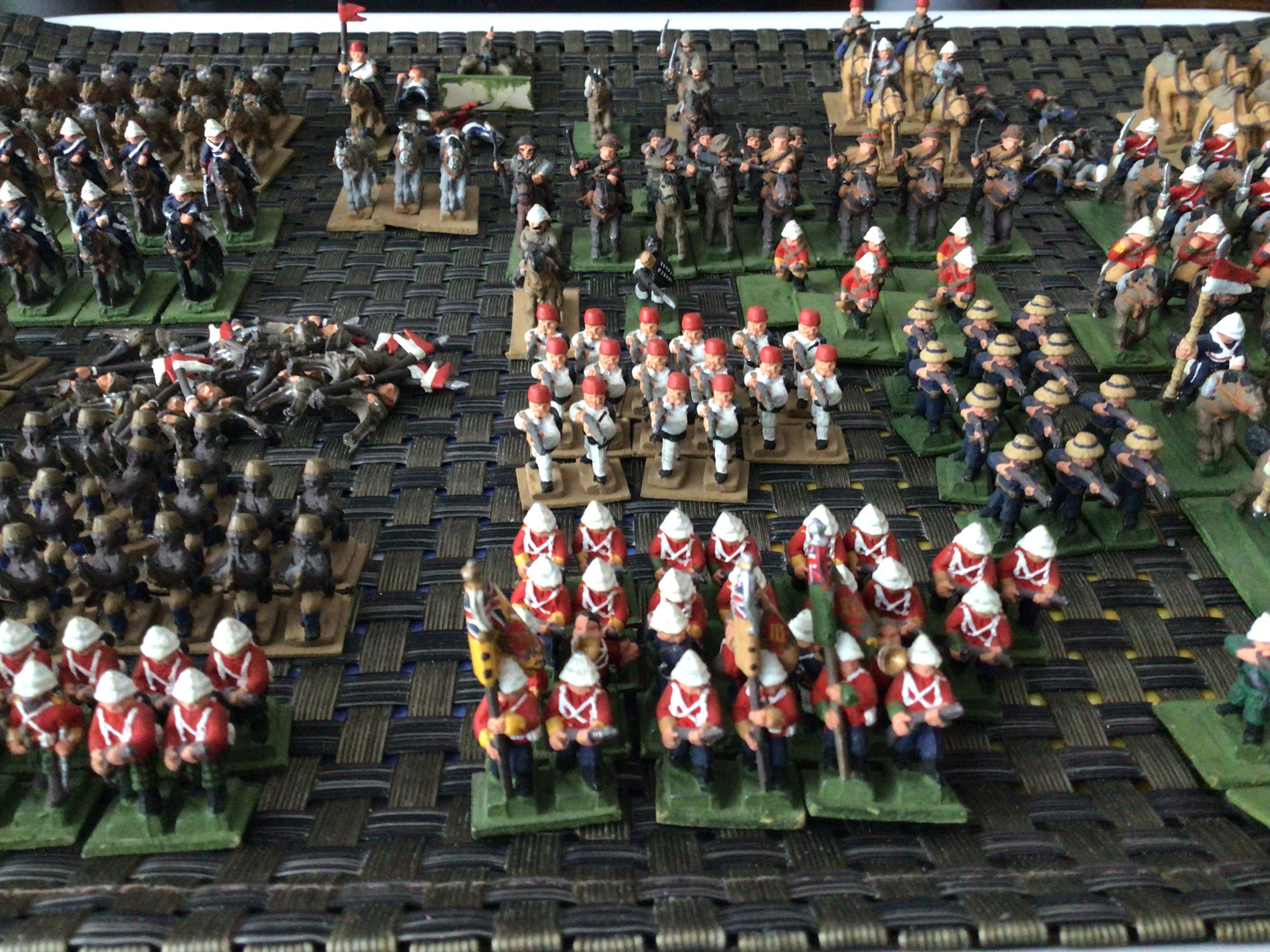
15mm Mike’s Models Colonials. Sudan British for 1882/85 and the later Omdurman period. Camels, rifles and a naval landing party. Egyptian infantry, cavalry and camelry along with Sudanese Askaris (I think). A single artillery piece and a Gatling gun along with a small Boer contingent.

The Anglo-Turkish War of 1880 was originally an idea I had in order to get some later ‘blue water’ ironclads built. My plan was to fight a battle between the two opposing fleets for inclusion in Developing The Portable Ironclads Wargame - the addition of ‘The American Civil War’ to the title came about when it decided that  the between the two books the focus was primarily on the war between the states. A fictional conflict felt a little out of place surrounded by ships and battles of the American Civil War - despite the ‘what if’ nature of many of the combats I fought! 

The ironclads for the Royal Navy and the Ottoman Turks are still under constriction - they have been started but thus far only the hulls have been prepared - but for now will have to wait to get finished because of a fairly exciting development. The development that I am talking is my acquisition of a selection of painted 15mm Colonial figures - British, Egyptian, Boer and Askari types - produced by Mike’s Models. I will let the pictures do the talking.

British infantry followed by what looks like a Zulu War era volunteer mounted rifle unit(?) - I do not know the period well enough to comment.


More British followed by the Egyptians and Sudanese (on the left) and the Boers in the rear.


Rifles, British cavalry, mounted infantry and the artillery park.

The collection is by no means complete but there is more than enough to form the basis of a good 1880 set up featuring the British Army along with a smattering of Egyptian and Boer opposition. For organisation the available types would be ideally suited to something akin to Bob Cordery’s Portable Colonial Wargame meaning three figure infantry bases, two figures cavalry and skirmishers and for artillery/mgs a gun and two crew. There is a distinct shortage of artillery so I will need to raid Irregular Miniatures to bolster this arm.

The first order of business will be some tidying up of the figures - a lot of the riders have become unhorsed - in respect of the paint job. I am not planning on any extensive repaints but there are a few chips here and there. The painting technique is very old school and would be easy enough to replicate - even for me! There is also the rebasing - luckily these are on cardboard bases so that should not be difficult to do. I shall also give them a coat of satin varnish just to freshen them up but other than that there will be little to do. 

The Siren Lure of Madasahatta….

So how does this all tie in with Madasahatta? Well, it doesn’t, at least not yet but that is where my thoughts are heading. The problem is changing the back story of the island to accommodate forces for 1880. Madasahatta as we know it only really came to prominence in 1891 with the discovery of gold in the Bloeminstip mountains. The Germans moved in first and established Hansaland followed by the British two years later with New Surrey. The border between the two colonies, running along the centreline of the Bloeminstip Mountains, was set in the Treaty of Badlikortout agreed in 1898. Taking the history of the island back to 1880 changes things a little so I will need to get my head around a feasible prequel. I have an idea about this but need to flesh it out first. I will say no more than other than it was a good job that there featured an Arab Concession centred on Port Maleesh!

Once the figures have been repurposed and reorganised, and the ships built, the plan is to make use of Eric’s marvellous creation once again - either through the Portable Colonial Wargame or possibly even Dominion of the Spear and Bayonet.

I am delighted to have secured this little lot as it will save me a heap of time getting the collection to the tabletop and enjoying these vintage warriors.

Wednesday, 21 August 2024

Madasahatta Meandering and Arabian Activity


A smattering of inspirational reading material for my ‘no so latest’ flight of fancy!

This is not really a new post as such - more like a ‘the story so far’ kind of thing! If you look through the Madasahatta folder you will see a number of ideas I have bounced around over the years - mainly from the naval side and incorporating Madasahatta, East Africa and the Red Sea/Arabian peninsula. Originally I worked on the basis that the German East Asia squadron - centred on the armoured cruisers Scharnhorst and Gneisenau - headed west rather than east, to be based on Madasahatta. In fact I have acquired the models for this in 1:2400th from Tumbling Dice. 

Fast forward to today and with the Lake Tanganyika project in full flow - serious painting starts today - I am now looking to revisit the earlier idea, albeit on a smaller scale. 

Previously I had included the Goeben and Breslau, a brace of ‘I’ class Royal Navy battlecruisers, HMS Triumph and Swiftsure and a random selection of assorted obsolete cruisers etc. Looking at this from the perspective of building the models myself the project itself now will be at a lower level. There will be a degree of fudging in terms of the ships involved but being as this is designed firmly with Steamer Wars or similar in mind, that will be no bad thing. As it stands the largest ship that will appear will probably be the odd predreadnought battleship so no battlecruisers. 

As it stands the list of models to build is surprisingly small but overall there will be more work involved in the construction of them. As far as possible I will use what bits and pieces I have from stock but there will certainly need to be some bespoke pieces ordered from Warbases, mainly hull pieces.

This will be naval war of older and extemporised warships, gunboats and second line types with the odd more modern vessel - mainly of the light cruiser variety. 

As yet I have given no thought to the land side - either in Africa or Arabia - but in either theatre the rules of choice will probably be the Portable Colonial Wargame or maybe even When Empires Clash. The block armies will be used for this.

As far as naval rules are concerned I will need to think about this as Steamer Wars is fine for the gunboat level stuff but would rolling out light cruisers be a step too far? In any event I do not have to worry about that for now as the first batch of building will feature nothing larger than a gunboat or possibly an armed merchant cruiser (AMC). I will need to think about merchantmen though, primarily as targets methinks!

Thursday, 22 June 2023

Taking the Plunge


S.M.S Scharnhorst in her colonial, pre war colour scheme.

I have previously waxed lyrical about the famous Madasahatta Campaign devised by the late Eric Knowles way back in the late 1970’s in which myself, a mere callow youth still in his teens, took part along with such luminaries as Bob Cordery, Messrs. Fox and Hardman and various others. The campaign on the fictional Indian Ocean island of Madasahatta at the outbreak of the Great War featured a degree of naval activity which at the time was fought using 1:1200th scale models from Eric’s collection (still with his son, Bill, I believe) and the rules of choice were those of Fletcher Pratt. It was all great fun - mainly as the number of models in use was fairly modest - unlike the fleet scale actions fought in the later South East Asia naval campaign. 

Anyways, fast forward to more recent times and I have previously mentioned about a rather roundabout idea I had to revisit the island but with an expanded theatre of operations. This would include the East coast of Africa and the Red Sea along with the Arabian Peninsula. The basic idea is that both the British and the Germans have a presence on the island and that the events in East Africa and the Arab Revolt have a bearing on the overall scheme of things. 

To make this work I have allowed the German Pacific Squadron to have sailed West rather than East and that the Goeben and Breslau were able to escape down the Suez Canal to join them, based on Madasahatta. Obviously the Konigsberg in East Africa and the Royal Navy Red Sea squadron would feature along with such assets as can be spared from the Mediterranean and North Sea. The Turks would be present in the shape of the two ex German pre-dreadnoughts and a handful of torpedo boats.

The focus will be very much on a kind of ‘fleet-in-being-whilst-commerce-raiding’ type of set up with the Royal Navy in their best ‘hunting-the raider-and-bringing-the-enemy-fleet-to-battle’ guise. In other words a kind of diluted North Sea scenario.

The forces deployed will be largely League One or Championship level rather than Premier League although alongside all the second and third line scrap metal there will be a smattering of more modern stuff available. There will be no dreadnought battleships although battlecruisers will feature. 

What I have not mentioned about this is the l-o-n-g drawn out decision making that needed to be made in respect of the models. My plan originally was to build them myself but after a lot of soul searching I have reluctantly abandoned the idea. The insurmountable obstacles presented - time taken as well as the design of the relevant parts - meant that it really would have been a project that would have taken a long time to come fruition. On the back of a few selected disposals I decided instead to buy the models in 1:2400th from Tumbling Dice from their Age of Battleships range. The rationale behind this decision is speed of execution as all that will be required is the painting and I have a speedy technique for this.

This is not the first time I have been down this path but the critical advantage now is that Tumbling Dice have added to their range to capture some of the early war vessels so the collection can be better rounded out. There is nothing worse than a range that has some key elements missing - be it model ships or figures!

To give you a taste of the forces for this the models I have acquired are as follows:

MSP 9 British China/Pacific

ABB1a Centurion (rebuilt)
ABB 5 Canopus
ABB 12 Monmouth
ABB 15 Drake
ABB 20 Arrogant
ABB 22 Pelorus

MSP 11 German Pacific

ABG 12 (x2) Scharnhorst
ABG 14 (x2) Bremen
ABG 16 (x2) Emden
ABM 2 Tramp Steamer

MSP 12 British Falkland Islands

ABB 42 (x2) Indefatigable
ABB 12 Monmouth
ABB 13 Devonshire
ABB 38 Bristol
ABM 10 Otranto

Aside from these battle packs I also ordered the following:

ABB 9 (x2) Swiftsure
ABB 14 Cressy
ABB 38 Bristol

ABG 2 (x2) Brandenburg
ABG 24 Moltke
ABG 30 Magdeburg

The nautically inclined amongst you will have noticed that there are no torpedo boats present. I shall be adding a smattering of these in due course but to be honest I have not decided on the types or the numbers involved - they will however be older and fewer than for, say main fleet formations. This is after all primarily a reinforced cruiser style conflict.

Overview

Initially the Admiralty were satisfied that the forces on station, old and arthritic though they were, would be more than sufficient for patrol and containment purposes. The arrival of the German Pacific squadron was in turn countered by the assigning the two Swiftsure class battleships to the region but the stakes were raised again when the Goeben and her escort arrived. A pair of Indefatigable class battlecruisers were then ordered on station. The pieces were in place.

Rules

I am spoilt for choice here as there are many commercially available sets I could call upon but my first thoughts are looking at the rules in Bob Cordery’s Gridded Naval Wargames and seeing where that takes me.

In any event it is a while away yet as firstly the models need assembling and painting.


Monday, 6 March 2023

A Life (Back) on the Ocean Wave….


S.M.S. Scharnhorst in her colonial colour scheme

It was always my intention to take the systems used in Portable Ironclads Wargame and extend the coverage up to and including the Great War. It was also my intention to build the requisite models that I wanted to use in this undertaking in the style of my ACW collection - complete with lashings of MDF and bamboo barbecue skewers! Whilst the first sentence definitely holds true the second has now been reluctantly discarded. I will not be building models for the later period - mainly because they would require rather more designing than those of the earlier period and, to be honest, they would be rather too large for what I have in mind. 

I shall be using 1:2400th scale models for the project I have in mind and these will be largely from the Tumbling Dice ‘Age of Battleships’ range. Of necessity this will also mean a change of scale in terms of using hexes in that models will occupy a single hex rather than two hexes. This would serve to make ranged combat look more, well, ranged. I am confident that the Ironclads engine would work well enough for the later period although more efficient and numerous artillery may stretch the elastic band rather further than is prudent! We shall see and needless to say a few ideas are ‘bubbling under’.

So what am I doing then? Well, in a nutshell I am revisiting an old idea centred on an expanded Madasahatta style set up. There are a number of assumptions I shall be basing my idea upon.

1. The German East Asia Squadron (Scharnhorst, Gneisenau etc) heads west rather than east and heads for the German part of the island.

2. Goeben and Breslau, along with a couple of Turkish predreadnoughts manage to dash down the Suez Canal and head for Dar Es Salaam before war is declared.

3. The Royal Navy send a brace of battlecruisers, along with Triumph and Swiftsure into the area to keep the Germans and Turks honest.

Aside from the newer units most of what will be used - especially for the Royal Navy - will be a motley selection of armoured and protected cruisers in various stages of decrepitude with some old battleships in use as guard ships or for bombardments. 

Madasahatta suddenly becomes a major threat against traffic from India but the Royal Navy have to make do with what they have. Numbers are on their side though. 

The beauty of this set up is that it does not require an awful lot of kit - no Jutland sized fleet actions here for sure - and should be relatively painless to organise. The challenge will be getting a suitable map designed and of course the all important tabletop rules.

I have to say that this idea has given me a real rush of enthusiasm for a variety of reasons - the main one being because any excuse to get something, anything, Madasahatta related on the table!


Saturday, 9 July 2022

Figuring the Figures


Hat Industries British Zulu War Command, Artillery and Gatling Guns. 


The rear of the boxes showing poses and construction where appropriate. The small box contains the ‘red’ contingent from the board game sans the gun model.

As mentioned previously I had decided to source some extra figures to go with the pose available from the War in the Age of Imperialism board game. It is safe to say that for those gamers that choose to use 1:72nd  scale plastic figures - either by chance (in my case) or by design - enjoy an availability of such that is a quantum leap from what is was way back when I first started out in the hobby! One of the most prominent companies producing plastic figures is Hat Industries and so it was to them that I first turned for some additional bits and pieces.

I had checked out the figures on the really useful Plastic Soldier Review website so I had a pretty good idea of what I was getting in terms of how they looked but until I could physically place one of them alongside the standing firing infantry figure that was gong to be the rank and file for my planned forces I simply had no clue as to how they would look together.


The acid test. On the left are a brace of Hat British commanders and on the right are the infantry from the board game with the ruler to illustrate the respective heights.

As I expected the Hat figures are obviously far more detailed and anatomically better built (probably not on a diet of ‘Horse meat in axle grease’ as served to the rank and file….) but height wise are not too far apart, certainly not enough to cause any difficulties that is.  The infantryman is scrawny by comparison with the command figure and has a noticeably smaller head and a shorter firearm although in the case of the latter the bayonet is not fixed. As the infantry will be on multiple figure bases and the number of command figures will be limited it should not be too much of a visual issue.

Artillery (including the rather splendid Gatling Gun) does not present any such problem as there are no gun crew contained in the board game - there is a nice engineer figure though - and in any event are usually ‘distanced’ from the infantry. 

For cavalry I shall be using exclusively the figures from the board game - there is one with a sabre and one with a carbine - although Hat do produce a Zulu War lancer. Given the small number of mounted figures I envisage for the set up it would be difficult to justify buying a box of lancers - which undoubtedly means I will do at some point! I did note from the Plastic Soldier Review website that a box of Chasseurs D’Afrique are available which would be very difficult for me to resist for the French force!

I will be able to use the full range of Hat (and others) Colonial figures for the various opposition types but for now have more than sufficient to build the main bulk of the European contingents.

Summing it all up

Overall I can live with the discrepancies between the Hat figures and those from the board game and so I am hoping that once they have been painted the differences will be less obvious to the eye - especially when in the heat of battle. This will be a while away though as the ACW need finishing and in truth, there is probably more likelihood of the naval component of this project seeing the light of day first but we shall see.

Thursday, 7 July 2022

Home Thoughts from Madasahatta and 1891


Bob Cordery’s updated version of the map of Madasahatta - it looks a whole lot more legible than the original version!

The original Madasahatta campaign organised by the late Eric Knowles was set in the early years of the Great War. As you can see from the map above - expertly updated by Bob Cordery and available from the The Madasahatta Campaign book available as a download from the Wargames Vault - the main breakdown of the nationalities involved consisted of the Germans in Hansaland and the British in New Surrey. There is of course the Arab concession as well as numerous local tribal types. 

According the ‘official history’ of the island it was primarily populated with various local tribal groups and an Arab trading concession granted by treaty between the Sultan of Zanzibar and the Whoppituppas (one of the indigenous tribes) in 1784. Gold was discovered in 1891 which led to European interest with the Germans arriving in 1894 under the auspices of the Hansa Ost Afrika company followed by the British two years later. The boundary between the two European powers was defined by the Treaty of Badlikortout in 1898 and ran along the centreline of the Bloeminstip Mounains, effectively cutting the island in two. The British came out worse from this treaty as the bulk of the gold deposits were in fact on the German side of the boundary - a fact that displeased Her Majesty Queen Victoria considerably - and so since then a succession of governors have looked to extend the northern boundary as far as possible where able to. That was the situation at the outbreak of the Great War.

This is where things get a little complicated, or not depending on how you view these things.


Bob Cordery’s map of Africa taken from his ‘Imagi-World of 1891’. Note the island of Madasahatta bottom right - with New Surrey, Hansaland and Fezian Madasahatta.

Bob Cordery’s outstandingImagi World of 1891’ shows the island of Madasahatta split between three blocks - Hansaland, New Surrey and Fezian Madasahatta located primarily where the Arab Concession is located. The implication is that the island featured a German and British presence earlier than mentioned in the ‘official history’. I have no problem with this as all three nationalities being in situ earlier than expected makes my plans a little easier to formalise.

My plan would be take things back to the mid 1880s with the forces already attempting to ‘stake a claim’ on the island - initially mercantile but supported by troops for local protection etc. Look upon it as being a kind of mini scramble for Africa. Ironically it means that the Fezian presence is the most established one although given the precarious state of the Fezian Empire at the time is probably the most tenuous. 

So what exactly is all this leading to?

I rather like the idea of the earlier period but with a small difference from the 1891 set up. The Fezian/Arab Concession will feature a small French enclave - I have written about this previously - that the Germans are keen to oust by any means short of all out war. 


Soon (actually not that soon but you get my point!) to be seen in British, German and French forces with a suitable paint job

The figures I shall be using for the French, Germans and British infantry will be those from the War in the Age of Imperialism board game. The overall cut of the uniform and the distinctive pith helmet will stand up to my efforts at paint conversion readily enough and there is an absolute wealth of other figures available for native tribal groupings, volunteers and locally raised Sepoy/Askari types.

The key thing behind all of this is of course the naval dimension as I will be able to deploy British, German, Turkish and French ships - all of which will need building. 

I have previously toyed with this idea but until now have never really ‘drilled down’ into the feasibility of it. At one point I planned to use the block armies for the land side but to be honest using something like the Portable Wargame as the basis for such a set up means that actually using figures is a lot more attractive and best of all can be done at my own pace. 

For sure liberties will be taken over uniform details and the ships being used will probably span a decade or so either side of the planned timeline but you know what? Who cares? It is the fun that matters!


Sunday, 6 June 2021

Out of Africa - WW1 Style


 S.M.S. Konigsberg in the Rufiji River

Over the years I have dabbled with various facets of the Great War afloat using a variety of rules and scales - from fleet actions down to low level skirmishes. I have enjoyed many games pitting battling dreadnoughts against their opposite numbers or their older, less advanced ‘pre’ versions, magisterial actions involving battle cruisers and with the full panoply of types available to a modern naval power. It has all been enormous fun. In recent years I have looked more towards the lower level style of operation especially that old standby of naval wargaming - hunting the raider. 

The early part of the Great War contained a lot of this type of warfare as the Royal Navy and her allies attempted to round up the overseas units of the German High Seas Fleet and in this they were ultimately successful but at a cost. These ‘hide and seek’ style actions are immensely rewarding as games for a number of reasons. It is a good opportunity to use lighter warships than endless lines of battleships and of course, the older vessels still in service had a vital role to play. Few models are needed so expense can be kept to a minimum.

I have looked at various of the naval operations involving Africa during the Great War and the surrounding seas - the Red Sea and Indian Ocean - and of course this was the setting for the Madasahatta campaign. Naval warfare played a small but significant part of the famous Madasahatta campaign but it was always first a foremost a land affair.

One of my earlier ideas was to expand the Red Sea squadron of the Royal Navy to include East Africa and Madasahatta - with the forces for all sides being upgraded slightly. I planned to do this using Tumbling Dice 1:2400th scale models and indeed, acquired the models I needed - long since moved on to pastures new once I had run out of steam - for such an undertaking. 

I still rather like the idea although now it would not be to the scale I planned originally - either in terms of the number and variety of ships available or the ‘strategic situation’. I have a few ideas in mind as to how I want to approach this but the main point of this - and yes, Lake Tanganyika does play an important role - is that I really want to build the models myself. 

The Rufiji delta operations against the German cruiser Konigsberg are something else I would like to include so a careful look at the Indian Ocean and Red Sea coast of Africa is something I will need to investigate further but I reckon tying all the threads together should be simple enough.

So what does all this mean? Well, I have always intended tackling something Madasahatta related and so the extra bits and pieces from Africa would add on quite seamlessly. I plan to steer away from great lines of dreadnoughts because this will really be League One naval warfare as opposed to the Premier League - a war of older warships with the occasional modern type making an appearance, of hastily requisitioned civilian vessels turned into ersatz warships and where the largest ships afloat will probably be old enough to vote!

From a practical perspective my building technique is better suited to ‘simpler’ looking ships so the classic pre dreadnought battleship would be about as ambitious as I would consider. I have plenty of material to work with but inevitably there will be the need for some bespoke pieces from Warbases. Cruisers of various types and vintage will feature and working to my maximum hull size of 6” the models will of course be stylised and ‘based upon’ rather than strictly accurate.

The biggest challenge I have at present is the thorny subject of non turreted guns and how to build them. Again, I have a few ideas but some experimentation will be needed.

I would love to be able to say that I would also be raising land forces to go with this but for now I have parked any such notion. The ships will the thing and so there will be time enough to think about that side of things. Besides, I have not even finalised the naval forces involved yet.

Thinking about this logically the entire set up will certainly be smaller than the ACW collection - in my mind’s eye I am thinking around 30 to 40 models - which fits in nicely before I tackle the next ‘big’ ship build. It also breaks down into nice bite size chunks as well so Lake Tanganyika will form one part, Rufiji Delta another and then the Red Sea and whatever happens at Madasahatta.

Easy stages, that is the secret to maintaining momentum!

Tuesday, 11 May 2021

Madasahatta in the 17th Century


Madasahatta in 1914. Over two hundred years previously the landscape would be very different although the settlements that would eventually become Port Maleesh, Bluchershafen and Port Victoria were already established.

 For sometime I have been thinking about pirates and Madasahatta - although not simultaneously! The 17th century came to the fore with my acquisition of Oak and Iron by Firelock Games. This includes a selection of 1:600th scale 17th century ships of various types that could be readily supplemented but the expansion packs available as well as those from the very nice range produced by Miniairons. That all round good egg The Jolly Broom Man added to my collection a selection of models from them and they are really very nice indeed (many thanks once again old chap!). My interest in the whole pirate thing was originally from the naval side but now is more in terms of having a land dimension as well using those very nice figures produced by Peter Pig.

I have finally ‘pulled the trigger’ and taken delivery of sufficient Peter Pig 15mm Pirates to give me two HOTT/PW sized forces that will also include a contingent of Barbary Corsairs. Whilst I have sufficient models for the Pirates and likely government opposition I shall need to avail myself of some Xebecs for the Corsairs - Warlord are launching some in their Black Seas range but these are 1:700th. I rather like the variety available from Miniairons so will probably use theirs.

So where does Madasahatta come in to all this?

Well, as a ready made environment for gaming it has plenty of potential. By winding the clock back some two hundred odd year to the latter end of the 17th century then a very different picture emerges of what Madasahatta looks like - before the Colonial period and later.

To begin with, the island would be largely unexplored but with some key players already making their mark on the landscape. Bluchershafen was originally a Dutch settlement with a garrison and was a vital staging post en route to the Dutch East Indies and their spices. Although a strong position and adequately garrisoned the Dutch were content to keep themselves to themselves but woe betide anybody attempting to interfere with their spice trade. 

Port Maleesh was a Barbary enclave owing allegiance to the Sublime Porte. Privateering was rife and the slave markets in the merchants quarter were well renowned for the quality of their merchandise and the speed with which they could fleece the unwary.

Port Victoria was a pirate stronghold operated by the Brethren of the Coast (Indian Ocean Chapter) and modelled (rather unsuccessfully it must be said) on the fabled pirate utopia of Libertalia.

From this little lot the following emerges. The pirates will pick on anybody but are wary about being too obvious when it comes to the Dutch or the Barbary Corsairs. The Dutch will pick up the odd prize here and there but for the most part are more concerned with their lucrative spice trade. The Barbary Corsairs will take on anybody as long as they have a local superiority - occasionally that are very dangerous when the Sultan is behind them.

So the scene is being set for a variety of raids, privateering and general mischief making in the early days of Madasahatta.

That is the plan in any event but first of all the ACW ships need finishing.


Wednesday, 10 March 2021

Thoughts on Madasahatta - Afloat and Ashore


Fun and games along the Danube....


....or across the vastness of Lake Tanganyika

 I have much unfinished business as far as Madasahatta is concerned and events of recent days have served to remind me that it is an itch that will need scratching in a big way at some point! A while ago I made a start on some new (mis)adventures concerning the island set before the events of the famous WW1 campaign. I am looking at the latter years of the 19th century and it will be far more along the lines of being traditionally Colonial rather than a sideshow of the Great War.

My first thoughts are naval facing and what a veritable smorgasbord of warships I can choose from to equip the various navies! Working on the premise that any major power would want their biggest, best and newest ships close to home it follows that the navies of the colonies will have to make do with second line, obsolete or obsolescent ships - with the occasional flag showing of something up to date. This is a blank canvas for me as it means that all manner of ‘stuff’ can be built and used and I have to say that I am really looking forward to it at the appropriate time.

It will be a war of cruisers and of hastily requisitioned and converted civilian vessels with the odd arthritic battleship to overawe the locals and to ‘fly the flag’. Gunboats will also feature but for the most part the forces will be quite modest - no fleet actions here for sure!

From the land perspective I have absolutely no excuse for not raising some Portable Wargame sized forces based around my army maximum of 15 units. Bearing in mind that I will be using the 4, 3 and 2 standard (infantry, cavalry and artillery/mgs) for the units you can see just how small we are talking about - think DBA with the options! At this stage I have yet to decide on the figures of choice but I have to say that Jacklex are looking strong contenders at the moment. Having said that I may even look to my block armies with some model support where needed. That would certainly be a far easier option for me than painting figures!


Both of the above will be required reading for what will be coming - not that much persuasion would be needed as both are excellent!

The War at Sea - Madasahatta 1900 style

Unsurprisingly I have given a fair amount of thought to this part of the Madasahatta puzzle and so have more or less settled on what there will be ‘on station’ - at least as far as the main types if not the actual ships themselves are concerned. To expand a little on my comment above all of the major powers will have at least one ‘capital ship’. I should qualify this by saying that in each case it will be deemed to be the flagship but make no mistake - we are talking about second, possibly even third rate vessels, sufficient to make a show and keep the locals overawed. It would be contrary to the spirit of the times if the Royal Navy was anything less than pre eminent - in terms of numbers at least! The main fighting units will be cruisers of various types and again, these will be older or specially built Colonial types. At the lower end of the spectrum there will be gunboats and these I intend to be the real workhorses of the various contingents. There may be the odd torpedo boat but I have yet to make a decision about that. Much use will also be made of converted civilian ships as auxiliary cruisers or makeshift gunboats to supplement the naval forces as required.

At this stage I am thinking around 6 to 8 models per fleet of which there will be four - British, German, French and Turkish. Again some liberties may be taken as to when the ships were actually built/rebuilt - Messudieh I am looking at you! - but given that this is very much an ‘imagi-naval’ project it matters not!

To mix things up a little I also plan to allow the odd flag showing visit of something brand new and shiny for each of the fleets and naturally, such forces could feasibility be called upon should the diplomatic situation worsen or in the event of outright hostilities. Such is the almost Byzantine and labyrinth-like state of international relations on the island that anything is possible!

At the lower end of the scale  - the gunboat part if you like - my plan is to make use of the quite excellent set of rules produced by David Manley called Steamer Wars. The original rules were designed to enable gamers to refight the campaign on Lake Tanganyika during the Great War but thee have been expanded via a couple of supplements to include the wars on the European rivers - mainly the Danube - during the Great War as well as further supplement covering the Russian Civil War. All of these are available from the Wargames Vault under David Manley’s Long Face Games label. I hope he adds to this series as there is plenty of potential for similar scaled actions in other parts or the world!

The War on Land - Madasahatta 1900 style

The only decision I have taken for this part of the project is that I shall be using Bob Cordery’s Portable Colonial Wargame for the rules! In the event of me actually raising armies of figures for this then I shall be working to my 15 unit maximum per force or large sized DBA if you like. I really fancy making use of the Jacklex 20mm range as this covers most of what would be needed and the figures are quite old school and charming looking. In fact some of these were used in the original campaign fought way back in the late 1970’s so for sentimental and nostalgic reasons this option has a lot to commend it. 

The lack of figures would not stop me gaming any land actions as the block armies stand ready to step in should the need arise although figures are my preferred choice for this.

When oh when?

To do Madasahatta justice represents a significant amount of work for me so it is unlikely to be fully realised on the tabletop much before next year. Having said that I am keen to make a start on the models at the very least I am aiming to do so at the start of the summer - say July or thereabouts. It is for this reason that I have been scouring my naval reference collection to get some ideas together for when the build commences. One thing is certain though - I am not doing any model making for it until the ACW and the Russo Turkish collections are complete.

I am really looking forward to it though!


Friday, 27 November 2020

Madasahatta: “There is nothing a German Officer cannot do”


General Freiherr Wilhelm Von Boozy, Iron Cross (First Class) with his ADC, Trottel, seen on manoeuvres in Germany prior to their transfer to Madasahatta.

When we last visited Madasahatta we had a situation whereby the French had set up a small landing  stage midway along the Northern side of the Ogopogo Delta. This was garrisoned by a detachment of the French Foreign Legion and had been set up to ensure that the flow of French gastronomic comestibles to El Toupee and the French Embassy in Port Maleesh was uninterrupted. The arrangement suited everybody - Makmi Anoffa continued to ‘turn a blind eye’ for as long as he received his percentage. Jacob Geltmeister, the principle German trading partner, was excluded from this cosy arrangement - El Toupee was his enforcer after all - and so, with his boss, General Freiherr Wilhelm Von Boozy, Iron Cross (First Class) - the governor and military commander of the German Colony of Hansaland - they made their plans to disrupt this cushy little number thereby ensuring that French comestibles would attract the higher tariffs (of which a percentage would find its way into the coffers of Geltmeister and Von Boozy).

The German Response

Whatever his shortcomings as an individual (which were many and varied) Von Boozy was no mean commander. He was well aware that any overtly military action would attract the attention of the British and he could ill afford the potential diplomatic repercussions. The honour of the Fatherland demanded some action against the accursed French for this outrage (actually as his income stream for the usual tariffs on French goods had been interrupted, Von Boozy was also a financial pragmatist) and so he resolved to do something about it.

After an exceptionally chilly ice bath, a strenuous workout and a large helping of Bratwurst and Sauerkraut, Von Boozy, his faithful Dachshund, Hochhetzen at his feet (being a small dog that was as high as he could reach) and his obsequious ADC Trottel set to work over a large map of the Ogopogo Delta.

Unknown to all but a handful of the German High Command the dense and seemingly impenetrable jungle on the northern side of the Ogopogo river had in fact a long and meandering narrow stream that started due East of Gindrinka’s Kraal and emerged very close to where the unsuspecting French had built their small landing stage. The stream was overgrown and infested with all manner of disease bearing insect life,  poisonous plants, venomous snakes and crocodiles - and that was in the easy stretch - and so was largely unknown and unused. It had been ‘rediscovered’ by the famous Boer big game hunter Isaac Maarten Bloemingdeer whilst on a hunting trip and who, at an exorbitant fee, had offered to act the guide for the German expedition. The stream itself could just about support a small launch so Von Boozy would need to use three of these meaning that a platoon would require three vessels with Bloemindeer in the leading craft along with the platoon commander, Oberleutnant Dieter Von Trumpf.

Oberleutnant Dieter Von Trumpf was a highly regarded and efficient officer currently assigned to the 1st Battalion Askari Infanterie stationed at Festung Teufel charged with watching the Breakneck Pass. Is record was exemplary, mainly because he possessed that rarest of qualities - an almost pathological unwillingness to deviate by as much as one iota from the text of the German Army Officers handbook. If it was not in the book then it could not be done. He could be relied upon to follow any orders given to him without question and to the letter. This endeared him to Von Boozy who would not tolerate any displays of initiative from his junior officers. Von Trumpf was fully convinced of the fundamental correctness of German military training and doctrine and through the sacred and hallowed pages of the various field manuals he regularly carried about his person (even, it was rumoured, in the bath!) and via them his oft repeated mantra of ‘There is nothing a German Officer cannot do’ was nothing short of a statement of bald fact. He was also a royal bore of the first order. 

When selected by Von Boozy for command of the landward part of the operation he immediately consulted the relevant section of ‘Schlieffen’s All the World’s Battle Plans’ and drew inspiration from the text therein. Truly he would be striding in the shadow of giants and as long as the right hand sleeve of the right hand man brushed the right hand or northern edge of the waterway all would be well because Schlieffen had said so and his word was gospel.

Isaac Maarten Bloemingdeer (his business card had his name as I.M. Bloemingdeer) was a first rate hunter and tracker and was a well known personality - both on the island and across Africa. He organised hunting parties for the rich, famous and richer still and so his services were eye-wateringly expensive. Von Boozy had nearly turned him down flat until Geltmeister pointed out the advantages to having someone that could actually find his way about through the trackless jungle of the expeditions route. The cost could be written off as expenses and the potential long terms gains far outweighed the short term bill.

The naval side would be rather more straightforward. A German merchantman would anchor in the road stead and would send three small picket boats - with a platoon sized landing party - to attack the landing stage under the guise of ‘clearing out a nest of dangerous pirates and criminals’. The small matter of the French Flag would be airily dismissed as being ‘false colours’. A gunboat was to be made available to support the landing and the plan required the landward assault to arrive simultaneously with the naval one.  This was going to depend on how well Bloemingdeer could navigate the meandering, fever ridden waterway through the heart of darkness....

On the face of it the plan was a sound, if complex one. The French would be assailed from all sides and quickly overwhelmed. The landing stage would be destroyed and any comestibles carried off as seized contraband. In the confusion of battle mistakes are made and the so the party line was that it was all a case of mistaken identity. In the meantime though, the diplomatic part of the operation had began with the first of a series of strongly worded notes to the authorities at Port Meleesh as well as making anti-piracy overtures to the British. Von Boozy considered the diplomatic smokescreen to be of pivotal importance as it was imperative that everybody acknowledged the aggrieved status of the Germans in respect of how badly smuggling was impacting on the finances of the colony (no mention of course being made of Von Boozy or Geltmeister’s involvement in the said trade) and that they had the right to protect their property and the lives of their countrymen, by force if required.

Von Boozy had gambled on the indifference of the authorities in Port Maleesh and that the British would be unconcerned unless there own traffic was in anyway impeded. In this he was correct as smuggling and piracy were almost a way of life in the Arab Concession and the British were far enough away not to be overly concerned by low level German naval activity.

Both the Arab Concession and the British had overlooked one small thing in all this bluster and German sabre-rattling. 

The object of all this diplomatic ‘flam and paradiddle’ was not any old gang of smugglers or pirates - it was the French.

To be continued....


Tuesday, 24 November 2020

Madasahatta: The Naval Dimension


A superb set of rules with a neat campaign system for refighting the naval battles on Lake Tanganyika during WW1.


The first supplement extends the coverage into Europe

 Before the next instalment of the adventures and misadventures of the island of Madasahatta I thought it would be a good idea to outline my thinking in respect of the naval dimension. When the campaign itself was fought, way back in the late 1970’s, the models were 1:1200th and the rules of choice were Fletcher Pratt. The number of models used was small although representative of everything from dreadnought battleships down. Using the models on a tabletop worked well as the number of models in use was very small. In many ways it worked rather too well which led us into the following South East Asia naval campaign which, although enormous fun to fight, really stretched the rules beyond that which was practical as they did not handle fleet level actions particularly well - typically there were too many models in too small an area.

Some of the naval actions are recounted in Bob Cordery’s Madasahatta book and suffice it to say that although they were enormous fun they were all low level affairs with few models in evidence.

So what of Madasahatta before the events of the famous 1914 campaign?

To me this falls squarely into the realm of Colonial cruisers, gunboats and the odd old ironclad or obsolete battleship. Small, purpose built patrol vessels or extemporised warships from whatever was to hand would be the order of the day, perhaps with the occasional flag showing visit from a modern warship. This is pretty much how I am going to play this. Needless to say the ‘real world’ naval situation can be replicated in a small way so the British would be the dominant force although from a quality perspective perhaps not quite premier league status. They would have the numbers and the prestige. Old and second class cruisers, gunboats and the odd old battleship as the flag would be about right.

The Germans would have a very modern and efficient but small force. Anything large that would impress the locals, regardless of any tactical value, would be used to fly the flag - typically an old cruiser or similar. With Teutonic thoroughness they would also have earmarked vessels for conversion into armed merchant cruisers should the need arise. They also possess a number of torpedo boats.

The French are limited in what assets they can deploy mainly as they do not have an official treaty in place allowing them to bring in warships. Having said that, they have a number of small craft for patrol and escort duties and a couple of purpose built but old gunboats. 

The Arab concession maintains a small navy but this is chronically underfunded, undermanned and, if the Germans had their way, under their control. It is made up of a mixture of vessels including two ironclads currently rusting away at Port Maleesh and a number of smaller craft. As a force it is of negligible fighting value although the Germans have offered to take it in hand to bring it up to date - something the British naval attaché has taken a dim view of.

Gaming Implications

This will not be a campaign of great squadrons of dreadnoughts fighting it out. It will be low level stuff with the odd cruiser fight in extremis - remember that technically there is not a war on as such. All sides are not above using small craft to patrol and police their interests and the incidence of ‘mistaken identities’ to justify opening fire is quite high. As long as no one side gains the upper hand then the status quo is maintained and such ‘incidents’ are politely dismissed. All are aware of the dangers of escalation though so keeping a lid on things works to the advantage of everyone for the time being.


David Manley’s collection for Lake Tanganyika - this lot could readily be transported to the River Ogopogo on Madasahatta!

Given the scale of actions I envisage fighting and the type of craft typically being used my first thoughts went to David Manley’s excellent set of rules: Steamer Wars and the River Wars supplement. These are designed for low level fights in rivers and lakes and by extension I reckon that inshore would work just as well. When the bigger stuff comes out then I would look to use another set - probably something from the Gridded Naval Wargame although I will think about that as and when it happens.

In the meantime though, I have the last of the current batch of ACW ships to finish building and then it will be on to Madasahatta for some shipbuilding.

Tuesday, 17 November 2020

Madasahatta: Carry On Up the Ogopogo


The reworked and updated Madasahatta map - superbly done by Bob Cordery and based on the original version. It certainly looks a lot clearer! The Ogopogo delta is in the bottom right of the map - notice Port Maleesh and also the extent of the jungle that borders on Hansaland territory.

For reasons lost in the mists of time the forces of France never appeared in either Madasahatta or the follow on South East Asia naval campaign, both of which were organised by Eric Knowles. Given the Colonial reach of the French historically this was rather surprising. As a gaming setting the island of Madasahatta has much to commend it for both Colonial and early 20th century games and so the following is an attempt to add a further chapter to the tumultuous and turbulent history of that tropical paradise.

 My aim is to incorporate the French in some fashion - not as major players per se but with enough presence to ensure that the Germans have a minor distraction to contend with. I have tried to do this in keeping within the spirit of Madasahatta but at the same time adding a little historicity. The following then, concerns the Arab Concession and the French involvement with it. Imagine a city rather like a casbah on steroids, where temptations of the flesh and senses are to be found in abundance and available cheaply on every street corner and in every square and where the saying ‘money can’t buy everything’ is unheard of. A seething flesh pot and cesspit of a city where every pleasure, however sensual, gluttonous, debauched or depraved or material thing can be found for a price and where the traveller is always welcome - until their money runs out that is.
The Arab Concession, notionally under the suzerainty of the Sultan of Zanzibar (in turn under the suzerainty of the Fezian/Ottoman empire), had largely ignored (and in turn has been ignored by) the various machinations and jockeying for position undertaken by the Colonial administrations of New Surrey  and Hansaland. They have continued to plough their own furrow, since time immemorial, dealing in slaves (very much ‘under the counter’ these days) gold, guns, ivory, Daz, Mars Bars and other dangerous goods via the seething flesh pot that is Port Meleesh. Although technically neutral the Arab Concession has been observed as leaning rather more towards German interests - largely due to the somewhat dubious nature of the dealings between Jakob Geltmeister - the local representative of the government funded Hansa OST Afrika trading company - and Makmi Anoffa - the principal Levantine trader in Port Maleesh as well as the Sultan of Zanzibar’s representative - in a large variety of assorted trade goods and as such this has attracted several strongly worded memoranda from the British Governor, Sir Charles Buckpasser-Cleverly.
These have been largely ignored by the Arabs, safe in the knowledge that as friends of the Sultan, the Germans will have their back. The reality however, is a little more complicated.
The wig wearing, vain and brutal de facto enforcer of Port Meleesh, El Toupee, is a firm Francophile. Whilst serving as a doorman at a French Restaurant in Algiers - the Michelin rated El Grande Fromage - he developed a fondness for French cuisine and so when invited to act as a minder or ‘fixer’ by Makmi Anoffa he insisted on bringing the entire kitchen staff from El Grande Fromage with him. To a man they joined him - fear of broken legs etc being a powerful incentive - forcing the owners to close the restaurant down. Protests to the French Consul were in vain and indeed, the main consular concern was that French nationals were going into a lawless environment (Port Maleesh had been likened to Dodge City on a bad Saturday night) with little or no protection. The risk that the secrets of fine French cuisine could be obtained under duress was a serious matter so, after consultation with the French Colonial Office, it was decided that for the honour of France, a detachment of the Foreign Legion would be sent to Port Maleesh to provide security for the kitchen staff.
So the French embassy in Port Maleesh gained a first class catering arm as well as a company of the Foreign Legion for protection. It also ensured that El Toupee could satisfy his taste for the finest in French cuisine
It was an unwritten rule in Port Maleesh that all goods passing through were subject to a very minimal tariff that swelled the coffers of the ‘Port Maleesh Home for retired Traders and Entertainers’ - in reality these were split between Jakob Geltmeister and Makmi Anoffa - with El Toupee tasked with ensuring that such dues were collected in a timely fashion. Needless to say, El Toupee’s uncompromising hard line approach was so successful that this inevitably resulted in a sharp rise in smuggling and it was not long before the banks along the Ogopogo delta were a veritable hive of illicit activity. Geltmeister and Anoffa actively (albeit surreptitiously) supported this clandestine activity - mainly because their ‘consideration’ was unofficial and therefore not officially accounted for.
Due to the relative shallowness of the Ogopogo delta large ships would anchor in the road stead and their goods would be transferred to local craft for onward passage to Port Maleesh. A steady stream of Dhows of various sizes would be seen, travelling to and fro, along the delta but not all would unload at Port Maleesh. There were a few secluded inlets that were used for the unloading of smuggled goods and in some cases the larger gangs of these cutthroats were quite open about their activities. Rumours that these were on the payroll of Makmi Anoffa were rife but nothing tangible could ever be proven. It was pretty certain that Geltmeister himself also dealt with these bands but with both business partners turning a blind eye to the trade all was well - as long as neither gained the advantage. 
Into this happy arrangement ventured El Toupee. The French catering staff under the auspices of the famed chef, Phil Et O’Steak, had been struggling to replicate the dishes for which they were famous due to the impossibility of obtaining the requisite ingredients. The duty that had to be paid on imported French cuisine - especially wine and cheese - was especially steep (this was at the behest of Geltmeister as his immediate superior, General Freiherr Von Boozy, positively loathed anything and everything about the French) so El Toupee decided to do something about this state of affairs and so would go into the smuggling business himself in order to ensure that his gastronomic tastes would continue to be catered for.
It was very easy to organise but when the commander of the Foreign Legion got wind of it he insisted, for the honour of France, in providing an escort to any and all cargoes of French delicacies. 
Makmi Anoffa soon came to hear of this but rather than incur the displeasure of his minder took the pragmatic view that a happy enforcer was a willing enforcer and so turned a blind eye to it (subject to a small consideration naturally).
Geltmeister, largely for the benefit of his belligerent superior, gave a good impersonation of being an aggrieved entrepreneur but was far too shrewd a businessman to be bothered for long. Live and let live as far as he was concerned so as long as his ‘considerations’ continued to roll in he would carry on as before.
To keep the French delicacies ‘off the books’ so to speak, El Toupee had to maintain the front of these items being in effect being smuggled goods. Makmi Anoffa still took his cut but significantly the Germans were excluded. Anoffa maintained that under diplomatic law there was nothing he could do so the protests of the Germans about a French presence went unanswered - but not forgotten.
To maintain the smuggling front the French constructed a small jetty, midway between Port Maleesh and the entrance to the Ogopogo delta on the northern side with a couple of buildings for storing goods and a blockhouse for defence. A single platoon formed the garrison with a couple of machine guns and a 75mm artillery piece emplaced overlooking the facility. Once unloaded the goods would be taken overland by native porters to the embassy itself, under guard by the men of the legion. The tricolour of France fluttered over all, defiant in the breeze.
To further support their efforts the French converted a couple of small motor launches into gunboats to provide an escort to the Dhows carrying their goods. So it was that the French went into the smuggling business - all officially unofficial naturally....
To say that General Freiherr Wilhelm Von Boozy (Iron Cross, first class) was not best pleased by this flagrant insult to the flag of the Fatherland was rather like describing the eruption of Krakatoa as some minor seismic activity - he was apoplectic with incandescent fury - more so when he discovered that despite his strongest protests the Arab Concession merely shrugged their collective shoulders (mainly in the hope that the furore would abate so that business could could continue uninterrupted) in the face of such Teutonic remonstrations.
Von Boozy was not a man to take this perceived insult to the honour of the Fatherland lightly and so resolved to do something about it. Once his fury had subsided - a combination of ice baths and strenuous exercise calmed him down somewhat - he summoned his officers for a top secret and highly confidential planning session - the object being to remove the French from the Arab Concession without attracting international - especially British - attention.
To be continued.....