Showing posts with label Early 20th Century. Show all posts

Tuesday, 27 September 2022

Strike of the Eagle - The Polish Soviet War 1919 - 1920


Rather dramatic looking box art!


Close up of a game in progress


The back of the box


What about that for a map!

I am a sucker for a bargain - especially when it is a board game that is pristine condition and covering what, for me, is a period of history that I am unfamiliar with. So it was that I spotted the above board game on jolly old Facebook marketplace for a really attractive price I thought - hello, that looks interesting…. The rest as they say, is history.

This is the opening blurb from the 8 page rule book:

“The year is 1920. WW1 has ended, but the battle for Europe has just begun. Trotsky, Lenin and Stalin plan to spread the worker’s revolution by blasting through Poland in order to support the growing communist movements in Germany, France and Britain. Only the armies of Poland stand in the way of the Bolshevik state.”

None of the Great War trench malarkey with this - we are talking huge movements from Kiev and Minsk to Warsaw and the German border - compete with tanks, armoured cars and planes as well. The game is card driven and block based with blocks representing anything from 1,500 to 8,000 men.

The production quality of this game is really high featuring a mounted map that uses linked towns and cities together with road and rail networks, numerous counters, two decks of cards controlling the opposing forces and of course the blocks (that will need stickering) representing the units and key commanders.

There is also a potted history of the war together with scenarios ranging from the start of the conflict to the end. The game is also designed for two to four players.

I have recently been reading Antony Beevor’s new book on the Russian Civil War which overlaps this conflict so having this game makes for a useful addition to the collection. I also have David Manley’s excellent Steamer Wars Russian Civil War supplement so between the two I am sure that something may arise project wise. Time and research may or may not prove otherwise!


Sunday, 6 June 2021

Out of Africa - WW1 Style


 S.M.S. Konigsberg in the Rufiji River

Over the years I have dabbled with various facets of the Great War afloat using a variety of rules and scales - from fleet actions down to low level skirmishes. I have enjoyed many games pitting battling dreadnoughts against their opposite numbers or their older, less advanced ‘pre’ versions, magisterial actions involving battle cruisers and with the full panoply of types available to a modern naval power. It has all been enormous fun. In recent years I have looked more towards the lower level style of operation especially that old standby of naval wargaming - hunting the raider. 

The early part of the Great War contained a lot of this type of warfare as the Royal Navy and her allies attempted to round up the overseas units of the German High Seas Fleet and in this they were ultimately successful but at a cost. These ‘hide and seek’ style actions are immensely rewarding as games for a number of reasons. It is a good opportunity to use lighter warships than endless lines of battleships and of course, the older vessels still in service had a vital role to play. Few models are needed so expense can be kept to a minimum.

I have looked at various of the naval operations involving Africa during the Great War and the surrounding seas - the Red Sea and Indian Ocean - and of course this was the setting for the Madasahatta campaign. Naval warfare played a small but significant part of the famous Madasahatta campaign but it was always first a foremost a land affair.

One of my earlier ideas was to expand the Red Sea squadron of the Royal Navy to include East Africa and Madasahatta - with the forces for all sides being upgraded slightly. I planned to do this using Tumbling Dice 1:2400th scale models and indeed, acquired the models I needed - long since moved on to pastures new once I had run out of steam - for such an undertaking. 

I still rather like the idea although now it would not be to the scale I planned originally - either in terms of the number and variety of ships available or the ‘strategic situation’. I have a few ideas in mind as to how I want to approach this but the main point of this - and yes, Lake Tanganyika does play an important role - is that I really want to build the models myself. 

The Rufiji delta operations against the German cruiser Konigsberg are something else I would like to include so a careful look at the Indian Ocean and Red Sea coast of Africa is something I will need to investigate further but I reckon tying all the threads together should be simple enough.

So what does all this mean? Well, I have always intended tackling something Madasahatta related and so the extra bits and pieces from Africa would add on quite seamlessly. I plan to steer away from great lines of dreadnoughts because this will really be League One naval warfare as opposed to the Premier League - a war of older warships with the occasional modern type making an appearance, of hastily requisitioned civilian vessels turned into ersatz warships and where the largest ships afloat will probably be old enough to vote!

From a practical perspective my building technique is better suited to ‘simpler’ looking ships so the classic pre dreadnought battleship would be about as ambitious as I would consider. I have plenty of material to work with but inevitably there will be the need for some bespoke pieces from Warbases. Cruisers of various types and vintage will feature and working to my maximum hull size of 6” the models will of course be stylised and ‘based upon’ rather than strictly accurate.

The biggest challenge I have at present is the thorny subject of non turreted guns and how to build them. Again, I have a few ideas but some experimentation will be needed.

I would love to be able to say that I would also be raising land forces to go with this but for now I have parked any such notion. The ships will the thing and so there will be time enough to think about that side of things. Besides, I have not even finalised the naval forces involved yet.

Thinking about this logically the entire set up will certainly be smaller than the ACW collection - in my mind’s eye I am thinking around 30 to 40 models - which fits in nicely before I tackle the next ‘big’ ship build. It also breaks down into nice bite size chunks as well so Lake Tanganyika will form one part, Rufiji Delta another and then the Red Sea and whatever happens at Madasahatta.

Easy stages, that is the secret to maintaining momentum!

Saturday, 5 June 2021

Going Forth with Mimi and Tou Tou


The dust jacket is a little ‘tired’ but the book itself is in really good condition - I can forgive the wear and tear for the sum of £3.29!

 When it comes to looking for one of the more bizarre episodes of the Great War, or indeed any war for that matter, then the Royal Navy expedition to Lake Tanganyika must surely take pole position!

I am aware of the story and indeed, have owned the above book previously - it is one of a number that mysteriously vanished during one of my various ‘reorgansations’ - so when the opportunity to avail myself of a new copy for next to nothing I promptly did so - and it arrived this morning.


From the indefatigable Mr David Manley (available from the Wargames Vault) and….


….the ever prolific Bob Cordery (available from Amazon and Lulu - the book that is, not Bob himself….)!

The battle and campaign have featured in various wargaming publications but the two I am most concerned with are Bob Cordery’s Gridded Naval Wargames and David Manley’s Steamer Wars. The former has a novel set of tactical rules  whilst the latter also covers the whole campaign for control of the lake. There are models available from Tumbling Dice in 1:600th and also from a New Zealand firm (I can’t remember the name off the top of my head) but for a miserly old skinflint like myself they would certainly be easy enough to scratch build (and I know that Bob Cordery did just that!).


David Manley’ collection featuring some commercially available types as well a few conversions. It all looks pretty straightforward to my stylised building technique eyes!

It would be really easy to tackle this as a mini project with a view to using the campaign rules from David Manley’s set and either his tactical rules or those from Bob. Certainly something to think about and a little different for sure.

In other news….

It has been a pretty wretched week as SWMBO, my daughter and I have all succumbed to a bout of a summer cold. It all started at the beginning of the week with scratch eyes, a tickle in the throat and then came the streaming nose. I am no expert on these things but I reckon having our second Covid jab on Tuesday actually accelerated the process so by Wednesday my wife and I were feeling pretty grim (at this stage my daughter was not quite as bad), so much so that on Thursday we took the precaution of taking a Covid test which was happily negative. Aside from the above there was also the feeling hot and cold and having a head that felt as though it was full of cotton wool. 

This was only ever going to end one way and sure enough we all now have horrible hacking chesty coughs.

It is nothing more serious though - which is a relief!


Sunday, 4 April 2021

Back in the Back of Beyond


Complete with all the fold out maps and a quite fascinating read

 That was close! A few posts ago I listed a selection of books for disposal and one in particular had slipped through the net and found itself being placed up for sale. This has now been rectified.

The book you see above is a veritable goldmine of a title. It is the official history of the operations conducted in what was Persia during the Great War. Turks, Russians, British, Germans, Indians and Afghans all feature and so the whole theatre is crying out for some Portable Wargaming. In many ways it comes across as being the last hurrah of the Great Game with the Russians trying to take advantage of the Turks who in turn trying to take advantage of the Persians whilst the British are trying to preserve the (pro British) status quo. The Afghans are doing what Afghans seemed to do best - plot, scheme and generally stir up trouble.

I know there is a whole ‘Back of Beyond’ following with figures available that are specific to the period but for me these are currently beyond my horizon. It is a tantalising prospect though!

Something else to think about.

Monday, 14 September 2020

Return to Madasahatta


A fitting tribute to Eric’s campaign and a piece of wargames history.


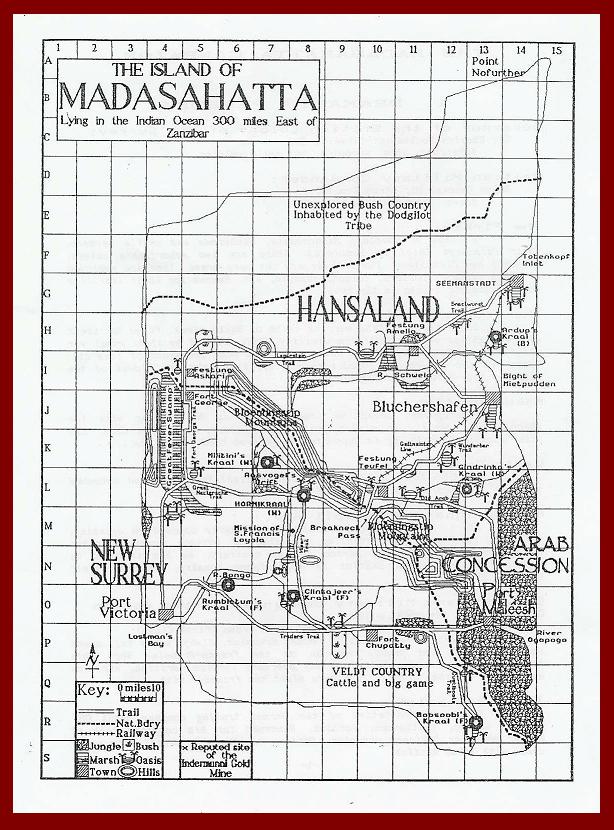
A map of the island and for fuller details I suggest buying Bob’s book - you certainly would not be disappointed!

It is funny how things go around in cycles and then when they come into focus occasionally generate an idea or two. Madasahatta is course the island setting for the famous 1914 based campaign run by Eric Knowles in the late 1970s that I was lucky enough to take part in. My involvement was minimal as I only appeared at the very end of the campaign but it was very much one of the wargaming highlights of my life. Bob Cordery, another survivor of the campaign, coordinated the surviving documentation about the island, it’s topography, dramatic personae and the combatant forces and also penned a brief biography of Eric Knowles which he has published via Lulu. It is not a campaign history as such although the two campaign newspapers feature therein.

Bill, Eric’s son, has the remnants of the forces that were used and amongst these feature quite a few Jacklex figures. Jacklex have a new lease of life and new management and Mark Lodge, the new proprietor, is looking to expand the range. Thus far he has added the French in Mexico and, perhaps more significantly in the context of this post, German colonial troops. There are also Sudanese infantry which could double as Askari. Add in the ‘modern’ artillery models available in their US in Mexico range and you have a veritable smorgasbord of gaming potential.

In many ways Madasahatta was almost a Colonial campaign, featuring as it did British and German overseas troops and various varieties of tribal types - think Zulus and Mahdists/Afghans with some European settler types (Boers by any other name) and you can see what I mean. The fact it was set on an island meant that the naval dimension featured  so in many ways Madasahatta was a fusion of late 19th and early 20th century warfare.

I had flirted with an idea to shape an updated version of Madasahatta to include East Africa and the Arabian peninsula but this kind of grew out of all proportion to what I originally intended so I quietly shelved the idea. However, like a burr under the saddle, the lingering and siren call of the island is never far away.

In many ways raising forces based on the original organisation for the campaign would serve to satisfy many a gaming itch. It would be difficult (but not impossible) to refight the campaign but I am thinking that instead it makes a wonderful canvas to embark upon on one’s own Madasahatta adventures. Almost a kind of ‘Carry On’ style distraction. There is sufficient variety of forces therein to satisfy the most jaded palate or seasoned Colonial gamer.

At the opening of this post I mentioned about circles and such like and so it is worth mentioning that I saw a number of Jacklex figures in various parts of Eric’s Ottoman Turkish army of all things and I was struck by the elegant simplicity of the figures. The fact that the range is a going concern and with new models being added means that as a distinct possibility Madasahatta could reappear once again as a viable gaming setting.


Friday, 29 May 2020

Just Deserts


Best read with the film soundtrack playing in the background and sitting in 30+ degrees of sunshine!

Of all the theatres of the Great War the ones that will always capture my attention are invariably about as far removed from the Western Front as you can get and also usually feature camels. I am of course referring to the desert - be it in North Africa or Arabia. I have recently looked at the Senussi campaign as well as the fighting over the Suez Canal and in Palestine and of course, the great Arab Revolt, of which T.E. Lawrence was a part. Again, my interest in the life and exploits of Lawrence is well known and so whenever a new work is published about him or the campaigns he was involved with there is a good chance it will pique my curiosity.

Lawrence of Arabia On War by Rob Johnson (published by Osprey in hardback) examines the context of his war in the desert, and his ideas on war itself.

This is looking at the Arab Revolt from a different perspective as it not only looks at how it meshed in with the operations of the regular forces but also how the irregular forces could be accommodated and utilised to their fullest advantage - always a challenge and subject to a continual juggling act by Lawrence (not always successfully either).

The Arab Revolt is ideal Portable Colonial Wargame fodder (and I have a supply of 1:1200th scale desert buildings, some 1:600th Rolls Royce armoured cars and am casting covetous eyes at some Tumbling Dice aircraft in the same scale) and so this is something I will need to look very carefully at again. I will game it at some point but at this stage I need to be sure about the best way to do so.

In the meantime though I will probably watch the film again - purely for research purposes naturally....

Friday, 27 March 2020

With Lawrence in Arabia*

* Not the book of the same name by Lowell Thomas but a good title for this post!

All being well and with a fair following wind we should soon see the launch of the latest volume in the ‘Portable Wargame’ series by Bob Cordery - The Portable Colonial Wargame.


The cover for Bob’s latest tome - nothing smacks more of Colonial Wargames than Redcoats and arid, rocky desert in my opinion (with apologies to the non-arid, rocky desert Colonial gamers!) with the obligatory horde of revolting natives.


The provisional contents of the book and of particular interest for this post starts on page 142 - Early twentieth century colonial wargaming

Some time ago I acquired from Irregular Miniatures two 15mm forces for a planned Arab Revolt style set up. I have the Arabs and Turks and whilst what there is would be more than sufficient for a game I decided that a few bits and pieces should be added. I wanted to add some regulars to the Arabs - Armoured Cars, machine gunners and some mountain artillery - but never got around to doing so.

You may recall that I even went as far as to expand the revolt to  include a naval dimension and even at one point thought about adding in Madasahatta. As usual the project suffered from advanced ‘mission creep’ and quickly grew out of control so, like many ideas before, the whole concept was quietly shelved and some of the material disposed of.

Well, Bob’s very timely new book will help to resuscitate the idea albeit in a more manageable form. Aside from the forces I already own I will need to add an Imperial force and for some unaccountable reason I am seriously thinking about something ANZAC themed. I say unaccountable because this was certainly not the original plan! I have yet to finally decide on this but I reckon it would make an interesting force to raise - shades of the Lighthorsemen perhaps? Naturally the naval dimension will feature but on a much smaller scale than previously.

The first step though, would be to acquire the armoured cars, machine guns and mountain artillery to support the Arabs.


A selection of Irregular Miniatures 15mm Arabs - all suitably generic in a Hollywood kind of way and usable for a variety of things (including Beau Geste but that is another kettle of fish altogether).


A selection of Irregular Miniatures 15mm WW1 Turks. I rather like the portly looking commander and the rather natty looking staff car. I have artillery and machine guns for them and indeed, I just uncovered a couple of hard plastic German 105mm howitzers that could be used to increase the Turkish artillery park

I will need to refresh my memory in respect of the Arab Revolt but that will be no hardship and of course, this will need to be fitted in around the Napoleonics.

David Lean’s Lawrence of Arabia it is then....

All men dream: but not equally. Those who dream by night in the dusty recesses of their minds wake in the day to find that it was vanity: but the dreamers of the day are dangerous men, for they may act their dreams with open eyes, to make it possible. This I did.” T. E. Lawrence


Wednesday, 18 December 2013

A Profound Influence


"The dreamers of the day are dangerous men...."

By now I expect that most readers of this blog are aware of the fact that the actor Peter O'Toole passed away after a long illness on the Saturday just gone. He was a very fine actor appearing in both films and theatre (I really enjoyed Jeffrey Bernard is Unwell) and of course, came to world renown with his portrayal of Lawrence of Arabia in the 1962 David Lean film of the same name.

The film is one of my all-time favourites and from when I first saw it on video (sadly I have never seen it on the big screen although I was lucky enough to see my other film of the era - Zulu - at a cinema in the early 1970s) was enthralled by the whole Lawrence story. At the present time I have the film itself on Blu-Ray, the extended version of Maurice Jarre's superb soundtrack album, numerous Lawrence related books, have avidly read the Seven Pillars of Wisdom and planned numerous tabletop adventures set during the Arab Revolt.

The film was truly epic in scale and Peter O'Toole's performance was certainly worthy of an Oscar - he hold the record for the most nominations without actually winning one although did receive an honorary lifetime type one. Historically the film was all over the place and being described as 'based upon' is probably the most generous way to describe it - any film using Seven Pillars of Wisdom as a reference is always going to be on slightly wobbly ground - but, like Zulu, doe not in anyway detract from what was a towering cinematic achievement.

As Lawrence it is fair to say that he captures visually much of the complexity of the man and his many facets. It was a thought-provoking depiction although in reality he was around a foot too tall - Lawrence was quite short.

In closing I would say that the film Lawrence of Arabia, and the late, great Peter O'Toole's depiction of the man himself have been the main instigators of my lifelong interest in the Arab Revolt and have contributed, by extension to interests in many related areas.

R.I.P Peter O'Toole.

Monday, 27 May 2013

Thoughts on the Balkan Battle of Hook's Farm

Much as I enjoyed enormously game number 39 - the Battle of Kanca Ciftlik or Hook's Farm - it did give me cause to think about a couple of 'tweaks'. Bob Cordery's 'Memoir of Battle' is derived from a fusion of the Command and Colours system with a dash of Morschauser thrown in for good measure. As a game system it works really well and Bob's tinkering has produced a set of rules for the late 19th and early 20th century that are easy to play, fast flowing and with that all important 'feel'. He has also added a very neat solo version which does not use the usual command cards and it is with this adaptation that this post is mainly concerned. There are a number of areas that I would like to expand upon though - and I must emphasise that this is purely a personal whim - and these will form the subject of this post.

Exhaustion Levels

The exhaustion level is quite simply the point at which the army is no longer capable of offensive action. This is usually reflected by the number of strength points the army has lost - when it has accumulated casualties equal to or greater than the predefined exhaustion level the army may no longer conduct any offensive actions such as moving forward towards the enemy. As a general rule this figure is usually equal to around a third of the total strength points although I would tend to define this on a scenario basis.

Battle Back

The concept of Battle Back - whereby a unit that is attacked may immediately counter-attack depending on various circumstances -  serves to level the playing field to an extent in that an attack will require rather more thought than previously. I do not envisage using this for every type of combat - only that which takes place in an adjacent hex. In effect it could been seen as a local response to an attack. Ranged combat would not be effected by this rule so straight away you can see that the effect of such a measure would be ensure that under normal circumstances a proper fire plan against the target unit would be employed to 'soften' up the defences before an assault when in.

Saving Activations

With Bob's solo version of his rules the player rolls a number of combat dice to determine what units he can activate during the game turn. This is s simple and effective way of replacing the use of the command cards. However, it makes no allowance for activations being stockpiled for future use - or, put another way, command cards being held back to launch and sustain an attack in a particular sector. Using dice means that each turn can be very different in terms of what you can and cannot do.

The rule I am considering is this. A player may hold back activations for future use but may never use more activations in a game turn than are allowed by his commander rating - this is either 6, 5 or 4 for good, average or poor respectively. Also, when a player rolls for his current activations for his game turn, should any flags be rolled these will have the effect of reducing any 'banked' activations for each flag rolled. This will allow a player to gamble on building up a bank of, say, infantry activations but these could be jeopardised by rolling a hand full of flags.

I believe that this rule will have the effect of giving the commander the ability to plan ahead to an extent but it is not a 100% certainty. It is a gamble and could have potentially a battle winning impact but it could also paralyse a part of the army for no reason. When using command cards a player is able to hold back those cards that he thinks will give him a fighting chance of landing a telling blow in due course. Hopefully using the system outlined with the dice will have the same effect.

I am hoping to run another action next weekend to try these ideas out and of course I will report the findings on the blog.

The Battle of Kanca Ciftlik, May 1913....Game Number 39

I am not ashamed to admit that the inspiration for this action came solely from the excellent article in Miniature Wargames Number 361 by Arthur Harman - Little Wars for little money in little space. The article was described by the author himself as 'Being an adaptation of Mr HG Wells' toy soldier kriegsspiel according to the principles of Messrs Morschauser and Cordery, for the entertainment of impecunious gentlefolk in these recessionary times, by Arthur Harman, resplendent in his stripy blazer and straw boater.'

The following action represents a further spin on the immortal Battle of Hook's Farm in that I am using a hexed grid (my Hexon tiles), Bob Cordery's Memoir of Battle rules and my own particular homage to wargames in days gone by - my wooden block armies.

The Set Up

The combatants for this action comprised the Turks and the Bulgarians rather than Red and Blue and each side consisted of the following forces:

1 x 2 block command unit
6 x 4 block Infantry units
3 x 3 block cavalry units
3 x 2 block artillery units

This means a total of 41 strength points each and both sides had an exhaustion level of 14. As a game turn consists of both sides completing their respective actions I decided that in the event of both sides reaching their exhaustion level in the same game turn then the side that had lost the least casualties was deemed the victor.

The battlefield was a standard Command and Colours sized 13 x 9 hexed playing area. The buildings are from my collection of ceramic souvenirs. 

The Battle of Kanca Ciftlik, May 1913


The initial dispositions viewed from the Bulgarian start line. Kanca Ciftlik is to the left of the central clump of pine trees whilst Yangin Kilise is the blue roofed building on the right. The Bulgarians are fairly concentrated with the infantry deployed to either flank and the bulk of the artillery in the centre and most of the cavalry on the left.


The view along the opposing battle lines with the Turks on the left of the picture. The Turks have four of their six infantry regiments facing Kanca Ciftlik and their cavalry deployed in the centre and left flank.


Turn 1 sees the Turkish advancing on either flank and securing Yangin Kilise (the church at the top of the picture) unopposed. Meanwhile the Bulgarians move up their artillery with infantry support for the assault on Kanca Ciftlik.


The Turkish advance guard secure Yangin Kilise with the cavalry screening their left flank and the artillery moving up in support.


Turn 2 and whilst the Turks are able to move into Kanca Ciftlik the Bulgarians response is swift and deadly as the farm is assaulted by their infantry and heavy casualties are inflicted on the defenders.


Meanwhile the Turks consolidate their hold on the church with infantry moving up in support.


Turn 3 sees the battle for the farm swinging first one way and then the other as the Bulgarian assault inflicts a further casualty on the Turks whilst they suffer heavily in return. The Turkish artillery joins the fray and opens up on the massing Bulgarian infantry in the centre.


Turn 4 and the massed Bulgarian infantry in the centre secure the central building, thereby threatening both Turkish flanks. The Turks manage to beat off the assault on the farm and on the other flank, send the cavalry around to attack the Bulgarian rear.


The gallant Turkish horsemen are driven back by the Bulgarians but a further regiment of Ottoman cavalry is on the way.


Turn 5 and at last the Bulgarian attack in the centre begins to take shape although casualties are suffered  from Turkish artillery and long range rifle fire. The Turks supporting the church are temporarily pushed back by the Bulgarian artillery.


The Turkish cavalry are repulsed by the Bulgarian horsemen.


Turn 6 and the remaining Bulgarian cavalry push into the wooded area on the left of Kanca Ciftlik whilst the infantry make ready to assault the farm.


Disaster for the Turks! The Bulgarian infantry assault the farm and the remaining Turkish defenders are forced out (note the two flag results). The Bulgarians rush in to occupy the scattered buildings formerly occupied by the Ottomans.


Turn 7 and the Turkish cavalry fight back against the Bulgarian horseman at the bottom of the picture.


Meanwhile, the battle for farm increases in intensity as the Bulgarians come under heavy rifle fire from no less than three Turkish units. Can the Bulgarians hang on?


Over on the Bulgarian right flank the last of the Turkish horseman are driven off and the Bulgarian artillery pounds the Ottoman infantry by the church.


Turn 8 and at last the Turks begin to prevail against the Bulgarian right flank. The second Turkish cavalry unit gallantly charges into the Bulgarian horse and routs them whilst the Ottoman artillery continues to pound the Bulgarian infantry on the crest. The Bulgarian return rifle fire inflicts heavy casualties on the Turks by the church by way of returning the compliment.


Meanwhile the farm of Kanca Ciftlik changes hands for the final time as the remaining Bulgarian defenders are destroyed and the Turks reoccupy the buildings although not without heavy losses. The Bulgarian cavalry engage with the Turkish infantry at the far side of the wood with each side suffering minor casualties.

At this point both sides has reached their respective exhaustion levels - Turkey 15 and Bulgaria 17 so the Turks were declared the victors in a hard fought and close run action.

Aftermath

I really enjoyed the battle as it is the first game I have played for a while. The rules (Bob Cordery's Memoir of Battle) worked really well although I may incorporate the 'battle back' facility whereby units can fight back against attackers if they are not destroyed as per the normal combat rules (not against artillery though). The solo mechanisms worked well but I will think about banking activations in some way - I will post about this in more detail later, once I have thought about it - so that game turns can potentially have a little more control over them.

It was great fun to fight and many thanks to Arthur Harman for the idea - along with, of course, Messrs, Wells, Morschauser and Cordery....;-)


Tuesday, 20 November 2012

Further thoughts on the Portable Wargame


"Just tell me one thing....Are these chaps really the last of the Mohicans?"

I have used Bob Cordery's Portable Wargame rules for both 19th century and modern (WW2 in old school speak) games very successfully and will happily do so going forward. However, being an inveterate tinkerer I have a few ideas to throw into the mix. I am not alone in this as many other gamers have been experimenting with other periods - The English Civil War being one, with Steven Page being the driving force with his blog - Forlorn Hope ECW. For my own part (and much as I would love to tackle the ECW at some point) my immediate needs are far simpler, comprising as they are the 'musket' period (roughly 1700 to 1850) and perhaps some 'tribal' types to add in to the 19th century (and earlier as well). I also have some additional plans for the 'modern' set.

For the traditional 'musket' era my thoughts are fairly simple. I want to include unit formations in some fashion - the traditional 'column, line and square' that feature in many sets covering the period - and also to allow for skirmishers and light infantry. My plans are very much in their early stages with this but the key thing for me is to be able to represent such formations within an individual hex. Once I have some clarity around what I want to do and how I want to do it I will post to the blog in the usual fashion.


"Honestly Sahib, it was only used once a week by my grandmother to visit the local Fakir"

The 19th century will add in some Tribal types for the Colonial era and also for earlier so, for example, the French and Indian War could be gamed with its hordes of woodland Indians. Mention of Indians also raises the possibility of Clive and his exploits on the Indian sub continent as well as the later wars up to and including those campaigns of a certain rather well known British historical figure to boot....;-)


Not seen this version but certainly played the first and second edition

For the modern set the changes I want to try are probably more radical than for the earlier set. I want to be able to break units down so that for my current set up a single block is a strength point and that a hex has a stacking capacity expressed in strength points rather than units. This would enable, for example, a couple of blocks of infantry supported by a machine gun block to be represented. I am also toying with allowing individual blocks having their own combat dice rolls so that the aforementioned unit of two infantry and a single MG would roll 5 x d6 - 1 each for the two infantry and 3 for the machine gun. This would raise the spectre of assigning hits but there are various ways of getting around it with the simplest being to roll a d6 and count around. Failing that, (and is probably the simplest method) just assume that the hits are taken by the majority type first so the formation above would lose both infantry with the MG being the last man standing. I would also like to employ area effects for artillery (one could argue that possibly MGs should be so treated) and at the moment my thoughts are along the lines of if an artillery piece hits a hex then all strength points currently occupying the target hex are attacked. This would encourage players to spread out and avoid bunching which is perfectly accurate in my opinion.

Essentially my thoughts around the modern game are very much geared towards a lower level of action than the earlier set and are probably closer in intent to such rules as Command Decision where a base represents a platoon-sized formation.

All of this in very much in the early, experimental stage and naturally I will report via the blog as and when I have something concrete to convey.

Saturday, 10 November 2012

Historical Battles - Portable Wargaming Style


No prizes for guessing what this picture is from!

It occurred to me this morning, whilst browsing idly across the net and other blogs, that all of the games I have fought this year in the man cave have been based around hypothetical actions. They have all been great fun to fight for various reasons and for the most part have 'felt' like that which they are supposed to be representing. This can be attributed to a variety of factors - the quality of the rules, the fertile imagination of the chap running the game (?) - very important when using blocks - or the feedback from those that have read the after action report. One thing I have yet to do though, is to tackle a refight of an actual historical battle. I have run a couple of Battle Cry scenarios to be sure but in all three cases the donkey work of translating a battle into a game ad already been done.

Right then....

I have decided to tackle a historical battle before the end of the year using the Big Battle Portable Wargame as the rules of choice. I am undecided as to which one or even which war at this point and so will open this up to the readers of this blog to decide. The first stage will be to pick the war in question and then to find a suitable action to refight and the only restriction is the fact that I do not at present have any desert terrain to speak of.

The wars I am considering are as follows:
  • The Russo Turkish War 1877
  • 2nd or 3rd Afghan War
  • The Zulu War
  • The Balkan War 1912
  • August 1914 -Western Front
I have managed (after prompting from Peter Douglas - many thanks old chap!) to set up a poll so that readers can vote for their particular favourite. The plan is to have the war decided upon over the course of the next couple of days (with the result announced on Tuesday) and then I can start the deep dive research into the battle I want to fight. I will make the battle the big finish for the year and will of course post the development process leading up to the battle itself.

I plan to get some other games in before the end of the year but this one will be the grand finale. Essentially then, you decide the war, I pick a battle and then the refight will provide my end of year entertainment!