Showing posts with label Russo-Turkish War 1877. Show all posts

Wednesday, 9 February 2022

The Russo Turkish War in the Black Sea


One of my favourite wargame books. The only rules I have used extensively from this book are for the Great War but it is chock full of great ideas

Day 10 and still testing positive….

Historically the naval operations of the Russo Turkish War of 1877/78 were unspectacular to say the least. The Russians had very little in the Black Sea following their defeat during the Crimean War and the subsequent treaty restrictions. The Treaty of Paris signed in 1856 limited the Russians to a very small flotilla whilst the Turks, supported by Great Britain, were allowed to build up a formidable force of ironclads - many of which were built along the Thames. On the face of it then, the Russians were both outgunned and outmanned. Had the Turks chosen to be far more aggressive in the use of their fleet the outcome of the war may have been very different, however, muddled command, low morale and lack of properly trained crew meant that for all their superiority the Turks largely surrendered the naval initiative to the Russians. 

The Russians were nothing if not brave and inventive. The use of spar torpedo steam launches and mining operations, together with shore based artillery ensured that the Russians quickly seized the initiative along the Danube. Their armed merchant steamers were able to harry the Turkish merchant marine and lines of communication, thereby drawing Turkish ironclads away from their primary missions of shore bombardment etc. The Turks did enjoy limited success and indeed, a former Royal Navy Captain - Augustus Charles Hobart-Hampden - was appointed as an admiral in Ottoman Service and was known as Hobart Pasha was instrumental in this. His memoirs are available on Project Gutenberg and I am reading them at present and he was certainly very active in the Black Sea. He had an interesting career, fighting slavers, blockade running for the Confederacy and helping the Turks put down a Cretan rebellion. 

So for all this how does one make the game and setting rather more interesting than was historically? 

Well, I have been turning this over in my mind and have a number of ideas to play around with. The key thing is that the Russians definitely need some heavier metal, above and beyond the two circular ironclads, the Popov and the Novgorod, however whimsical they may be! I certainly plan to build these two naval oddities, if only for the sheer fun of it. During the war the main strength of the Russian Navy was in the Baltic so I could arguably cherry pick some ships from there and redeploy them to the Black Sea. The challenge there is how would they have gotten to the Black Sea? Another alternative, and there is a historical precedent for this, would be to allow the Russians to have captured and repurposed some Turkish ships. During the war the did this with a couple of Turkish Danube gunboats and later, during the Great War refloated the Turkish Cruiser Medjidieh after she had been sunk by a mine and took her into Russian service as the Prut. Given the Russian fondness for spar torpedoes and mines there could be an opportunity to ‘snag’ a Turkish ironclad or two. Perhaps the Russians could sow an offensive minefield on a suspected Turkish shipping lane whilst they are en route to bombard a harbour or similar. Coupled with a night time spar torpedo boat raid it would be feasible for a Turkish ironclad to be sunk in range of Russian territory. A swift salvage operation, some quick repairs and hey presto! A new Russian warship!


A few years after the Russo Turkish War but with a cracking idea to play around with

I should be mindful of making the Russians too powerful as the Royal Navy would not standby and see the Turks outfought in the Black Sea. Indeed, the Mediterranean squadron sailed to the Sea of Marmara to keep the Russians honest - remember this was the period when the Russian ‘designs’ in Asia that could potentially threaten India or the Suez Canal were viewed very seriously by Parliament so any Russian moves against Turkey would set alarm bells ringing.

Historically when the Royal Navy sailed into the Sea of Marmara at the end of the war the Russians planned to mine the Bosphorus to prevent them entering the Black Sea. Great Britain got wind of the plan and promptly told the Russians that this would be considered an act of war and so they backed down.

If I allowed the Russians to gain a couple of ironclads then depending on how well the Turks fared against them would determine whether or not the might of the Royal Navy would intervene. There is a marvellous battle report in Paul Hague’s book: Sea Battles in Miniature describing a fictional action between elements of the Royal Navy and the Russians who have been equipped with some British designed ships built by them from plans acquired from spies. By the simple expedient of adding ‘ski’, ‘vitch’ or ‘off’ at the end of the ship names these British ships were suitably ‘Russianised’.

Taking all this into consideration my options for the Russians are perhaps not as limited as history dictated. I rather like the idea of captured Turkish ships being repurposed - as mentioned there is a precedent for this - and also for allowing some additional units to have been built at Sevastopol. It will be fun factoring this in and of course building the models. One thing is for certain though. A six ship squadron for the Royal Navy will need to be built.

Oh yes indeedy!

Tuesday, 8 February 2022

Black Sea Turkish Ironclads….Part 3


The first of the Turkish ironclads. I have a couple of Russian armed merchant cruisers currently under construction by way of some opposition. Historically these were used as tenders for spar torpedo launches, minelayers and also to draw Turkish ironclads away from shore bombardments etc. Very much ‘shoot and scoot’ type operations.

It was a strange day yesterday. I felt particularly lethargic and it was a real effort doing anything let alone painting models but I gave myself a gentle nudge and pressed on and I am glad that I did. At the time of writing I am still testing positive but today, aside from a nagging and irritating cough I feel relatively normal.

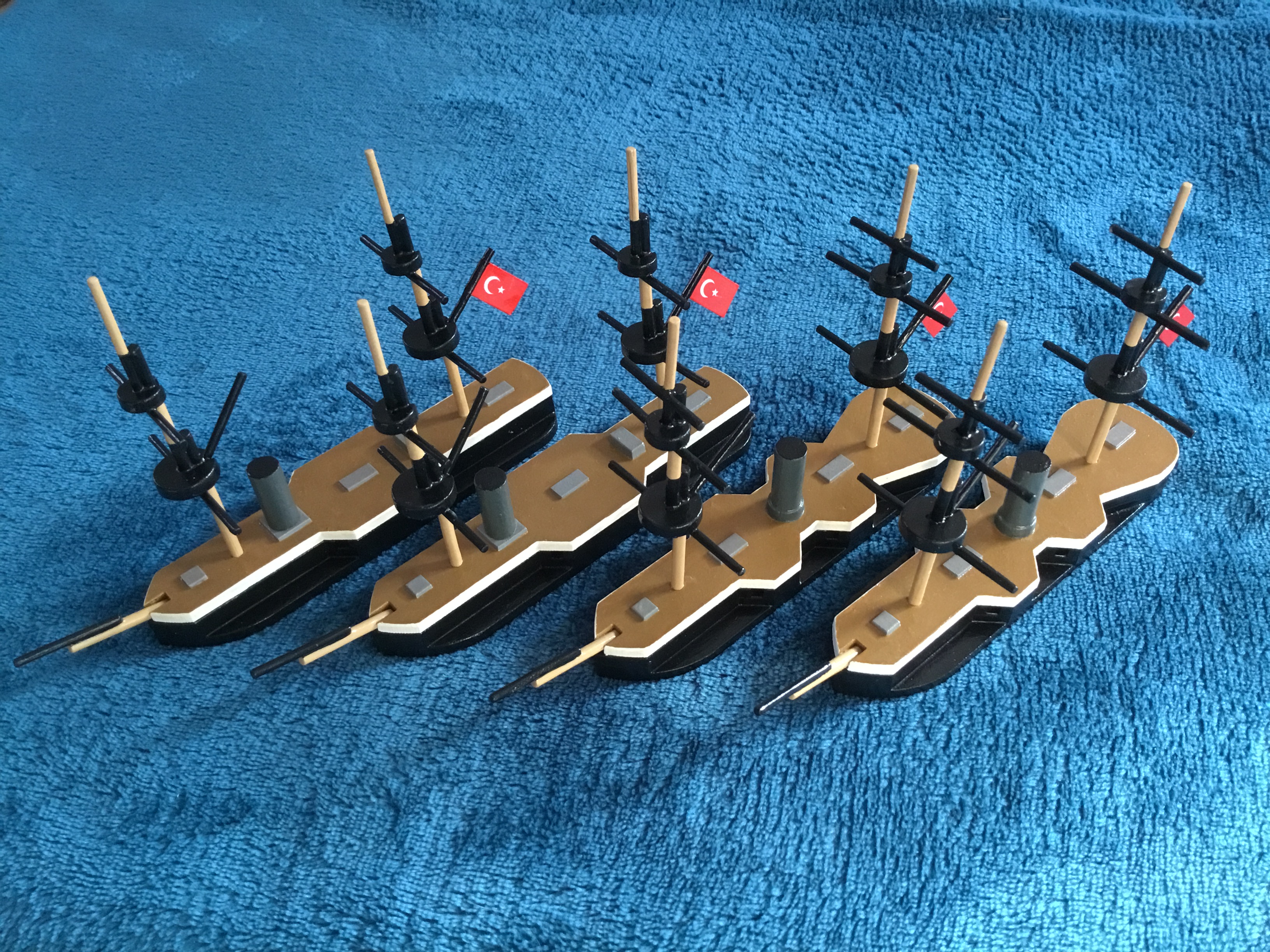
I finally finished the four Turkish ironclads and I have to say that I am rather pleased with how they came out. As usual they are very much ‘based upon’ rather than super detailed scale models but for my purposes they will work quite nicely. Whilst I was working on these I gave some thought to the opposition and so have taken a couple of hulls from the ACW ships currently under construction and will repurpose them into Russian armed merchant types. When my Warbases order arrives I shall be able to build the other two Turkish ironclads which will suffice for the collection although I could easily build another four!


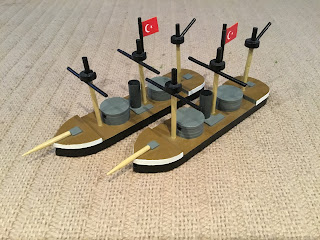
The Feth-i Bulend class of central battery ironclads - one built on the Thames (Feth-i Bulend) and the other in Istanbul - the Mukaddeme-i Hayir


The Avnillah class of central battery ironclads - note the cutaway section in the casemate to increase the fields of fire. Both ships were built on the Thames and the other of the class was the Muin-i Zaffir

The models were built using my tried and tested MDF laminate technique - in this case four layers each of 3mm thickness. Deck fixtures are mostly card except for the funnels that are dowel rod cut to size. Masts are from bamboo skewers with cocktail sticks for the spars. Paint was a mixture of Humbrol enamel - and Vallejo - Iraqi Sand for the masts and Black for the hull and spars. As per usual I opted for a satin varnish as this gives a suitable ‘old school’ appearance and is in keeping with the overall ‘look’.

On the face of it the Russo Turkish War does not really have a lot to offer. Historically the Turks had an overwhelming superiority in terms of material but for the most part the overall command of the fleet was poorly handled and listless in operation. The Russians were quickly able to seize the initiative along the Danube, thereby ensuring that the armies movement was not overly inconvenienced. The various extemporised cruisers the Russians employed, whilst not being a match for the Turkish ironclads in a stand up fight, were able to operate effectively across the Black Sea with little interference. They did cross swords occasionally and one such incident will feature in a game as soon as I have built the Russian ship in question.

Whilst I was building these models and indeed, also the ACW collection my thoughts naturally turned towards the other periods of history that I could produce stylised models for. If I am honest I reckon that the pre-dreadnought era would probably be about as late as I would go for capital ships although certain facets of the Great War would certainly be achievable. The problem as I see is that when one get to the dreadnought era warships become a lot more ‘fussy’ in terms of above deck detail. My approach would probably not be flexible enough to capture this adequately. The type of combats I will be fighting tend to be at closer ranges so dreadnoughts hurling 15” shells at 20,000 yards does not really sit well with my system. Besides, there are plenty of cheap, commercially available smaller models to cater for these types of combat.

Thinking of the Great War and models thereof, I envisage primarily cruiser types being the main arm and these would be in certain cases very much the edge of the envelope for what I can build. Something to ponder for another time I should think.


Friday, 4 February 2022

Black Sea Turkish Ironclads….Part 2


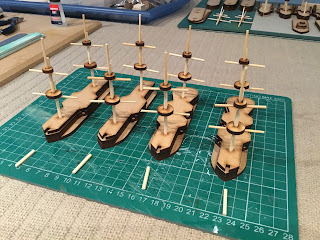
 Four completed Turkish ironclads awaiting sealing, painting and the final assembly. The models are based on the Avnillah (the two models on the left) and the Feth-i Bulend (the two models on the right) classes. The masts, bowsprits, funnels and the main decks are not glued in place simply because it is easier to paint them first. I have also trimmed 1/4” off the bowsprits as they were a little on the long side!

The four Turkish ironclads are now built and I am leaving them for the glue to harden off overnight prior to sealing, undercoating and painting. I am rather pleased with them and whilst they are being painted and the two river monitors are being refurbished I shall give some thought to some Russian opposition.

For the most part this will be assorted armed merchantmen and a bevvy of torpedo launches - ultimately I shall be building the pair of circular ironclads for the Russians as well as the Turkish ships captured and pressed into service.

On the face of it the naval situation in the Black Sea during the war of 1877 was, on paper at least, very much in the Turkish favour. The Turks enjoyed a hefty superiority in terms of warships so I may well allow the Russians to add a few additional units to their order of battle. I am currently thinking of a back story for this that could be viable and will post once I have done so. The Royal Navy may well be involved but I will leave it there for now.


I originally built these with a light pole rig but am now going to reinstate their full sailing set up - simply because they will look better and will be more in keeping with the newer ships.

The two ships you see above are a pair of river monitors of the Luft-u Celil class. These were built vey early in my shipbuilding career and perhaps unsurprisingly are now not of the current build quality. I am going to decommission them to rebuild them to the current standard. They will not require a vast amount of work (at least now that I have worked out the best to tackle it!) and the end result will mean that the whole Turkish fleet built thus far will be of a similar standard.


Thursday, 3 February 2022

Black Sea Turkish Ironclads….Part 1


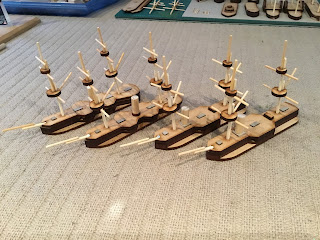
Under construction - four Turkish ironclads in their original configuration. Still to do are the bowsprits, gaffs, funnels, deck fittings and flagstaffs. The masts are not yet fixed in place and neither are the top decks. In each case it is for ease of painting.

It was good to get in the man cave for a couple of hours and chop up some bamboo skewers and cocktail sticks! The build for these four models will be completed tomorrow so, all being well, I should be able get them finished over the weekend. The two Turkish river monitors are going to be refurbished to my current standard as I am not happy with the pole masts I originally equipped them with, nor the bowsprits. That should not take long but I want to finish these four first of all as the refurb will require a degree of care.

In the meantime I have a couple of semi completed hulls that are going to find their way into the Russian navy and I will to once more think about spar torpedo launches as well some other Danube river craft.

I have to say that I am really enjoying the process with this project and I pleased that I decided to revisit it!


Wednesday, 2 February 2022

“I Can Resist Everything….Except Temptation!”….


Turkish ironclads, Russian Spar Torpedo launches, circular gunboats and river monitors - what could possibly go wrong?

Medical Update

The attack of Covid appears to be relenting somewhat although I (and my my daughter) are still testing positive. She seems to be suffering rather more than I am so it is just a case of maintaining the fluids and paracetamol intake to cope and waiting it out.

Laurel met with her consultant today and he was the bearer of some welcome good news. Her tumour is benign (he suspected as such but it is always good to have it confirmed) and he is really pleased with her progress. The loss of feeling etc is perfectly normal and so he has put her on a course of steroids for a few days to help with the internal swelling and therefore speeding up its return. We have also heard that she has a bed in a residential rehab facility located about 15 minutes from where we live which is really good news and will help further with her recovery.

All in all then, progress is being made.

Unexpected Gaming Stuff

After having spent some time yesterday sorting bits and pieces out in the man cave - the previous Battle of Britain post was a result of this - I once again looked long and hard at the ACW ships and what I need to do to finish them. It was then that I realised that the Warbases order I am waiting for is rather more essential than I originally envisaged. I have made a schoolboy error with this current batch in that it is rather larger than I usually work with - 13 models rather than 3 or 4 at a time - and although I have previously said I would split them up into batches due to the material shortages Warbases are currently rectifying, I am currently unable to complete any of the three sets. Having split them into types I am loath to reorganise them again just so as I get on with building so my eye fell upon the 4 hulls of the Turkish ships I want to build for the Russo Turkish War. Now these I can build as all the material has been amassed and in truth, they would make a welcome change.

I then compounded my schoolboy error by taking the book depicted at the head of this post off the shelf and opening it. I was suddenly struck by the realisation that many of the Russian ships would be pretty straightforward to build (circular gunboats notwithstanding) and in fact, some of the ACW hulls currently under construction could even be repurposed if required (I quickly dampened that idea down). The Russians would need a selection of Spar torpedo boats and there is a class of Turkish gunboats of which the Russians captured and reused. There are a couple more ironclads I could add to the Turks and in truth these are pretty straightforward to build.


The four Turkish central battery ironclads. Aside from masts, funnels, bowsprits deck hatches and flag staffs (and painting naturally!) they should prove to be a pleasing distraction.

Is this a big temptation? Absolutely! Is this a big distraction? On the face of it you might think so when all along I have been concentrating on the ACW models. For me though, I like to think of this as being more a change of position in a comfy chair - I can always go back to how I was once the bits and pieces arrive from Warbases but in the meantime a change is as good as a rest!

The Portable Wargamers came in 3 by 3 hurrah, hurrah!’

I have to say that I am really intrigued by the concept of this and am hoping to get a trial game in tomorrow. I shall be using the block armies and rather fancy something Russo Turkish War based. I shall be taking a look at the Neil Thomas book of 19th century European wargaming as there is a rather nice selection of small scale scenarios I can adapt. Most of all though, it will be good to fight a wargame - the first of 2022!


Friday, 12 March 2021

Naval Snakes and Ladders


My current ‘go to’ reading for the Ironclad period and the inspiration for my own rule writing endeavours 

 Now that I have gone as far as I am currently able with the ACW models I have been turning my thoughts to the Russo Turkish War and the rules that I shall be using to cover both. Of the Russo Turkish War I will speak later in this post but initially I shall be looking at the rules.

I have drafted a set that have worked quite nicely by taking elements from Bob Cordery’s ACW set published in his book Gridded Naval Wargames and also Dahlgren and Colombiad published by David Manley. Both of these worthies have been unstinting in their support and encouragement of my efforts which has been hugely appreciated. There is something though, that does not feel quite right about my set. It is nothing I can put my finger on specifically, it is more like that nagging feeling that something is missing. The best analogy I can think of is the Chinese take away that hits the spot when you eat it but for some inexplicable reason half an hour after you have finished it you are reaching for the toaster feeling hungry again!

I mentioned several posts ago that the rules needed a rewrite and if I am honest this seems to have made matters worse. Even parking them out os sight for a few days did not seem to help - there was still that feeling nagging away.

I think I now know what the problem is. I have been looking at my rules from the wrong direction. What I have done is to take elements of both sets and then effectively glued them together more or less as they are. What I have not done is to set out what I wanted to achieve with the rules from ground up. The fact that my improvisation has worked at all is testimony to the skill of both Bob and David as rule writers par excellence - it would be very difficult to ‘break’ either set. I suspect that I am not articulating this particularly well but it makes sense to me.

What I am going to do is to go back to the beginning and set out exactly what I want from the rules I am designing and then see what fits where in the manner I am aiming for. This will not be a slavish bolting together of various rules - it will be a proper dovetailed joint of an idea! This probably seems like a lot of work but in actual fact it is not as much of the groundwork has been laid already. So in a sense whilst I have gone down a snake there is a rather handy ladder nearby!

On the subject of Snakes and Ladders there has been a number of posts within the blogosphere about using the idea of this venerable board game as the basis for a campaign. I think this is a spiffing idea and naturally, given my current naval diversion, I thought about how this concept could be used for naval games. The short answer is of course it can but I need to sit down and think about the whys and wherefores but it will come as no surprise when I say that I already have a number of ideas to pay around with!


This is a magnificent read  - as are the other titles in the series although I am limited to just the Pacific War volume. My only criticism is that it is not available in hardback!

The Russo Turkish Naval War

I must confess that my enthusiasm for the naval dimension of this particular war was cooling - another snake - in favour of diving into Madasahatta but the above book - another ladder - has certainly restored it!

The Russian Black Sea fleet was virtually non existent following the Crimean War and indeed, for the war with Turkey they had nothing that could meet the Turkish ironclads on anything like an equal footing. Much use was made of armed civilian steamers but these could not be expected to take on an ironclad. The Russians were nothing if not inventive in that fitted out certain ships with large calibre mortars mounted aft in the hope that the Turks would pursue them. Due to the high angle fo trajectory a mortar shell could certainly go through a lightly armoured or unprotected deck to wreak havoc in a ship’s vitals.  It was using a shore based version in this fashion that the Turks lost one of their Danube river monitors. Attempting to try this tactic out led to the famous fight between the Russian steamer Vesta and the Turkish ironclad Feth-i Bulend. For the most part the Russian Black Sea steamers were used to harry Turkish communications and attempt to draw off the Turkish ironclads from shore bombardments etc.

The Russians made extensive use of mines and torpedoes - both spar and even some locomotive versions -  and, together with the army, were able to take the initiative along the Danube despite being materially outnumbered. The Russians even made use of a couple of captured Turkish river casemate gunboats that had been sunk, refloated and repaired and incorporated into the Russian navy. 

One of the Turkish plans in the Black Sea Caucasus region was to persuade the largely Moslem population of such places as Chechnya to rise up against the Russians, thereby requiring troops to be diverted from the Balkan front. Landings were made to supply such insurgents with weapons and indeed, even Turkish troops were deployed in support but the movement never really got going apart from some sporadic looting. The main bulk of the Turkish fleet supported such operations.

This is a very brief overview of the naval dimension of the war - the book above is an absolute gem if you wanted to explore the period further - and it has given me plenty of ideas for gaming purposes. 

Essentially you have the weaker navy being far more aggressive and landing some telling blows due to flexibility and technical innovation against a much larger, better equipped but far more passive opponent. 

That will certainly make for some interesting and tactically challenging games.

Wednesday, 27 January 2021

Building Turkish Ironclads and the Russian Response


 A quite superb title - I only wish it was in hardback! Note the positions of the spars on the leading ship - very much looking to operate with a reduced sailing rig

Part of my ship building programme includes a selection of ships for the Russo - Turkish War. My main references for this is the excellent book by Piotr Olender as well as my old friend The Ottoman Steam Navy 1828 to 1923 although I have it on very good authority that apparently the latter is not quite as good as it appears. Naturally Conways also features (I own the ‘holy trinity’ of the 1860 to 1905, the 1906 to 1922 and the volume going to 1946) as well the internet which has been a revelation in respect of information if you are prepared to do a little digging.


I thought this was the definitive work on the subject but apparently this is not the case. I always found the coverage of ships a little uneven but the redeeming features of plenty of pictures and some very useful plans made up for it! It is a good book all the same.

I have a certain amount of wargames history with the Turkish navy although primarily from the Balkan and Great War period so it has been a really enjoyable experience looking at those ships the Turks had from their original commissioning and in their original configuration. Many of these earlier ships were rebuilt and served in the later periods - not exactly in a hugely successful way it must be said - but given the parlous economic situation the Ottomans routinely found themselves in modernising an old ship was probably a better bet than building from new.

Anyways, aside from the Danube river theatre I wanted to get some deep water models built otherwise the whole project would have been very similar to what I am doing for the ACW - mainly river and coastal actions. This way I am covering a wide strategic canvas so to speak.

I did not want to go overboard (never a great idea when on a warship....) with the build and fortunately the naval forces for both sides were quite modest although the Turks definitely had the advantage, in numbers if nothing else. I finally settled on five or possibly 6 ironclads.

To give you a flavour of how my construction process works and just why using Warbases was such a life saver take a look at the following.


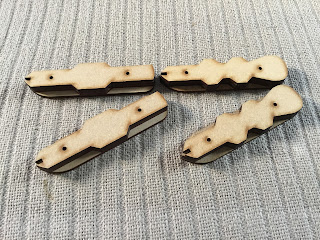
Using the template on the right as the base of the hull you can see how the layers are built up. I am waiting on the hull shapes you see (in the quantities stated) to finish this pat of the process. The holes are where the masts will sit and the notches are gun ports and also for the bowsprit as all of these will have a full sailing rig. The two diagrams on the left are all that is required for the two hulls I have started on - in this case the Feth-i Bulend and her sister. The larger three are for the Messudiye.


The above are for the Muin-i Zaffir and her sister ship. In both the above pictures you can see the gun sponsons and the central box battery. getting these laser cut would be immeasurably more accurate than anything I could do by hand!

The Messudiye, as befits her size will have a hull a full 6 layers deep (meaning she will be 18mm tall at the main deck level. Feth-i Bulend and the Muin-i Zaffir will be 4. In actuality both of these were roughly three quarters of the length of the Messudiye and a third of the displacement but I shall be building them to the same length of 5” (and thereby having my soul cursed for all eternity!). As they are primarily for use on a grid it does not make any real difference in respect of the size in my opinion.

Once I have the hull assemblies the rest of the model is very straightforward. All I will then add will be hatch covers (usually placed where there is an empty space on the deck!), funnels and the masts and spars. I need to think about deck mounted artillery - the Peter Pig models are a little too detailed for the models - and am also looking at adding ship’s boats at some point.

Hatch or gun port covers are usually from card, funnels are from dowel rod cut to length, masts are from bamboo skewers, spars and flagstaffs are from cocktail sticks. 

Russian About....

I wanted to beef up the Russian navy so I shall build two or three of the Ekaterina ll class despite them not being commissioned until the mid to late 1880s. Certainly the Turkish navy had not changed since the end of the war and in fact had probably gotten worse! This ship will be a challenge for sure given the curious arrangement of 3 barbette gun positions. These will be the last models for the Russians for this project and they will only be built once everything else has been. It has given me an extra idea though.


Now that is going to be fun to build and no mistake!

The Russians were very concerned about the possibility of the Royal Navy entering the Black Sea to prop up the Turks (bear in mind the Bombardment of Alexandria in 1882) and in fact the class of ironclads mentioned were built with this threat in mind. They were built with two barbettes forward and one aft with the forward two deployed side by side. This gave them a four gun forward broadside considered to be very helpful when used in support of amphibious landings as well fighting in a confined roadstead with limited room for manoeuvre.

Rule Britannia 

Mention of the British brings me to the final part of this post. The final part of this project will be the building of a Royal Navy squadron - no more than six models for the battleships, possibly with some support vessels - to help keep the Russians honest. Paul Hague in the first volume of his Sea Battles In Miniature fought an action between the Royal Navy and the Russians using his own rules - and it was great fun to read. This would take the project into ‘imagi-naval’ wargames which I have no problem with at all.

Summary

This all seems like a lot of work but it should be viewed through the prism of being both very practical and spread out over the next couple of months. Most of the models for the Russo Turkish war are of a simple style to build with the sailing rig being the thing that takes the longest to tackle. With the exception of the pieces for the four Russian ironclads (and for the British although one ship may be built alongside the Messudiye) I will have everything I need to build the models from stock. 

First of all though, I need to finish the ACW part as well as the rules.

No pressure then....


Monday, 11 January 2021

Russo Turkish Tinkering


The original model (of which there are two). Nothing wrong with it and yet.... 


....by adding to the sailing rig and applying some white trim to the hull it looks a whole lot more business like.

In advance of the resumption of ship building once my order from Warbases arrives I spent some time thinking about the models I want to build for the Russo Turkish half of the project. Whilst I have settled on the Turkish order of battle there was something nagging away at me in respect of the first two models I have built - the two river monitors of the Luft - u Celil class.

I built these two models with a reduced sailing rig but after further research decided that they need a little more in the way of spars. The option I have chosen reflects something of a compromise but given that the Turkish navy of the period seemed to be several steps behind the curve in respect of how ships were handled and maintained I certainly think it does not look out of place. I also took the opportunity to add a little detailing in respect of painting and so they now grace some rather fetching white trim - again this has been seen on a number of contemporary prints and pictures etc.


A closer look

Taking it all into consideration it has certainly perked the two models up rather nicely and I think they look far better in their current configuration. I will certainly incorporate the white trim on the next batch of models I build for this project.

Sunday, 10 January 2021

We’re only making plans for....Martin!

The three drawings to the right (3, 4 and 5) are the key three layers of the hull of the Mesudiye - there will be two plain templates under these making five layers in all. The lighter lines on drawing 3 give a good top down view. The two on the left are for the Feth - i - Bulend and her sister - these will be built up in the same way but with only a single plain template making four layers. I have the necessary templates for this class except for the two illustrated. They are smaller ships so by reducing the height if helps to differentiate them as I am not being too pedantic about scaling.


Mesudiye as originally built - her sister ship was taken over by the Royal Navy as H.M.S. Superb


The above shows to good effect the layering technique I am using. It is a time honoured, tried and tested method for building up a hull shape!


The plans for the Muin - i - Zaffir - note the double sponsons. Again these will be built up in three layers with a single complete piece as the base layer. 


A plan of the sister ship of the Muin - i - Zaffir. You can see how my model will be using a different overall hull form as it is fuller at the bow and stern

In the immortal words of C3 PO “Thank the maker!’ Or in this case thanks to Martin and Diane at Warbases who are now back in the custom order business. I cannot tell you how pleased I am about this as by the addition of some selective custom cut pieces I should be able to more or less finish the building for the ACW and Russo Turkish War projects.

The pictures are above are the rather crude plans I have drawn up for the hull section for three of the Turkish ironclads I shall be building. It is rather unusual for me in that I have owned and painted all three types but in their rebuilt Balkan and WW1 guises but never in their original form. As ever these will not be to scale in that they are very much in the ‘based upon’ mould rather than the historically accurate.

Producing the hulls for these models will be very straightforward once I have the pieces from Warbases. The most time consuming part will be making the masts but even that is quite straightforward albeit fiddly.

First up though will be the remaining ACW models.

All good fun!

Saturday, 9 January 2021

Where we are or the state of the Union


 One of ‘Pook’s Turtles’ in action

As I have now reached the point where I can go no further with the models for both the ACW and the Russo Turkish War I figured it would a good point to take stock and think about the next phase of the projects in more detail. In truth I could push on by improvising the pieces I need but as these are being cut by Warbases I may as well wait and make construction that little bit easier!

For the ACW the plan is to build another six side wheel paddle steamers - 3 for each side - of which four are under construction and awaiting parts from Warbases (which have now been ordered) to finish. There will be a couple of ‘Pook’s Turtles’ in the mix and then some screw gunboat types. The eagle-eyed amongst you will no doubt have noticed that his will take me beyond the original estimate of 24 models. This is not a problem as the figure of 24 models was always going to be the core of the collection - specific models could then be added as and when required. I like the idea of a couple stern wheelers but need to get my head around the rear wheel and how best to represent it.

For the Russo Turkish War I have four gunboats to build for the Turks along with six ironclads. With the two monitors already built that will give me twelve Turkish ships. For the Russians I shall be building two gunboats, six spar torpedo boats, three armed merchant types and of course a couple of circular gunboats - simply because I can! I rather like the idea of adding some later ironclads in to the Russian fleet but will have to see.

For the moment though I need to focus on getting the models on the table so over the course of the next few days battle will be joined.

In respect of the games I shall be running going forwards I have decided to work to the following format.

There will be three blog posts. The first will cover the background and will set the scene. The second will be the game itself whilst the third will cover the after action ‘wash up’ with thoughts on the rules and similar.

I want to adopt this approach as it means I can focus on each part in more detail - the purple prose can run freely!


Tuesday, 22 December 2020

A Slight Change of Plan


On the stocks at present. The two Jenga blocks on the left requiring cutting as do the two hulls next to them. There are three models currently with the superstructure only in place whilst the pieces on the right are for two Turkish river monitors. Note the dowel rod from which I shall be furnishing eight funnels.

 Hmm - I should have checked my supply of building materials before deciding on the building programme in the run up to Christmas! I do not have enough of the requisite parts to build the six paddle steamers for the ACW project although I am able to partially build them. Essentially it is a question of paddle boxes. I am using the stern section of the 4” long hulls - making them 3” - which are effectively off cuts. They are a nice shape to use and by backing them with some balsa wood I can get a pretty good paddle box assembly. The problem I have is that I do not have enough 4” x 1” hulls section to cut down to make the boxes - I have but a single one left over. 

I will go as far as I can go with them - I can complete the ‘sister’ ship to the model of yesterday - but will need to get some bits and pieces from Warbases in the new year. I will be able to get the next pair of Turkish ships completed and indeed, I should be able to make more progress with the Russo Turkish War models than for the ACW.

One thing I will do over the holiday period though, will be to give all the ACW models the appropriate flags. Tony at Brigade Models did a sterling job on these and I am really pleased with them. I will point out in advance that the Confederates do not have the later naval ensign - the one with the white field. I will be using the earlier version as well as the well known battle flag.

Taking all the above into consideration it means that work will continue over the festive period with the models for both projects but with a definite easing down of effort. However, this will give me time to attend to a couple of other associated tasks - the rules I plan to use as well as getting a game in. There is also the small matter of getting my next Warbases custom order organised - and this is going to be a large one!


Thursday, 17 December 2020

First of the Russo Turkish Warships


So far, so good. The masts, bowsprit, turrets and funnel are not yet fixed in place as I prefer to paint them ‘off piste’ so to speak. 

 Depicted above is the first of the two sea going monitors - the Luft-u Celil class - the Turks employed along the Danube during the war of 1877. The second of the class is at the same stage of construction. I opted for the reduced rig as these were used primarily inshore (where one of the two was sunk by Russian shore based heavy mortars) and I have made a conscious decision to reserve the full sailing rig for ocean going vessels. In due course this will mean that the half dozen or so Turkish ironclads will have the full sailing rig. The models are loosely based on the picture from the Illustrated London News but as usual, the emphasis is on the ‘based on’ rather than being strictly accurate representations.


As featured in the Illustrated London News

These will be sealed and undercoated today with the plan to have them painted and varnished in the next few days. I then have a further six gunboats to build - two for the Russians and four for the Turks - before tackling the spar torpedo boats. At this point I may add a couple of Russian armed steamers but for the most part that will be it until I can get the pieces I need from Warbases in the new year. Even the two circular Russian gunboats will need to wait as well....

All in all then it has been a positive start to this ‘side hustle’ and to add to the fun I have settled on a source of some quite superb data for my rules plan. No details on this as yet but it will save me a huge amount of time - time that can used to build even more models!

Tuesday, 15 December 2020

Ironclad Plans and Rules of the Game


The ever increasing folder of rules by David Manley! 

Busy day today as we celebrated our daughter’s 25th birthday with a ‘pre-tier 3’ lunch out. As a result it was just as well we did it today! 

The plans for the current building project have moved forward and so I have a better idea of what I will be  making. I am looking at a further eight ships for the ACW and a dozen for the Russo Turkish War. Once Warbases are back in custom cutting mode I can then get the final ships built for both projects finished. This means that the current build is now at around twenty or so models - a lot to be sure but fortunately many of these are quite straightforward. 

In the meantime though, I have also been spending some time looking at rules. I am really spoilt for choice in respect of what is available commercially but with the degree of perversity I am renowned for (when it comes to rules that is....) I have this burning desire to do my own thing in some fashion. I have previously started on a variant of Bob Cordery’s Gridded Naval Wargames ACW set but seem to have hit a dead end with them. One conclusion I have been coming to though is that I want to use a square grid rather than hexed so this will have a bearing on things for sure. I fully intend using the models with any kind of rules - gridded or otherwise - but am really keen to devise a square grid based set.

I like the idea of using eight natural compass points for directional headings rather than the six of hexagons. My favourite age of sail rules - Ship ‘O the Line by S. Craig Taylor - use squares with ships occupying two of them. Turns were made by swinging the stern in the opposite direction to the prow of the ship and the rules also included provision for diagonal moving and firing. Some time ago I thought about tweaking these into an ironclad set but it would have needed way too much work to be worthwhile.

I have been looking long and hard at the two sets for the period produced by David Manley as well as his really useful campaign supplements. Needless to say I have been looking at the one featured in the picture above! They have given me a number of avenues to think about in much the same way as Bob’s rules and also those of Andy Callan. I certainly have rules comfort blanket if my own ideas do not work in the way I would like.


Wednesday, 20 May 2020

Russians and Turks Afloat


Paddle steamers, ironclads, spar torpedoes and the Mesudiye in her original configuration - what’s not to love?

There is a tale behind this and it is one to tell your grandchildren (and mightily bored they will be). The Russo Turkish War is one of those conflicts that for me probably has more potential than was actually historically realised. It is a conflict in a long and depressing sequence (especially for Turkey) between two antagonists that routinely displayed bravery, heroism, stoicism and criminal incompetence depending on which day of the week it was.

I enjoy all these facets of a conflict and so having an insight to the naval dimensional well is all to the good in my opinion.

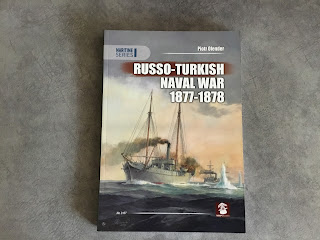
I bounced a fairly innocuous comment off of David Manley - my ‘go to’ oracle on matters naval related - about the war and he pointed me at the above book. This was duly ordered (courtesy of the balance of an Amazon gift card) and arrived today.

I was really surprised by a couple of points concerning this book. To begin with it is roughly A4 sized  - I don’t know why but I expected something akin to an Osprey campaign style title - and it is also around half an inch thick, albeit a soft back (which is a shame).

What an absolute treasure this is! Aside from details of the naval operations of the war there is a whole raft of information about the ships involved supported by numerous line drawings, maps and technical details.

I have been messing about with some scratch built models for the war and so this book is a really timely addition to the library - especially as the side profiles of the ships involved will help with the models.

Very highly  recommended and my thanks to David Manley for bringing it to my attention - cheers old chap!

Wednesday, 14 November 2012

Russo-Turkish War 1877....Part 1


Turkish infantry advance - note the Peabody Martini Henry Rifles

Now that the poll has closed the serious business of 'drilling down' into the war of 1877 can begin. The sources I possess are fairly modest; consisting as they do of the War in the East by Quintin Barry and the Osprey title covering the war. I also have some ebook histories including the work of Archibald Forbes which is a great read. Of course the internet will also be useful and for reasons that will become obvious the game at the end of all this research will look rather special. I will not go into details until a couple of experiments have taken place but if my plan works out OK then it will make a huge difference to the visual look of the action.

As far as the game itself is concerned I shall be using the hex based version of Bob Cordery's Big Battle Portable Wargame 19th century rules with a couple of very minor tweaks. I intend fighting an my usual 13 x 9 hexed playing area and of course, the action will be written up and recorded for posterity. At the moment though, the biggest issue I will have is finding an action to translate into a game that does not involve anything related to either the siege of Plevna or the numerous battles in the Shipka Pass!

Luckily there are a lot of other actions both great and small that could be worked into a game and that will be my main focus for the time being.