Monday, 31 December 2018

The Weekly Sitrep....Number 9


Slothology taken to a higher level....

This is the last Sitrep on 2018 and I must confess that writing it has given me much to reflect on as I look back over the year. The two funerals I have attended - Eric Knowles and Pete Green - have affected me in many ways and for longer than I would not have expected, but if anything they have hardened my resolve to make more of an effort to stay in touch with people within my orbit, both near and far.

The gentle reminder I received from the HMRC way back in February that I can retire in eight years has meant that I have spent rather a lot of time thinking about what I have done, what I am going to do and more importantly, when I am going to do it! The last thing I want to do is to appear morbid or downbeat but I would be less than truthful if I did not acknowledge the impact these three events have had on me over the course of the year and, to a certain extent, how they have influenced my immediate plans. I am determined to get my book about wargaming using block armies written so my main focus for 2019 will be very much directed to this end. It will mean that any practical projects will need to be simple and compact so expect to see naval games featuring alongside the Kurz and Allison project.


In many ways not the easiest of reads but a welcome addition to the library all the same.

Christmas has been and gone, and aside from hoping that all had a great time celebrating in whatever fashion you traditionally do, I thought it would be a good opportunity to share the details of my seasonal haul. The first two items were a 'known quantity' in that I knew they were coming but as it has been a while since I saw them it seemed like a good idea to mention them again.


30mm Spencer Smith Union infantryman and Confederate Cavalryman....


....and the rest of the box full. I have sufficient figures to produce a Charge! sized infantry regiment, two cavalry squadrons and an artillery battery per side plus the appropriate command for my 'old school toy soldier' Kurz and Allison project. With the imminent release of  'Rebels and Patriots' - the 'Lion Rampant' based rules covering the wars in America from 1750 to 1865 - I am sorely tempted to base the figures individually!

My son and daughter came up trumps with a brace of Amazon gift cards alongside some very nice Rioja and various other consumables. I have not used these in their entirety although I did buy a few titles for my Kindle. More by chance than design I seem to be duplicating some of my larger hardbacks with a digital version of the same for convenience. A good case in point is The Campaigns of Napoleon by David Chandler. Much as I enjoy sitting in a favourite leather armchair whilst sipping a glass of a decent Rioja in front of a roaring log fire with a faithful hound at my feet (actually it would on my sofa with bottle of beer and one of the cats parked on my lap but one can picture the imagery) lugging around such a door stop of a tome is not exactly convenient. For me this is where the Kindle comes in to its own. For my daily commute or on holiday it has become indispensable and although it will never replace a proper book in my affections, it is really handy to have.

From my gift cards I have acquired the following:

The Campaigns of Napoleon by David Chandler
The Forgotten Soldier by Guy Sajer
 Night Action - MTB Flotilla at War by Peter Dickens
The Battle of the Narrow Seas by Peter Scott
Dog Boats at War by Leonard Reynolds
Gunboat Command by Antony Hichens

You have probably worked out why some of the above titles have featured! I have yet to receive my copy of Cruel Seas by Warlord Games but am hopeful it will appear soon.

I would to extend a special note of thanks to davidinsuffolk for helping me out with a scanned copy of the C.F. Wesencraft article I mentioned in the last Sitrep - it has been very useful so many thanks again old chap!

Unsurprisingly work on the army level block rules and by extension the book they will feature in has taken a little bit of back seat over the holiday period but I have managed to scribble down a few ideas so it has not been entirely forgotten.

That about wraps it up fro this week so I would like to take this opportunity to wish you all a very peaceful and prosperous 2019.

Happy New Year!


A large Greenall's Gin and Tonic with ice and lemon, a ramekin of Planter's Peanuts and binge-watching Hercule Poirot - what's not to like?


Monday, 24 December 2018

The Weekly Sitrep....Number 8


For some reason Christmas always reminds me of Peanuts although I usually have mine in a bowl with a glass of seasonal ale....

The week leading up to Christmas Eve has been rather busy in many respects as one would expect but thanks to the organisational skills of SWMBO my part was quite limited! A couple of modest shopping runs - nothing urgent, more from curiosity than anything else - and finishing off my wrapping was about the limit of my involvement. As SWMBO was working for most of Saturday (she works at our local Marks and Spencer food hall) it was, by and large a pretty quiet weekend.

I have made a pleasing degree of progress with my block related adventures. To begin with I rediscovered all the digital files for my labels. I was a little concerned about this as they were originally drawn up in MS Paint and we are now an Apple house. I was able to experiment with the files and the good news is that I will be able to work on them for any amendments or new sets. It was quite interesting revisiting these files as there was a lot of tweaking and experimentation undertaken before I settled on my final versions. I even came across some generic naval labels as well as a few ACW ironclads types I was messing around with. In the short term though, it will mean that I can get a white set of blocks prepared.

I also managed to get some time in working on the draft of my book as well as the army level rules that will feature. As mentioned previously I rediscovered a notebook full of really useful stuff I had copied from a number of sources as well some ideas for a DBA inspired army level set.

It is very early in the process but these rules will feature elements from a variety of rule sets - both table top and board game - and I am really excited by the prospect. They are pitched initially at the Napoleonic Wars (indeed, this was my original intention when I was first assembling the block armies) but I am confident that they could be tweaked to cover earlier and later periods. In fact, I am also looking in due course to extend the system to cover the 20th century.

There has been a lot of posts on Facebook about Warlord Games Cruel Seas. there has also been some quite superb paint jobs and games in evidence. Warlord have just released a 10 page errata which, whilst being a very positive step, does give a little cause for concern as to the original rules. Given that the game has been in development for some time one would not have expected an errata to be quite so large!

I am still waiting for my review copy but I am sure it will arrive in due course.

"Yippee Ki Aay!!"....

At long last, 30 years after it was released, Die Hard has finally been classed as a Christmas film! I enjoyed the first two of this series but after that it did seem to go off the boil slightly in my opinion. I often wonder why there was never a game based on Nakatomi Plaza 24/12/88 (I am not including computer titles) as I reckon it would have been a blast....literally....

In closing this weeks Sitrep it only remains for me to wish you all a very Merry Christmas and I hope the gaming elves bring you lots of inspiring goodies!

All the best,

DC

Sunday, 23 December 2018

Revisiting an Original Idea


The first version of the block armies. I many ways I think I may have gone slightly too far down the half block route as there are practical advantage to using the larger, full-sized blocks. I may look to go down the ‘half and half’ route and use a mixture of both types.

As part of the latest round of my block adventures I made a point of locating the original set I made way back in 2011. These were the original full sized versions rather than my later half-block standard. I knew I had squirrelled some away in an old biscuit tin but I was quite surprised to see just how many there are. I had only produced sets in three colours - red, green and blue. The latter is a lighter shade than I currently use but is still quite a pleasing hue. I used a stylised cannon for the artillery blocks and these, together with skirmishing infantry and cavalry, have double images on a single block. It seemed like a good idea at the time as it shows the unit operating in a much looser formation. I was never really enamoured with the command block I used in this scale as it was too large and it was for this reason I looked at the half-blocks. Originally I planned to use half blocks for command, artillery and light infantry and cavalry skirmishing.

I could readily bring these blocks up to what I am now calling the ‘the half and half standard’ - I would use the larger blocks solely for major infantry and  cavalry formations with the half blocks dotted in where needed. The only problem I have is that the blue blocks are a different shade to that I have used for the half blocks so some reprinting would be in order. I shall give this some thought and so may well tackle this over the Christmas holiday period. 

I must admit that seeing these blocks again was a real treat and served as a pleasing reminder of how much enjoyment the whole block concept has given me over the last six or seven years. They will feature in my book in some capacity and the temptation to fight a small game using them again is proving hard to resist!

Thursday, 20 December 2018

Old Dog, New Tricks - Same Old Story!


The original version of Volley and Bayonet 


Napoleon Returns - one of the two Napoleonic themed supplements available with the other being for the 1809 campaign.

I am feeling a little on the embarrassed side. It is as though I have been trying to reinvent the wheel but of course the wheel is already in place and is perfectly serviceable as it is. For sure one could add some nice trim to the aforementioned wheel, perhaps even some glitzy chrome hubcaps or similar even, but the essential truth is that the tools for my large battle block game are already to hand - and I had completely forgotten about them!

Actually to say I had forgotten about them is not entirely accurate - I was aware of them but not exactly what was there to work with. Confused? I thought as much so allow me to explain.

Way back in 2012, during the height of the great block army growing pains, I messed around with a couple of ideas involving Volley and Bayonet by Messrs. Chadwick and Novak and Napoleon by Columbia Games (3rd Edition - and this is important as will be explained later). I even threw into the mix elements of DBA and also Bob Cordery's Memoir of Battle  - a Command and Colours based 19th century rule set minus the command cards. I took parts from each, mixed them up and tried to squeeze them into a hex-based set of rules that were unwieldy, unplayable and unsurprisingly 'fell at the first'.  However, and this is the important part, I made copious notes.

I suspect most readers of this blog are probably inveterate scribblers. I would go further and suspect that many have a number of notebooks or hastily penned scraps of paper lying around along with photocopied magazine articles, downloaded play sheets and all manner of written and printed material. In this particular case I had an A5 sized hardback notebook (I prefer these as they last longer when being carried around) with a lot of material in it relating to my plan to devise an army level set of block based Napoleonic wargame rules. I knew about the notebook but had forgotten exactly what was in it. In fact all I remembered for sure that was in the notebook were the Columbia Games order of battle charts. I was in for a very pleasant surprise.


The third edition version of Napoleon by Columbia Games. This version represented every division in the order of battle for all three armies. The map used to get pretty congested with blocks!

For reasons of convenience I had handwritten the tactical combat rules from Columbia Games Napoleon as well as photocopying the orders of battle from the game and sticking these into the end pages as a reference. I had also handwritten the complete order of battle from Napoleon Returns - the Volley and Bayonet supplement for the 1815 campaign - with strength points, exhaustion levels and morale and training ratings. I then when one step further and drafted not one but two variant sets of rules - De Bellis 1815 and Memoir of 1815. Admittedly these two are in fact incomplete but reading through them as I did last night they would not take much work to get table ready.

It is typical of me (the 'Same Old Story!' of the title) that not only do I no longer own a copy of Columbia Games Napoleon but that I have also disposed of both Volley and Bayonet and Napoleon Returns. Having the key information from both is extremely useful and so, in conjunction with the ideas of Charles Wesencraft and more recently, Andy Callan, I have plenty of material to work with in respect of realising a block based army level set of wargame rules.


The stylised battle board used with Columbia Games Napoleon....


....and the same in action - Prussians versus the French.


Sample labels from the third edition. The blocks are rotated as they sustain losses with the top edge showing the current combat strength point. As the labels face the owning player there is an inbuilt fog of war effect. Under the system I was working on and using the above as an example the Old Guard would have four 'brigade' blocks when at full strength.

Mention of Columbia Games Napoleon and the tactical rules contained therein reminded me of the idea I was considering in respect of the playing area. In the game itself when battle is joined on the map the blocks are then transferred to a battle board to fight he combat. This is divided into areas as shown in the picture above. Units (for this game the blocks represent divisions) fight for control of areas and the winner of the battle is the first person to clear an area of enemy troops. It is simple but works well in the context of the game. It would probably be a little too light as a standalone game but I reckon there is mileage in it to make it a little more 'wargamey'. It is an option to consider for sure.

Volley and Bayonet (I am referring to the original version) operates at a lower level than the Columbia Games offering and instead uses the brigade as its base unit size. As I recall my plan was to fuse the two approaches so that the strategic map moves were at divisional level and the tactical battles arising were to be fought using brigades. A typical Columbia Games divisional block has a strength of 3 or 4 which loosely represents the number of brigades or actual soldiery present. The plan was to use a single block to represent a brigade sized formation with the Volley and Bayonet strength points determining the number of combat dice used.

Where this all fell down was in trying to get it all to work on a hex grid which was why I abandoned the attempt. Now however, I am far better prepared to be able to make this a more viable idea and so for the umpteenth time I have offered up a prayer of thanks to the wargaming gods for hanging on to the notebook, even if I did rather foolishly let the game and the rules go!


Tuesday, 18 December 2018

Napoleonic Battles in the Grand Manner


Published in 1974 but now available from John Curry's History of Wargaming project

It never ceases to amaze me when the metaphorical wheel completes a revolution and comes back to where it started. The case in point is my long association with the Napoleonic Wars. I say long association deliberately because it was the period I cut my wargaming teeth on back in the early 1970s. I have mentioned previously my long gone but not forgotten Airfix British Army for 1815, my 1812 Russian Army and the 15mm 1815 set up I owned specifically for use with a set of rules called Le Petit Empereur. I have also mentioned my flirtation with Command and Colours Napoleonics and even a 54mm lawn based H.G. Wells style refight of the Battle of Leipzig, not to mention the naval side of the wars.

In short the Napoleonic Wars have given me much, if intermittent, pleasure over the years and so, for a variety of reasons, I now find myself staring down the barrel of dabbling in the period once again, albeit in different way from previously.

I am looking long and hard at army level actions - in effect fighting big battle/operational campaigns. This is a piece of pure indulgence for me as this is the type of game I wanted to fight years ago – in fact I messed around using Lego bricks as the units which will probably give you an idea about the vintage of this particular idea! Nowadays of course I use blocks of a rather different type. Having said that Lego is a great source for making simple 1:300th scale buildings, at least the earlier ‘non model specific’ sets were and whilst I do not have any to hand I will build a few so you can see what I mean.

Whilst looking at this as an idea the first thing that crossed my mind was the inevitable question about rules. This style of action represents quite a step up in scale from my recent games and so a different approach will be needed. 

There are a few sets of rules pitched at this level - for example Blucher by Sam Mustafa or something like Volley and Bayonet, both of which have much to commend them. At this stage though I have something else in mind.

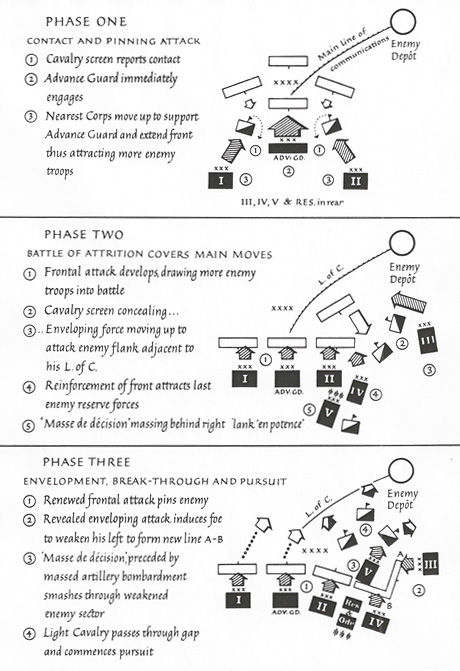
Way back in 1974 Charles Wesencraft published the book you see above. I recently acquired a copy of this and was really pleased to do so as I remember reading it 'back in the day' and being hugely impressed with it. The author's ideas seemed pretty advanced at the time although there was one set of rules contained therein that really caught my imagination and indeed, have stayed with me, waiting in the wings, until I was at the same level as the concept. I am of course referring to his 'Army Corps in Action' rules contained in chapter 11 of the book.

These rules use the following scales:

12" equal 1 mile
600/700 men equal 1 infantry base
400 men equal 1 cavalry base
1 gun model equal 1 battery.

I seem to recall an article by Charles Wesencraft in - and I stand to be corrected - a Battle Christmas special where he looked to fight battles where a single figure represented a battalion so in effect a typical base of three or four figures would represent a brigade. By extension a couple of normal infantry units of around 18 figures each would furnish in effect a Corps. 

As an aside if any readers have a copy of this (or whatever magazine it was published in!) magazine I would really appreciate a scan of the article.

Now I am going to throw in my two pence worth and say that a rule set on this basis would be better served by using either very small figures - 2/3/6mm - or, dare I say it, BLOCKS!

Old school I know but it is something I want to tick off the wargames bucket list. Assuming it works out I would even look to taking the rules into other directions as I reckon there is a degree of mileage in them.


Monday, 17 December 2018

The Weekly Sitrep....Number 7


For the record I am not using a typewriter!

It has been very much a block related week with much progress being made in a number of directions. The overall plan of the book has been finalised and I spent rather a lot of time organising notes and making lists. There are several plates spinning at present but all is well. At this stage I have not set a time frame as to when this will be ready simply because there are a number of research variables that need attending to for which I have little idea as to how long they will take to get resolved. I also have a whole raft of people to contact about various bits and pieces but at least now I have an idea of what to do and how to do it!

I have also spent some time reorganising the block collection and have decided on how I shall produce my unit command blocks. Again, this is something I will need to enlist some help with but my solution should not present them with any major difficulties.


All being well this little beauty will be out in January so it will be something to look forward to in the new year - and just in time for the launch of the show season!

All being well next month should see the release of the latest addition to Bob Cordery's Portable Wargame stable - The Portable Napoleonic Wargame. I am very much looking forward to this especially as it means that Bob's rather large collection of Del Prado Napoleonic figures will see some action. The basing standard he is using for this collection - if you look at Bob's blog you will see how he has done it -  is something I am looking at for use with the block armies. Two of my half blocks would equal one PNW unit so as soon as the book hits the press I will be good to go in the short term.


Magnificent is the only way I can describe this although awesomely awesome in its awesomeness comes pretty close!

In preparation for the launch of Bob's book I have been once again dipping into David Chandler's magisterial tome The Campaigns of Napoleon. I have an ulterior motive for this in that Napoleonic warfare will feature in my book and so revisiting the wars of the Corsican Ogre is essential. It will be doubly apt in that the original idea behind the block armies was in part inspired by this book.


Blocks in action....

In closing I am hoping to have some news relating to Warlord Games Cruel Seas at some point during the coming week and so will post as soon as I do.

Sunday, 16 December 2018

Flags for the Memory

One of the key areas in respect of using the block armies on a non-grid basis is the question of unit identification and facing. Neither of these ever seemed particularly important when using a grid but on a free table are a significant factor. I have experimented with a number of options as to how best I can tackle this including using miniature flag poles in some fashion but for a number of reasons this has not really worked the way I would like. I had a brainwave though, in part inspired by Andy Callan’s Spanish Succession set up. By placing a flag on a block you have an easy way of identifying a particular unit. That is all well and good but sadly for my set up it only works up to a point.


Ignore the green label although the position will be the same for the flag in due course. The top half of the label will be the flag itself whilst the bottom will be white with an identifying number or letter

The single drawback concerns the thorny question of whether or not to use regimental colours or national standards. Regimental colours would be fine is one was representing a specific unit but given that my collection is used for multiple periods the use of such distinctions would mean producing numbers of blocks for various periods as unit flags evolved and presumably added various battle honours. By far and away the simplest method would be to use a national flag with some kind of identifying feature which in turn would be referenced back to the army roster. That was my line of reasoning in any event and so that is what I am going to do.

When I was making the block armies I has a number of sets cut not only in half but also into a quarter and three quarters. The three quarter blocks I intended to use for naval forces whilst the quarter size - ended up being used for various status markers. They appeared in one of my Rogan Valley battles as markers for hidden units. I have decided though that these are far more useful being turned into in effect command groups. By placing a national flag and a reference number or letter on one of these small blocks I will be able to kill several birds with one stone.


A unit deployed in line with the command in the van


A column of march - once again with the command in the van


A column of attack with the command in the van spurring on their troops.


A square with the colours in the centre.
To begin with the unit will have an identity of sorts. I realise that it would only be from a national perspective but this will suffice for the time being. The reference number or letter will help with the use of the roster as well as drawing deployment maps. Finally, the position of the command block will be able to show the facing of the unit depending on where it is placed in relation to the blocks forming the body of troops being represented. The pictures below will show what I mean.

For the record the blocks I use are 60mm by 20mm and are 12mm deep. For comparison purposes one could say they are 10/12mm which helps as a useful guide for making or buying terrain. The quarter size block mentioned is 15mm wide or half the size of one my usual half blocks.

I am currently working out how many flags I will need for the most common armies and once I have done that I will get them ordered. Once the blocks have been labelled with their flags I believe it will really enhance their appearance and so I am looking forward to doing this and getting them into action.