Tuesday, 16 March 2021

Taking Stock of the Blocks


One of the seven colours of block army I made showing all the current troop types available - the other colours being red, blue, green, light grey, khaki and a mixed set for tribal irregular types. At the top is a command block and the next three rows are of infantry, cavalry and artillery with the black band being fro heavy and the white for light versions. The next two are a machine gun and mortar whilst the bottom row is of a tank, a truck and an anti tank gun


Two of the twelve boxes

It has been a while since I did anything block related despite having a few developmental ideas currently simmering away. As I write this I can see the dozen boxes of the block collection - this does not include the Command and Colours types - and can remember the frenzied round of games I fought using them with a sense of pride and of enjoyment. I had a lot of fun with these despite their limitations - which was as much to do with how I made them as anything else.

As part of my ‘to do’ list for this year I want to ‘pimp’ the block collection in a number of ways so as to improve the overall look and increase the visual appeal. The wags amongst you will no doubt say the best way to pimp a block based army is to buy the appropriate figures for the army in question and get painting! That would be far too logical for a man of my somewhat eclectic tastes in table top finery!

The block armies worked best for straightforward army types - the archetypical horse, foot and guns of the horse and musket period. The troop formations operated in blocks, the maps of the battles used blocks so it all works rather well. Where is falls down is when you are trying to represent army types that have a larger variety of troop types operating at a tactical level - this level is after all where most table top battles are fought. 

Taking WW2 as an example I want my armies to feature separate machine guns, mortars, anti tank guns, tanks, trucks, APCs and so on. With the best will in the world a labelled block does not really convey the right impression at the tactical level. I may be block-fixated but aesthetics are still important!

Similarly for the pre gunpowder period where you have a plethora of infantry types from light javelin armed skirmishing infantry up to pike blocks via tribal warriors, roman legionaries, Greek hoplites to fully armoured Knights, horse archers and so on - the blocks as I have made them struggle to differentiate between types.

My block collection can differentiate between the notional ‘weight’ of types - heavy, line and light - which is fine for the Horse and Musket era but is a little anonymous for everything else.

I have been thinking about this whole subject quite a bit and have come with an idea that will not only address the additional troop types but will also add to the aesthetic appeal of the exiting block types as well as enabling me to explore something rather more novel. I am still drafting the appropriate designs and so will share these once they are ready but suffice it to say that painting will be involved (there, you see, I am a proper wargamer....) as well as Warbases and the inevitable lashings of MDF....

Sunday, 14 March 2021

Tidying Up some Loose Ends


The models that are going to be rejigged or retired - the two versions of the C.S.S. Georgia (top) and the two smaller ironclads


The bare bones of the small octagonal casemate ironclad


The two hull sizes - the top model is now my standard hull width of 1 1/4”


The floating battery version of the C.S.S. Georgia - it has now had the base removed in readiness for the full hull to be added

 I mentioned yesterday that I planned to retire a couple of models and rework one of them up to the current build standard of the rest of the collection. This is something that is easily achieved and thankfully will not require too much work. The overall idea looks something like this.

C.S.S. Georgia - Currently I have two versions of this, the floating battery option and the full hull ironclad. I am going to take the former and add it to a new hull. There will be one model solely and it will look like a ship but will only be used as a floating battery. 

The two smaller ironclads - These are being stood down and replaced by, ahem, two smaller ironclads - one of these will be an octagonal type whilst the other will be more conventional. What is the difference? Well the change is due to the fact I have decided that my new standard hull size is now 1 1/4” wide and the two that are being retired are only 1” wide. 

The three models that are being retired are going to be turned into floating batteries by the simple expedient of removing the hulls and funnels - there may be a few other little tweaks to tidy them up into their new role. 

Now I realise that this may seem like ‘tweaking for the sake of tweaking’ but I am sure we all have those little niggles that need to be dealt with - and so I have!

For the Union it is far more straightforward. I debated about reworking my two single turret monitors - they are on 1” wide hulls - but the jury is out on that at the moment but to be honest it would not take anytime at all to build another couple of them if I needed to. The U.S.S. Galena will be remade and the existing hull will be used for something else for the Union - I am thinking about using this for a wooden sloop or similar.

I want to get these ideas fully squared away before the final batch of models are underway when my Warbases order arrives. There is no pressure (the small octagonal casemate ironclad notwithstanding....) and so I can take my time and enjoy the process.

Saturday, 13 March 2021

An Octagonal Dilemma


For a variety of reasons I was very glad to see the back of building this particular model! She has scrubbed up quite well although she came very close to being thrown across the man cave on more than one occasion....

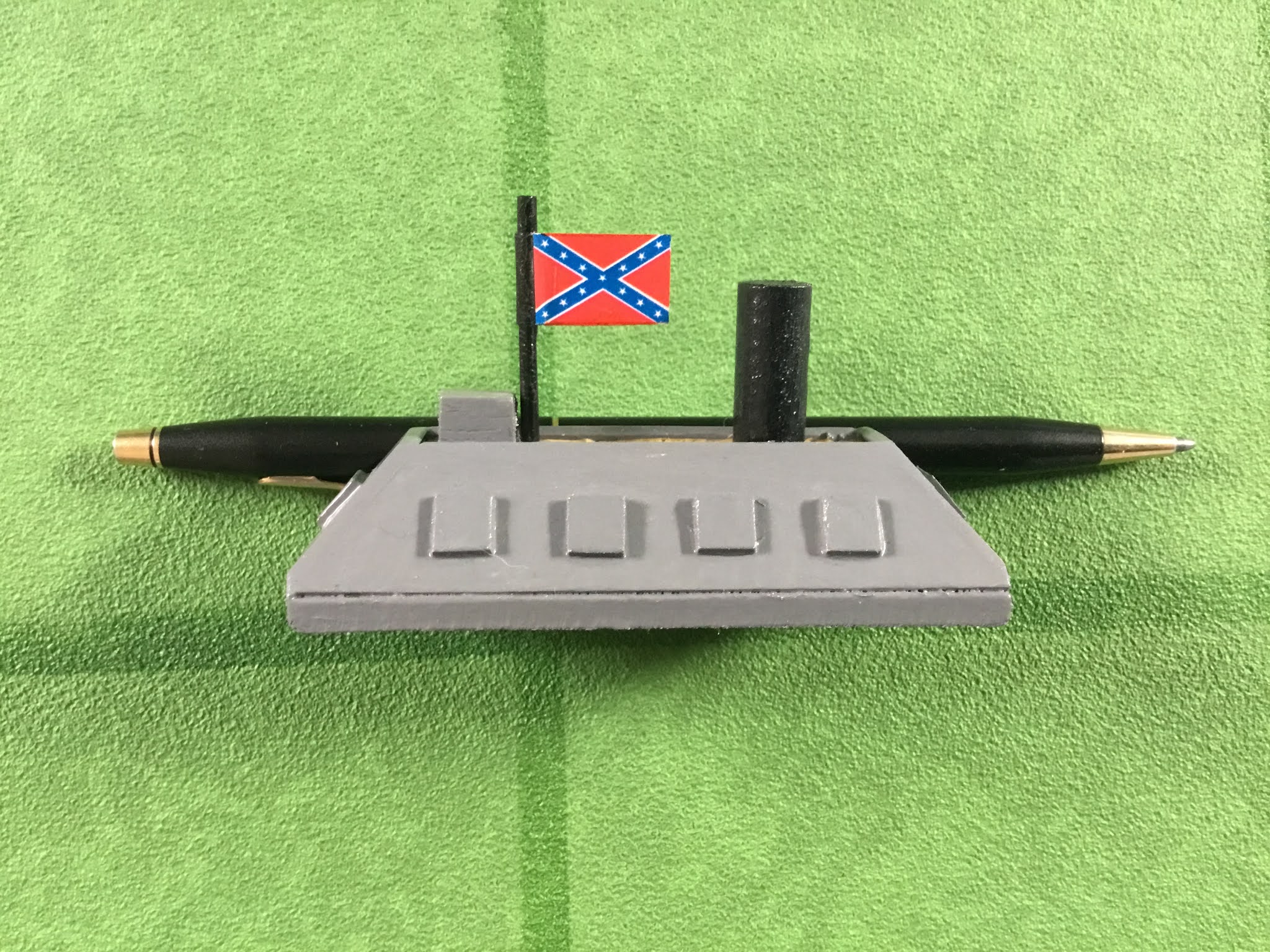
 My building technique for the ships comprising the ACW collection is a tribute to the power of the straight line. My ship hulls are invariably straight sided and the only curves to be seen are usually at the bow and the stern. Straight sides, however unrealistic they may be makes modelling infinitely simpler and so pretty much all of my casemate style ironclads have a very box like demeanour. The U.S.S Essex has a curved rear portion whilst the C.S.S. Manassas has a curve to her hull but other than that all of mine are angled on the front, rear and sides for sure but ramrod straight with it.

The Confederates built a number of casemate ironclads sporting an octagonal casemate. I do not know the full reasoning behind this other than the fact it saved raw materials in the build - for much the same reason as some of their later ironclads sported quite small, almost box like casemates. With this in mind I decided to build a larger octagonal casemate ironclad and a smaller version. This also ties in with the decision I have made concerning some of the other Confederate ironclads I have built - the C.S.S Georgia and the two smaller models.

Before I go into the octagonal ironclads in detail I will tell you what I am planning to do with the aforementioned trio of models. I am going to rebase the floating battery version of the C.S.S. Georgia and dispense with the full hull version. I am also going to retire the two smaller ironclads. These were amongst the first models I built and to be honest I have improved my construction technique to the point that they now look a little out of place. I will still have a use for them though as they will be used as floating batteries - I will simple take the casemate off the hull.

The octagonal casemate was an absolute git to build! I came very close to just abandoning the idea as a bad job because no matter what I did it seemed to go wrong. Matching up the angles of the casemate was a vexing experience for sure and no matter how I tried I could not get the front and rear face to sit straight!

After much cursing, filing, gluing and more cursing, filing and gluing - did I mention filing? -  I managed to get her assembled but the problems did not end there. For some reason I seemed to develop an acute case of ‘not being able to stick anything on to where it was supposed to go’ so gun ports, hatch covers, the funnel and flagstaff all needed positioning and then repositioning as they were wrong in the first place - all very tedious and very depressing.

I got there in the end and it was worth the effort but it was a torturous process - building three masted ships is a doddle by comparison and I still have one more octagonal casemate to build....

Deep joy!

Friday, 12 March 2021

Naval Snakes and Ladders


My current ‘go to’ reading for the Ironclad period and the inspiration for my own rule writing endeavours 

 Now that I have gone as far as I am currently able with the ACW models I have been turning my thoughts to the Russo Turkish War and the rules that I shall be using to cover both. Of the Russo Turkish War I will speak later in this post but initially I shall be looking at the rules.

I have drafted a set that have worked quite nicely by taking elements from Bob Cordery’s ACW set published in his book Gridded Naval Wargames and also Dahlgren and Colombiad published by David Manley. Both of these worthies have been unstinting in their support and encouragement of my efforts which has been hugely appreciated. There is something though, that does not feel quite right about my set. It is nothing I can put my finger on specifically, it is more like that nagging feeling that something is missing. The best analogy I can think of is the Chinese take away that hits the spot when you eat it but for some inexplicable reason half an hour after you have finished it you are reaching for the toaster feeling hungry again!

I mentioned several posts ago that the rules needed a rewrite and if I am honest this seems to have made matters worse. Even parking them out os sight for a few days did not seem to help - there was still that feeling nagging away.

I think I now know what the problem is. I have been looking at my rules from the wrong direction. What I have done is to take elements of both sets and then effectively glued them together more or less as they are. What I have not done is to set out what I wanted to achieve with the rules from ground up. The fact that my improvisation has worked at all is testimony to the skill of both Bob and David as rule writers par excellence - it would be very difficult to ‘break’ either set. I suspect that I am not articulating this particularly well but it makes sense to me.

What I am going to do is to go back to the beginning and set out exactly what I want from the rules I am designing and then see what fits where in the manner I am aiming for. This will not be a slavish bolting together of various rules - it will be a proper dovetailed joint of an idea! This probably seems like a lot of work but in actual fact it is not as much of the groundwork has been laid already. So in a sense whilst I have gone down a snake there is a rather handy ladder nearby!

On the subject of Snakes and Ladders there has been a number of posts within the blogosphere about using the idea of this venerable board game as the basis for a campaign. I think this is a spiffing idea and naturally, given my current naval diversion, I thought about how this concept could be used for naval games. The short answer is of course it can but I need to sit down and think about the whys and wherefores but it will come as no surprise when I say that I already have a number of ideas to pay around with!


This is a magnificent read  - as are the other titles in the series although I am limited to just the Pacific War volume. My only criticism is that it is not available in hardback!

The Russo Turkish Naval War

I must confess that my enthusiasm for the naval dimension of this particular war was cooling - another snake - in favour of diving into Madasahatta but the above book - another ladder - has certainly restored it!

The Russian Black Sea fleet was virtually non existent following the Crimean War and indeed, for the war with Turkey they had nothing that could meet the Turkish ironclads on anything like an equal footing. Much use was made of armed civilian steamers but these could not be expected to take on an ironclad. The Russians were nothing if not inventive in that fitted out certain ships with large calibre mortars mounted aft in the hope that the Turks would pursue them. Due to the high angle fo trajectory a mortar shell could certainly go through a lightly armoured or unprotected deck to wreak havoc in a ship’s vitals.  It was using a shore based version in this fashion that the Turks lost one of their Danube river monitors. Attempting to try this tactic out led to the famous fight between the Russian steamer Vesta and the Turkish ironclad Feth-i Bulend. For the most part the Russian Black Sea steamers were used to harry Turkish communications and attempt to draw off the Turkish ironclads from shore bombardments etc.

The Russians made extensive use of mines and torpedoes - both spar and even some locomotive versions -  and, together with the army, were able to take the initiative along the Danube despite being materially outnumbered. The Russians even made use of a couple of captured Turkish river casemate gunboats that had been sunk, refloated and repaired and incorporated into the Russian navy. 

One of the Turkish plans in the Black Sea Caucasus region was to persuade the largely Moslem population of such places as Chechnya to rise up against the Russians, thereby requiring troops to be diverted from the Balkan front. Landings were made to supply such insurgents with weapons and indeed, even Turkish troops were deployed in support but the movement never really got going apart from some sporadic looting. The main bulk of the Turkish fleet supported such operations.

This is a very brief overview of the naval dimension of the war - the book above is an absolute gem if you wanted to explore the period further - and it has given me plenty of ideas for gaming purposes. 

Essentially you have the weaker navy being far more aggressive and landing some telling blows due to flexibility and technical innovation against a much larger, better equipped but far more passive opponent. 

That will certainly make for some interesting and tactically challenging games.

Thursday, 11 March 2021

‘Big Wheels (Still) Keep on Turnin’


‘I saw three ships come sailing in’ - Not quite Christmas and without a sail in sight these are the three latest additions to the ACW collection which now stands at 30 models.

 Three more generic looking paddle steamers for the river part of the ACW project - two for the Confederates and one for the Union. Once again they are ‘based upon’ rather than any particular ship and can used as rams or gunboats as required. The Union vessel was painted with the U.S.S. Queen of the West in mind and so she looks rather striking in her white plumage. 

I have deliberate kept the design of these quite simple but by moving pieces around am able to get quite a variety of model. The various tricks I have used are as follows:

One funnel or two

Funnels forward or aft of the pilot house (and the same with the pilot house!)

Paddle boxes aft or centre

Number and position of gun ports

Number and position of deck hatches

Paint job

Superstructure - this is a Jenga block and I have used full sized versions, 3/4 sized versions as well as angled front faced versions (both horizontally and vertical angles)

I have another five river based paddle steamers to build and then will look to build some ocean going types - I am thinking four at present. There will also be a coupe of stern wheelers to factor in as well.

All told I reckon I have around 15 or so more models to build for this project although it could possibly be more. There will be a brief break from the ACW as the next batch of models will need some components from my next Warbases order (currently in the queue). In the meantime though, work can resume on the Russo Turkish War so I shall be looking at them next.

Keeping on keeping on!


Wednesday, 10 March 2021

Thoughts on Madasahatta - Afloat and Ashore


Fun and games along the Danube....


....or across the vastness of Lake Tanganyika

 I have much unfinished business as far as Madasahatta is concerned and events of recent days have served to remind me that it is an itch that will need scratching in a big way at some point! A while ago I made a start on some new (mis)adventures concerning the island set before the events of the famous WW1 campaign. I am looking at the latter years of the 19th century and it will be far more along the lines of being traditionally Colonial rather than a sideshow of the Great War.

My first thoughts are naval facing and what a veritable smorgasbord of warships I can choose from to equip the various navies! Working on the premise that any major power would want their biggest, best and newest ships close to home it follows that the navies of the colonies will have to make do with second line, obsolete or obsolescent ships - with the occasional flag showing of something up to date. This is a blank canvas for me as it means that all manner of ‘stuff’ can be built and used and I have to say that I am really looking forward to it at the appropriate time.

It will be a war of cruisers and of hastily requisitioned and converted civilian vessels with the odd arthritic battleship to overawe the locals and to ‘fly the flag’. Gunboats will also feature but for the most part the forces will be quite modest - no fleet actions here for sure!

From the land perspective I have absolutely no excuse for not raising some Portable Wargame sized forces based around my army maximum of 15 units. Bearing in mind that I will be using the 4, 3 and 2 standard (infantry, cavalry and artillery/mgs) for the units you can see just how small we are talking about - think DBA with the options! At this stage I have yet to decide on the figures of choice but I have to say that Jacklex are looking strong contenders at the moment. Having said that I may even look to my block armies with some model support where needed. That would certainly be a far easier option for me than painting figures!


Both of the above will be required reading for what will be coming - not that much persuasion would be needed as both are excellent!

The War at Sea - Madasahatta 1900 style

Unsurprisingly I have given a fair amount of thought to this part of the Madasahatta puzzle and so have more or less settled on what there will be ‘on station’ - at least as far as the main types if not the actual ships themselves are concerned. To expand a little on my comment above all of the major powers will have at least one ‘capital ship’. I should qualify this by saying that in each case it will be deemed to be the flagship but make no mistake - we are talking about second, possibly even third rate vessels, sufficient to make a show and keep the locals overawed. It would be contrary to the spirit of the times if the Royal Navy was anything less than pre eminent - in terms of numbers at least! The main fighting units will be cruisers of various types and again, these will be older or specially built Colonial types. At the lower end of the spectrum there will be gunboats and these I intend to be the real workhorses of the various contingents. There may be the odd torpedo boat but I have yet to make a decision about that. Much use will also be made of converted civilian ships as auxiliary cruisers or makeshift gunboats to supplement the naval forces as required.

At this stage I am thinking around 6 to 8 models per fleet of which there will be four - British, German, French and Turkish. Again some liberties may be taken as to when the ships were actually built/rebuilt - Messudieh I am looking at you! - but given that this is very much an ‘imagi-naval’ project it matters not!

To mix things up a little I also plan to allow the odd flag showing visit of something brand new and shiny for each of the fleets and naturally, such forces could feasibility be called upon should the diplomatic situation worsen or in the event of outright hostilities. Such is the almost Byzantine and labyrinth-like state of international relations on the island that anything is possible!

At the lower end of the scale  - the gunboat part if you like - my plan is to make use of the quite excellent set of rules produced by David Manley called Steamer Wars. The original rules were designed to enable gamers to refight the campaign on Lake Tanganyika during the Great War but thee have been expanded via a couple of supplements to include the wars on the European rivers - mainly the Danube - during the Great War as well as further supplement covering the Russian Civil War. All of these are available from the Wargames Vault under David Manley’s Long Face Games label. I hope he adds to this series as there is plenty of potential for similar scaled actions in other parts or the world!

The War on Land - Madasahatta 1900 style

The only decision I have taken for this part of the project is that I shall be using Bob Cordery’s Portable Colonial Wargame for the rules! In the event of me actually raising armies of figures for this then I shall be working to my 15 unit maximum per force or large sized DBA if you like. I really fancy making use of the Jacklex 20mm range as this covers most of what would be needed and the figures are quite old school and charming looking. In fact some of these were used in the original campaign fought way back in the late 1970’s so for sentimental and nostalgic reasons this option has a lot to commend it. 

The lack of figures would not stop me gaming any land actions as the block armies stand ready to step in should the need arise although figures are my preferred choice for this.

When oh when?

To do Madasahatta justice represents a significant amount of work for me so it is unlikely to be fully realised on the tabletop much before next year. Having said that I am keen to make a start on the models at the very least I am aiming to do so at the start of the summer - say July or thereabouts. It is for this reason that I have been scouring my naval reference collection to get some ideas together for when the build commences. One thing is certain though - I am not doing any model making for it until the ACW and the Russo Turkish collections are complete.

I am really looking forward to it though!


Monday, 8 March 2021

Raiders of the Lost Ark(ansas) Revisited....Game Number 64


 The three combatants - U.S.S. Essex at the top of the picture, U.S.S. Carondelet to the right and the C.S.S. Arkansas in the foreground. All of the above are roughly twice the size of the original versions modelled around nine years ago!

Now this is something I did not expect to do - refight one of my early battles with new models and rules after a game of nearly nine years! To christen the newly built C.S.S. Arkansas I decided to refight the battle that took place in June 2012, game number 11 in the man cave - a report of which can be seen here: Raiders of the Lost Ark(ansas)

The models of way back then were built solely with Hexon in mind so were designed to be no larger that around 3 3/4” long - in fact most averaged around 2 1/2” to 3” long. As they were built largely from Balsa I decided to base them on clear acrylic with the wakes, name and ensign emblazoned on it. Clear bases for naval models are a good idea as it means that they never look out of place regardless of the colour of the playing surface! My newer and much larger models are unbased and are far more forgiving of handling than the original and much softer Balsa wood versions.


The models and the Hexon have long gone but it was sharp little action back in the day!


U.S.S. Carondelet leading followed by the U.S.S. Essex


The C.S.S. Arkansas. 

The main difference from the first time around is the fact that I am using a square grid rather than hexagonal and that the newer and larger models occupy two grid areas rather than one. The rules used previously were Bob Cordery’s Memoir Of Battle At Sea or MOBAS as they were known at the time. These rules came about from a chance conversation Bob and I had at the Skirmish show in Sidcup. We were thinking about how the Command and Colours system could be applied to naval games and so he came up with a set of rules. As I recall we both had a lot of fun experimenting with different ideas and variants and the whole concept eventually morphed into some of the rules in Bob’s book - Gridded Naval Wargames.

The rules in use for the refight are those that I am currently working on so the ships involved will be far more closely aligned to their historical counterparts in respect of ‘vital statistics’ - speed, protection and firepower.

I have tried to mirror the original terrain set up as far as I am able although this has been hampered slightly in that I currently only have a limited number of 3” square terrain pieces and most of them are in need of painting. No matter, we shall improvise!

Somewhere, along the Yahoo River....

Thus far the journey of the C.S.S. Arkansas had been largely untroubled by the Union forces - which was just as well as she had problems enough of her own. The engines were proving to be be particularly unreliable and whilst they were of sufficient power for the great ironclad they were constantly threatening to break down. In fact the ship had already hove to on two occasions to fix one part or another before she could resume her journey.  Her captain and crew had taken what precautions they could to ensure her safety as the liberal coating of thick river mud along her casemate bore testimony. She could still fight though and so was ready to take on whatever the Union could muster to try and stop her from reaching safety - and a much needed overhaul. For now though, her engines pumped rhythmically pushing her forwards and closer to her destination.

The Yahoo patrol of the Union river fleet consisted of the gunboats the U.S.S. Carondelet and the U.S.S. Essex and in order to cover as much of the river as possible were steaming abreast of each other and hugging the opposite river banks where they could. It was the U.S.S. Carondelet that spotted the rebel ship first and so her captain signalled the U.S.S. Essex and prepared to engage.


The opening positions. The C.S.S. Arkansas (left) is able to see the U.S.S. Carondelet (top right) but as yet  has not spotted the U.S.S. Essex (bottom right)

Turn 1. No firing. Initiative was 6 for the Union and 2 for the Confederates. The Union requested that the Confederate ship moved first.


Both the C.S.S. Arkansas and the U.S.S. Carondelet turn to face each other but for different reasons - the former to make use of her ram whilst the latter wants to engage with her powerful forward facing artillery. Meanwhile, the lumbering bulk of the U.S.S. Essex manoeuvres to round the small headland.

Wasting no time the C.S.S. Arkansas swung her helm over and increased speed as much as she dare to engage the Yankee gunboat heading straight for her. Time was pressing so the captain of the C.S.S. Arkansas wanted to best her opponent as quickly as possible and so the order was given to make ready to ram. 

Aboard the U.S.S. Carondelet the forward gun crews worked feverishly to be ready to open fire on the fast approaching rebel ironclad. 

Meanwhile, the U.S.S. Essex prepared to enter the fray.

Turn 2. Both the C.S.S. Arkansas and the U.S.S. Carondelet opened fire at maximum range. Despite her better artillery the U.S.S.Carondelet missed whilst the C.S.S. Arkansas scored a single potential hit. A 6 was rolled meaning two points f damage were recorded against the Union ship (both pints taken as flotation hits). For initiative the Union rolled a 5 whilst the Confederates rolled a 6 so the Union had to move first.


Thinking that there was a nice piece of open water to head into the C.S.S. Arkansas pointed her bows at what appeared to be safety - only to see the looming bulk of a second Yankee gunboat heading straight towards her!

A ragged cheer was heard from the forward gun battery of the C.S.S. Arkansas as the obvious tell tale sign of a hit was seen aboard the enemy ship and she swung away from her. The captain, seeing a vast expanse of open water ahead immediately committed the ship towards it. His relief was short lived as another Yankee gunboat hove into view - dead ahead and blocking his escape route!

Turn 3. The C.S.S. Arkansas fired from her forward battery and her from her port side. She scored two potential hits against the U.S.S. Essex causing one point of damage (flotation points). She also scored two potential hits against the U.S.S. Carondelet causing one point of damage and a critical hit!

(The penetration factor of the port side guns of the C.S.S. Arkansas is 3 opposed to the armour factor of 2 for the U.S.S. Carondelet meaning a plus one was applied to each damage roll. The dice rolled a 3 and 6 meaning the adjusted scores were 4 and 7 - the 7 being a critical hit)

The critical hit roll was a 5 meaning a flood. The union ship reduced the maximum speed by 1 and would need to roll at the start of the next turn to see how the flood progresses.

The U.S.S. Carondelet fired back scoring a hit and inflicting a point of damage. The U.S.S. Essex scored two potential hits and for damage (which was at plus 1 due to her penetration factor being 4 versus the target armour being 3) scored 1 point and a critical (rolled 3 and 6 adjusted to 4 and 7). the critical was a 2 meaning hull damage.

For initiative the Union rolled 3 and the Confederate rolled a 2. The Union opted to move first - knowing full well what was about to happen!


As the U.S.S. Carondelet turns to rejoin the fray the U.S.S. Essex, in order to protect her powerful bow artillery, swings her helm over just as the C.S.S. Arkansas powers into her hull, scoring 4 points of flotation damage from her four d6. She did not get off lightly though as the damage she received in turn was equal as the U.S.S. Essex rolled two 6s! Fortunately the two ships managed to separate but the C.S.S. Arkansas was now in serious trouble having taken 8 out her 9 flotation points as damage!

After a punishing exchange of fire the battered C.S.S. Arkansas bore down on the U.S.S. Essex and scored a telling blow as she crashed into her forward port side. The rending screech of metal on metal and the ear splitting crack of splintered timber was soon replaced by another and far more unwelcome sound - that of water gushing in through the great gash in the hull of the rebel ship. As she withdrew from her victim whole sections of framework were pulled away. Left hanging over the side of the Yankee ship. The C.S.S. Arkansas was in deep trouble and needed to get away and quickly.

Meanwhile, aboard the U.S.S. Carondelet the crew feverishly attempted to bring the rising water in the lower hull under control.

Turn 4. The flooding aboard the U.S.S. Carondelet was being contained for the time being so she was still in the fight. The C.S.S. Arkansas resumed firing at the U.S.S. Essex scoring two hits and a single point of damage. By way of a return the U.S.S. Essex, using her weaker port side artillery (her forward guns were ‘out of arc’) scored two potential hits but no damage was inflicted. Meanwhile the U.S.S. Carondelet fired with her port artillery but to no effect. For initiative the Union rolled a 3 whilst the Confederates rolled a 2. The Union opted to move first.


As the leaking U.S.S. Carondelet continues to limp towards the fighting the C.S.S. Arkansas attempts to force a conclusion with the U.S.S. Essex. This would prove to be a pivotal moment in the action as the ram attack failed completely meaning that it was counted as a ‘glancing blow’

The C.S.S. Arkansas was nothing if not brave as it once again bore down on the U.S.S. Essex with the intention of ramming her, oblivious to the extent of her own wounds. By sheer luck - some adroit handling by the captain of the U.S.S. Essex - the blow was a glancing one so aside from once again hearing the banshee like sound of metal screeching against metal no damage was inflicted. All the C.S.S. Arkansas had done was to psh her opponent away from her.

Meanwhile the U.S.S. Carondelet continued her attempt to get back into the fray despite it moving further away from her.

Turn 5. The U.S.S. Carondelet rolled a 6 for her flood meaning that is was now uncontrollable and she would sink in d6 game turns - she rolled a 5 - losing speed at 1 per turn until she was stopped or sank. She could also no longer fire. The C.S.S. Arkansas continued to fire at the U.S.S. Essex scoring two hits and causing a single point of damage, taken from her speed. By way of a return the U.S.S. Essex scored a singe point of damage that the C.S.S. Arkansas took from her forward artillery. For initiative the Union rolled a 3 whilst the Confederates rolled a 6. The Confederates opted to allow the Union ships to move first.


The U.S.S. Carondelet desperately attempting to reach the shallows before sinking


The C.S.S.Arkansas slips by the U.S.S. Essex to safety - for the time being


Endgame - the overview

With the failure of the latest attempt by the C.S.S. Arkansas to ram the U.S.S. Essex- despite the fact that the big Yankee gunboat was getting perilously close to the shore - her captain decided that enough was enough and so turned his ship away from the U.S.S. Essex and headed towards open water and hopefully safety. The engines had held up magnificently under the demands of battle but he knew that he could only punch his luck so far and the shattered forward part of his ship’s hull was a reminder of just fickle a mistress dame fortune could be.

The U.S.S. Essex had seen the obviously distressed U.S.S. Carondelet making for the far shore so her captain resolved to offer what assistance he could as soon as his ship could reach them. The rebel ironclad would have to wait until another time for a reckoning. There would be time enough, time enough to repair is own ship and to seek to their elusive enemy.

With a dull booming noise the previously shored up section of the forward hull of the U.S.S. Carondelet gave way and water rushed in to the lower part of the ship. She was sinking, not quickly for sure but sinking all the same. Her captain resolved to get his ship into as shallow water as possible - he doubted she would be able to reach the shore before slipping beneath the murky waters of the Yahoo - so that, with luck, she could be relocated, repaired and brought back into action. He could see the U.S.S. Essex in the distance on her way to assist so was confident that all would be put to rights in due course.

One thing he knew for certain though, the rebel ironclad had taken one hell of a beating.

Overview

I have to say that I rather enjoyed that! The differences between the ships used were shown up to good effect in that the C.S.S. Arkansas - and by extension the rest of the ram equipped Confederate ironclads - was designed to fight ships first whilst for the Union gunboats it was not their primary function. Forward facing Union artillery appears to be pretty effective (wait till the U.S.S. Benton arrived!) but as a rule these ships were designed to support land operations. For these reasons it made for an interesting match up and it actually felt quite balanced. 

I need to hone a few points of the rules in regards to ships turning and ram attacks - nothing major, just some clarification really - and was pleased to have used a minor change to the flotation value. As it stands now a ships flotation value is made up of the overall size of the vessel plus its armour modifier. I may revise this further as I want to look at a few sample ship types using the formula in Bob Cordery’s Portable Colonial Wargame. The rules are still very much a work in progress but conceptually I am there or thereabouts.

Back to the ship building!